Minimal residual disease negativity is linked to longer progression-free survival in multiple myeloma patients
EVIDENCE meta-analysis: evaluating minimal residual disease as an intermediate clinical end point for multiple myeloma
Meta-analysis of randomized controlled clinical trialsBenefit found
Does minimal residual disease negativity predict progression-free survival in multiple myeloma?
Who
4907
Patients with newly diagnosed or relapse/refractory multiple myeloma
Compared
Newly diagnosed multiple myeloma: global odds ratio 4.02 (95% CI, 2.57-5.46)
Relapse/refractory multiple myeloma: global odds ratio 7.67 (4.24-11.10)
Main outcome
progression-free survival
Result: global odds ratio 4.02 (95% CI, 2.57-5.46)
Bottom line: Minimal residual disease negativity is an early end point reasonably likely to predict progression-free survival in multiple myeloma.
Blood · 2024-05-20Download image
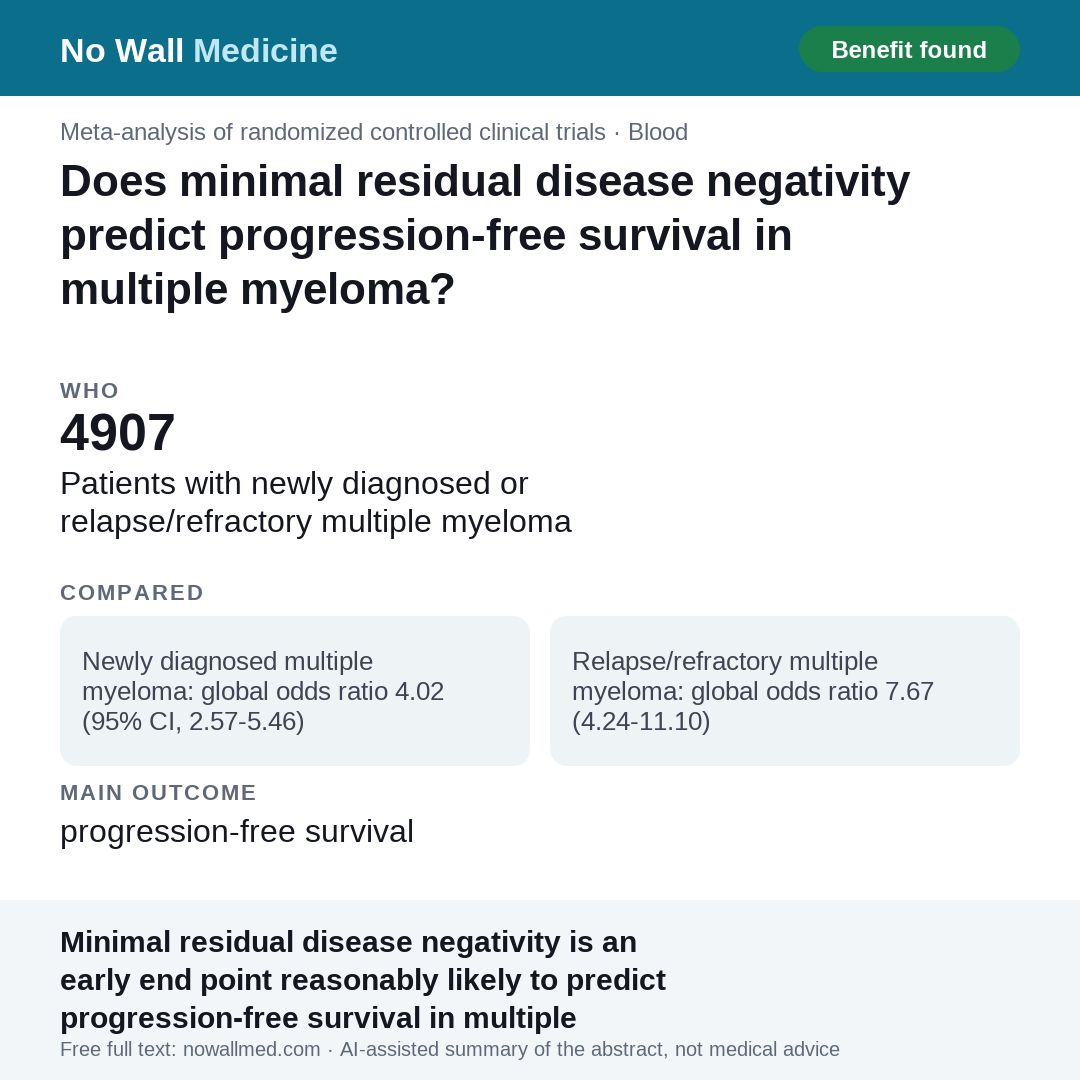
Clinical question: Does minimal residual disease negativity predict progression-free survival in multiple myeloma?
Why it matters: It is difficult to measure long-term survival in multiple myeloma trials as new treatments improve outcomes, creating a need for earlier markers that predict clinical benefit.
Key points
- Researchers analyzed eight studies of 4907 patients with newly diagnosed multiple myeloma to evaluate if minimal residual disease negativity predicts long-term benefits.
- In newly diagnosed patients, 12-month minimal residual disease negativity was associated with a global odds ratio for progression-free survival of 4.02.
- For patients with relapse or refractory multiple myeloma, 12-month minimal residual disease negativity was associated with a global odds ratio of 7.67.
Headline and key points written with AI from the paper’s abstract, with every number checked against it. Read the paper before relying on them.
Topics
Cite this article
Landgren O, Prior TJ, Masterson T, Heuck C, Bueno OF, Dash AB. EVIDENCE meta-analysis: evaluating minimal residual disease as an intermediate clinical end point for multiple myeloma. Blood. 2024. doi:10.1182/blood.2024024371
Spotted a mistake? Suggest a correction
Top studies every Monday
The week’s key trials and guidelines in your specialties, plus any topics you follow. By email, free.
Get the weekly digest