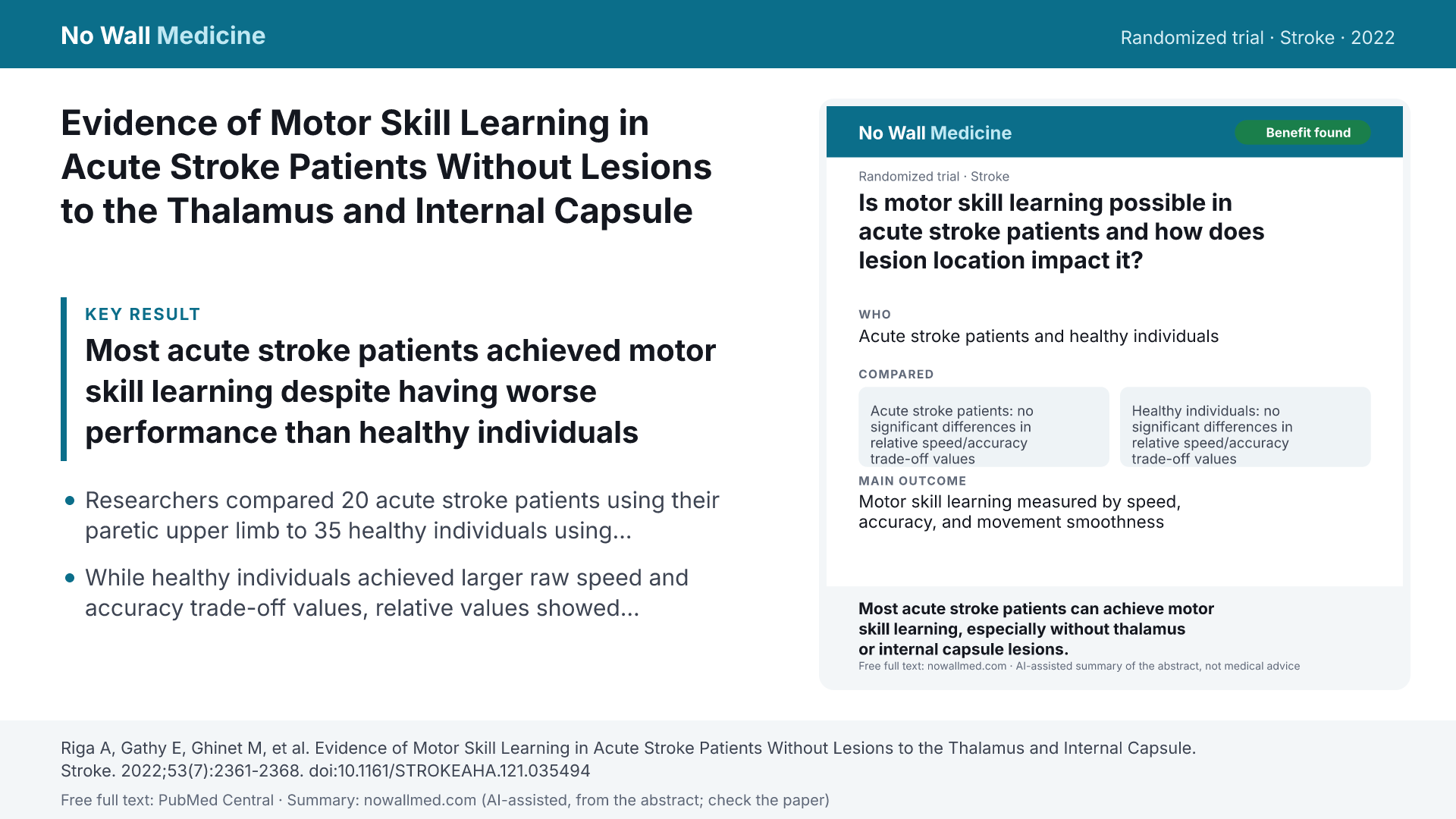
Most acute stroke patients achieved motor skill learning despite having worse performance than healthy individuals
Evidence of Motor Skill Learning in Acute Stroke Patients Without Lesions to the Thalamus and Internal Capsule
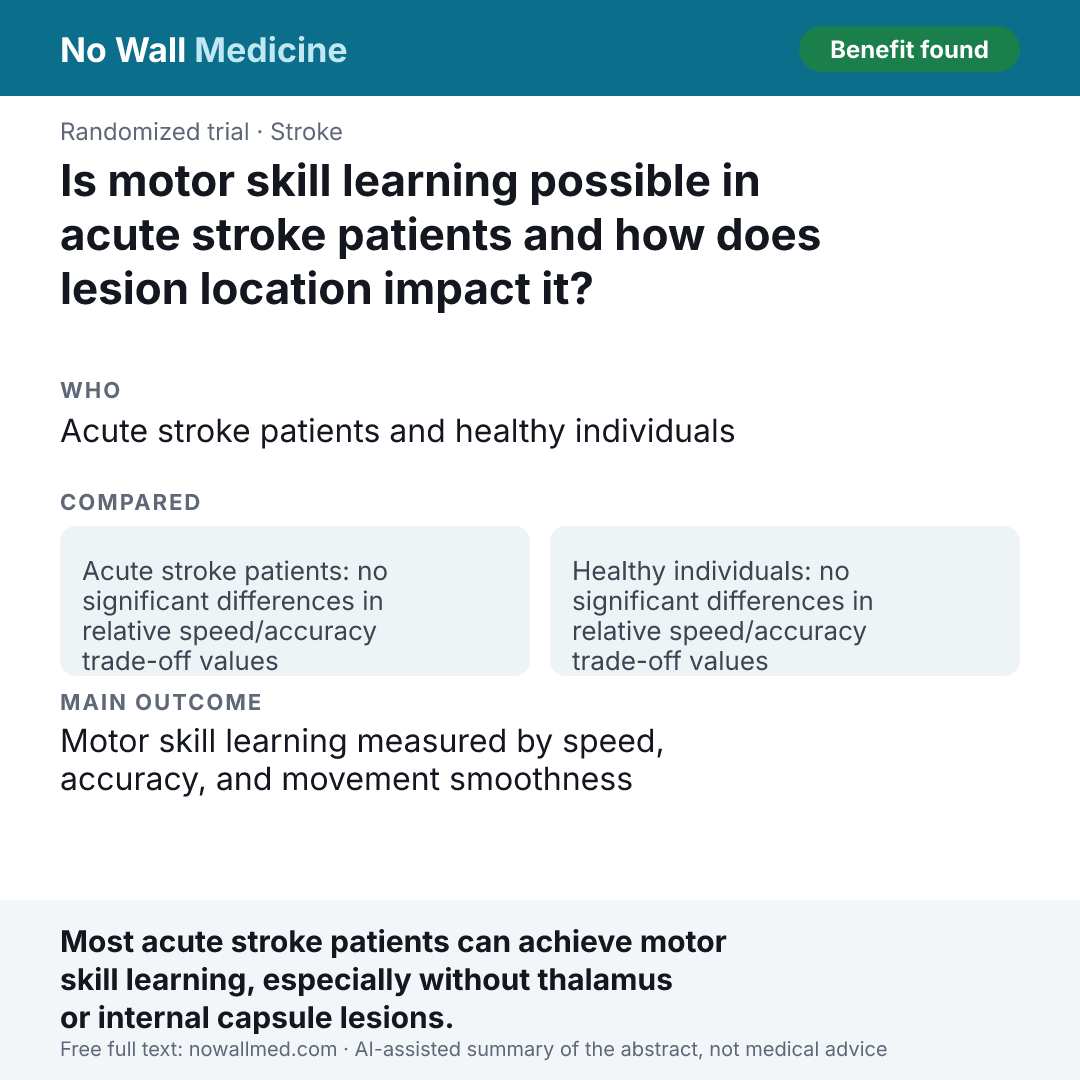
Randomized trialBenefit found
Is motor skill learning possible in acute stroke patients and how does lesion location impact it?
Who
Acute stroke patients and healthy individuals
Compared
Acute stroke patients: no significant differences in relative speed/accuracy trade-off values
Healthy individuals: no significant differences in relative speed/accuracy trade-off values
Main outcome
Motor skill learning measured by speed, accuracy, and movement smoothness
Bottom line: Most acute stroke patients can achieve motor skill learning, especially without thalamus or internal capsule lesions.
Stroke · 2022-03-21 · Save PNG
Clinical question: Is motor skill learning possible in acute stroke patients and how does lesion location impact it?
Key points
- Researchers compared 20 acute stroke patients using their paretic upper limb to 35 healthy individuals using their nondominant upper limb over 3 days of robotic training.
- While healthy individuals achieved larger raw speed and accuracy trade-off values, relative values showed no significant differences in motor skill learning between the two groups on day 3.
- Voxel-based lesion symptom mapping showed that acute vascular damage to the thalamus or the posterior limb of the internal capsule was associated with reduced motor skill learning.
Headline and key points written with AI from the paper’s abstract, with every number checked against it. Read the paper before relying on them.
Was this summary helpful?
Subject terms
Headline, design, result, key points, caveat and citation as plain text.
Cite this article
Riga A, Gathy E, Ghinet M, et al. Evidence of Motor Skill Learning in Acute Stroke Patients Without Lesions to the Thalamus and Internal Capsule. Stroke. 2022;53(7):2361-2368. doi:10.1161/STROKEAHA.121.035494
Spotted a mistake? Suggest a correction