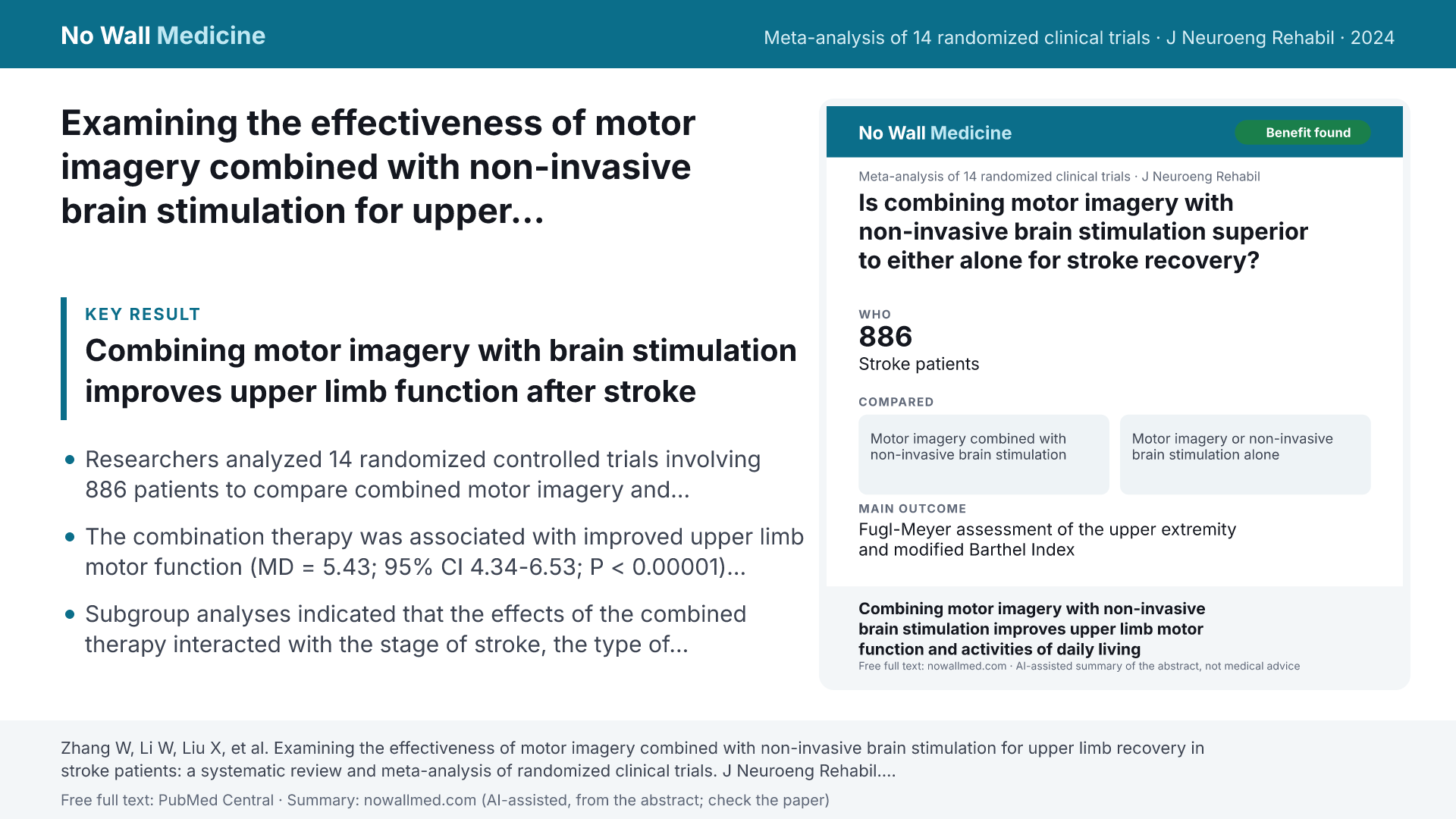
Combining motor imagery with brain stimulation improves upper limb function after stroke
Examining the effectiveness of motor imagery combined with non-invasive brain stimulation for upper limb recovery in stroke patients: a systematic review and meta-analysis of randomized clinical trials
Meta-analysis of 14 randomized clinical trialsBenefit found
Is combining motor imagery with non-invasive brain stimulation superior to either alone for stroke recovery?
Who
886
Stroke patients
Compared
Motor imagery combined with non-invasive brain stimulation
Motor imagery or non-invasive brain stimulation alone
Main outcome
Fugl-Meyer assessment of the upper extremity and modified Barthel Index
Result: MD = 5.43 (95% CI 4.34-6.53) for Fugl-Meyer assessment of the upper extremity; MD = 11.07 (95% CI 6.33-15.80) for modified Barthel Index
Bottom line: Combining motor imagery with non-invasive brain stimulation improves upper limb motor function and activities of daily living after stroke.
J Neuroeng Rehabil · 2024-11-30 · Save PNG
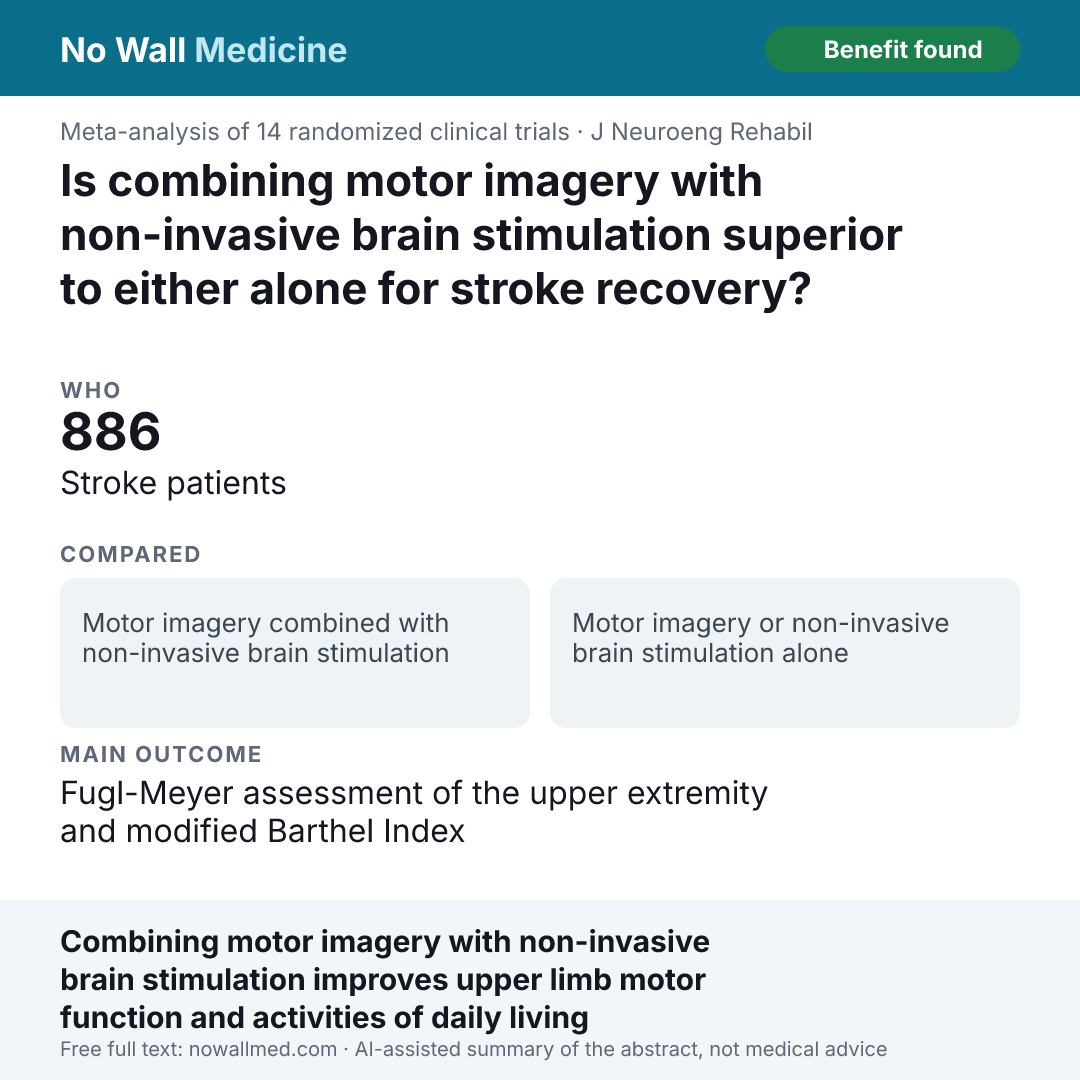
Clinical question: Is combining motor imagery with non-invasive brain stimulation superior to either alone for stroke recovery?
Why it matters: Evidence regarding whether combining non-invasive brain stimulation with motor imagery is superior to using either treatment alone for upper limb recovery after stroke is inconclusive.
Key points
- Researchers analyzed 14 randomized controlled trials involving 886 patients to compare combined motor imagery and non-invasive brain stimulation against either method used alone.
- The combination therapy was associated with improved upper limb motor function (MD = 5.43; 95% CI 4.34-6.53; P < 0.00001) and daily living activities (MD = 11.07; 95% CI 6.33-15.80; P < 0.00001).
- Subgroup analyses indicated that the effects of the combined therapy interacted with the stage of stroke, the type of motor imagery, and the type of brain stimulation used.
Headline and key points written with AI from the paper’s abstract, with every number checked against it. Read the paper before relying on them.
Was this summary helpful?
Subject terms
Headline, design, result, key points, caveat and citation as plain text.
Cite this article
Zhang W, Li W, Liu X, et al. Examining the effectiveness of motor imagery combined with non-invasive brain stimulation for upper limb recovery in stroke patients: a systematic review and meta-analysis of randomized clinical trials. J Neuroeng Rehabil. 2024;21(1):209. doi:10.1186/s12984-024-01491-x
Spotted a mistake? Suggest a correction