Blended learning approach showed higher pass rates in peer-led community cardiopulmonary resuscitation training
Exploration of 'generational' peer-led CPR training in the Australian community using blended learning approaches: a pilot randomised controlled trial
Pilot randomised controlled trialEarly signal
Is blended learning effective for community peer-led cardiopulmonary pulmonary resuscitation training?
Who
155
Community volunteers aged 18-85 years with no recent training
Compared
96.5 %Blended training (55/57, 95 % CI: 87.9-99.6 %)
75.9 %Face-to-face training (44/58, 95 % CI: 62.8-86.1 %)
Main outcome
Pass rates in simulated cardiac arrest assessments
Bottom line: Blended learning with multimodal aids enhances cardiopulmonary pulmonary resuscitation performance in peer-led community training.
Resusc Plus · 2025-12-15 · Save PNG
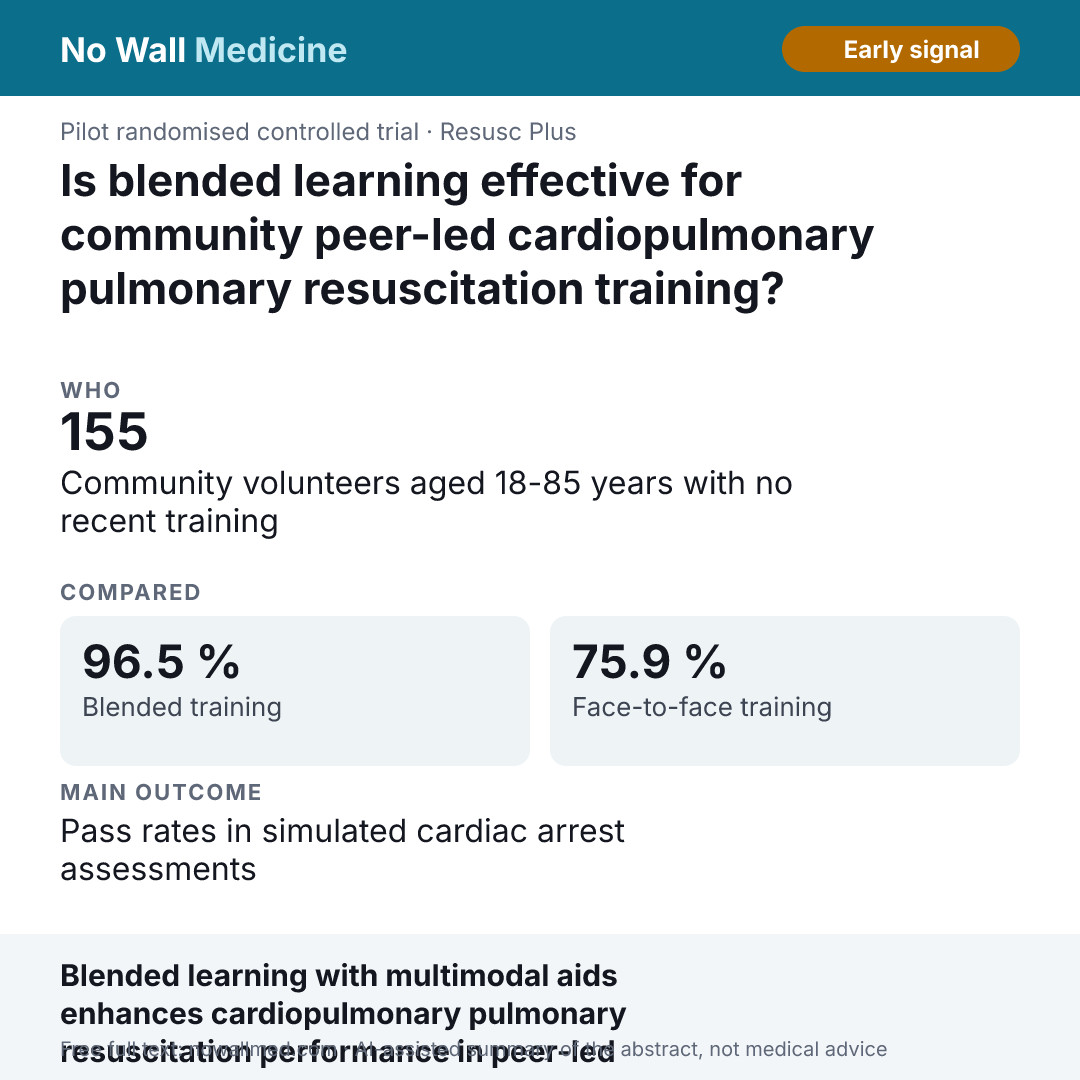
Clinical question: Is blended learning effective for community peer-led cardiopulmonary pulmonary resuscitation training?
Key points
- Researchers studied 155 community volunteers aged 18-85 years using a peer-led training model across four generations.
- The blended learning group had a pass rate of 96.5% compared to 75.9% in the traditional face-to-face group.
- The combined pass rate for all 115 assessments was 86%.
Headline and key points written with AI from the paper’s abstract, with every number checked against it. Read the paper before relying on them.
Was this summary helpful?
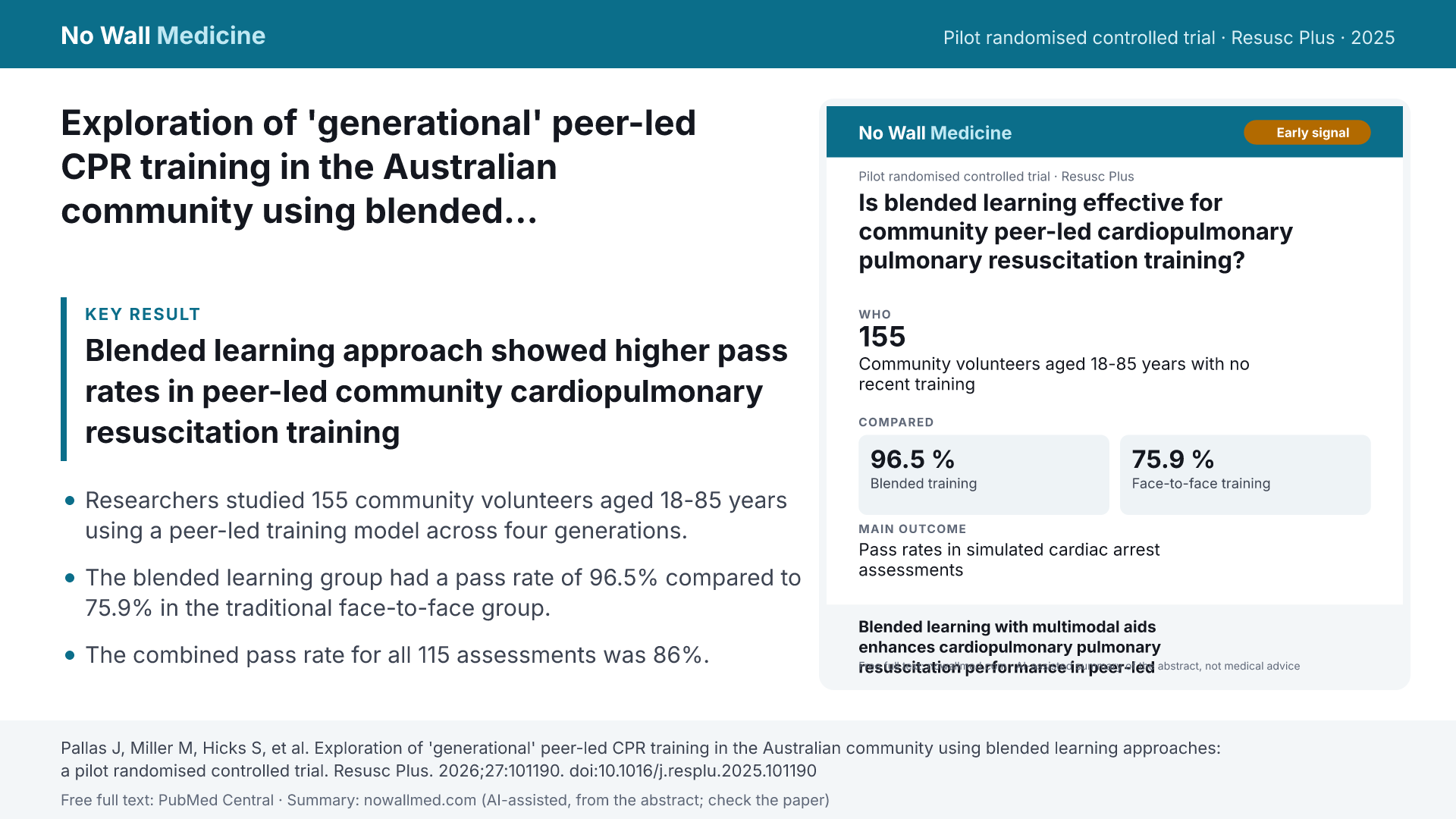
Headline, design, result, key points, caveat and citation as plain text.
Cite this article
Pallas J, Miller M, Hicks S, et al. Exploration of 'generational' peer-led CPR training in the Australian community using blended learning approaches: a pilot randomised controlled trial. Resusc Plus. 2026;27:101190. doi:10.1016/j.resplu.2025.101190
Spotted a mistake? Suggest a correction