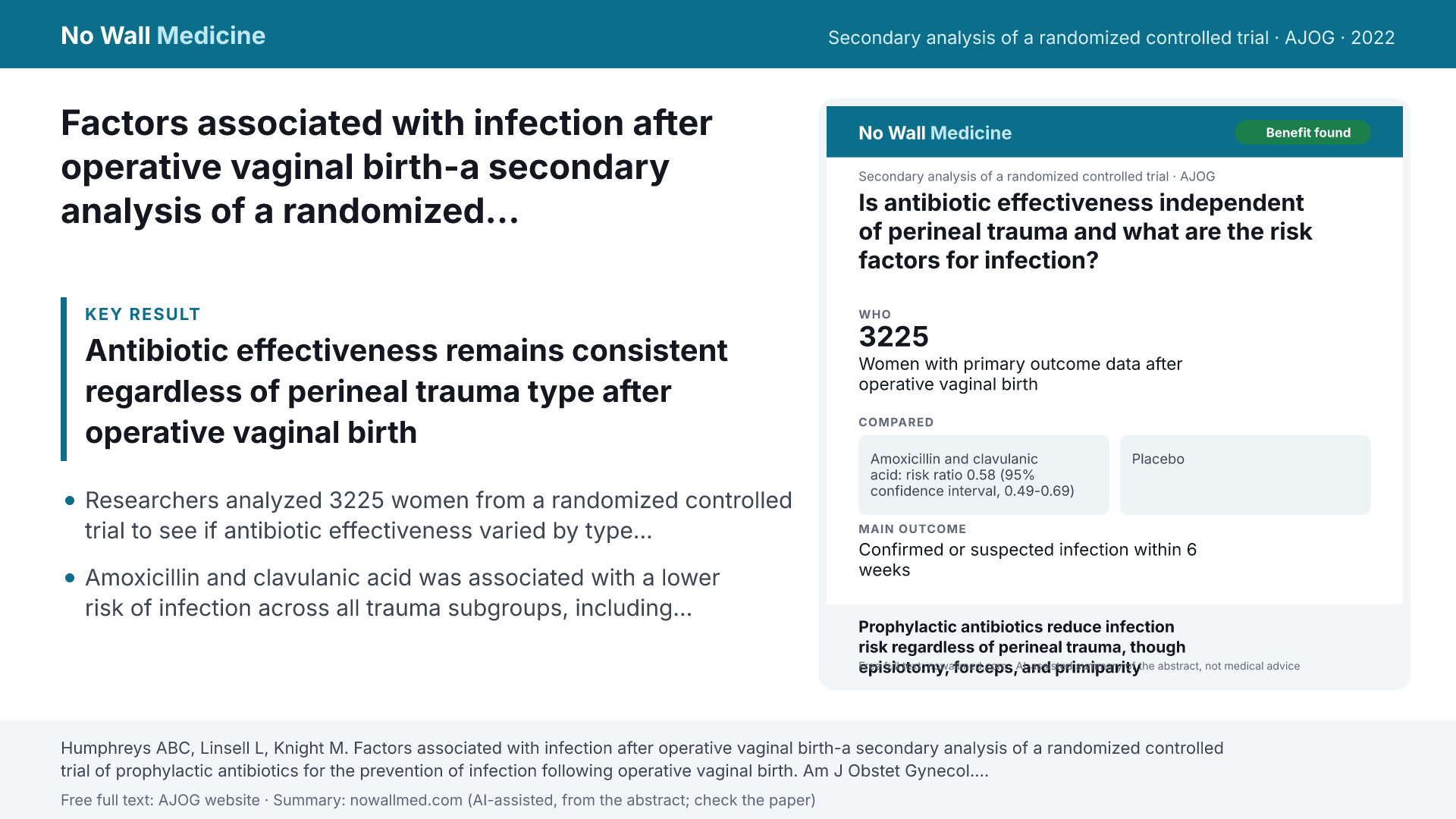
Antibiotic effectiveness remains consistent regardless of perineal trauma type after operative vaginal birth
Factors associated with infection after operative vaginal birth-a secondary analysis of a randomized controlled trial of prophylactic antibiotics for the prevention of infection following operative vaginal birth
Secondary analysis of a randomized controlled trialBenefit found
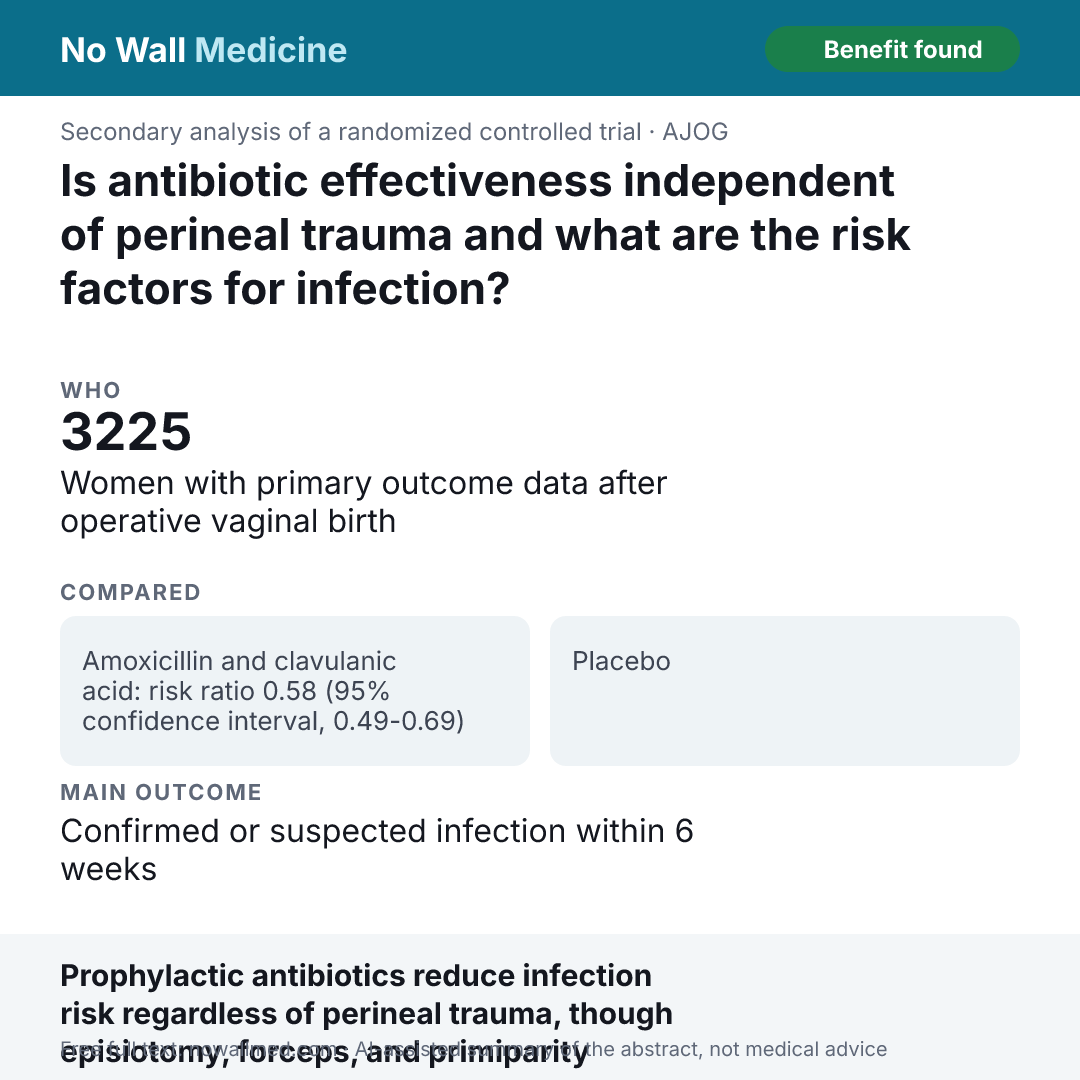
Is antibiotic effectiveness independent of perineal trauma and what are the risk factors for infection?
Who
3225
Women with primary outcome data after operative vaginal birth
Compared
Amoxicillin and clavulanic acid: risk ratio 0.58 (95% confidence interval, 0.49-0.69)
Placebo
Main outcome
Confirmed or suspected infection within 6 weeks
Result: risk ratio 0.58 (95% confidence interval, 0.49-0.69)
Bottom line: Prophylactic antibiotics reduce infection risk regardless of perineal trauma, though episiotomy, forceps, and primiparity increase infection risk.
Limitation: Generalizability may be limited in settings where the episiotomy rate is lower.
AJOG · 2022-08-24 · Save PNG
Clinical question: Is antibiotic effectiveness independent of perineal trauma and what are the risk factors for infection?
Key points
- Researchers analyzed 3225 women from a randomized controlled trial to see if antibiotic effectiveness varied by type of perineal trauma, such as episiotomy or tears.
- Amoxicillin and clavulanic acid was associated with a lower risk of infection across all trauma subgroups, including those with neither an episiotomy nor a tear.
- Factors associated with infection included episiotomy, forceps use, being a first-time mother, and a body mass index of 25.0 to 29.9 kg/m2.
Headline and key points written with AI from the paper’s abstract, with every number checked against it. Read the paper before relying on them.
Was this summary helpful?
Subject terms
Headline, design, result, key points, caveat and citation as plain text.
Cite this article
Humphreys ABC, Linsell L, Knight M. Factors associated with infection after operative vaginal birth-a secondary analysis of a randomized controlled trial of prophylactic antibiotics for the prevention of infection following operative vaginal birth. Am J Obstet Gynecol. 2023;228(3):328.e1-328.e11. doi:10.1016/j.ajog.2022.08.037
Spotted a mistake? Suggest a correction