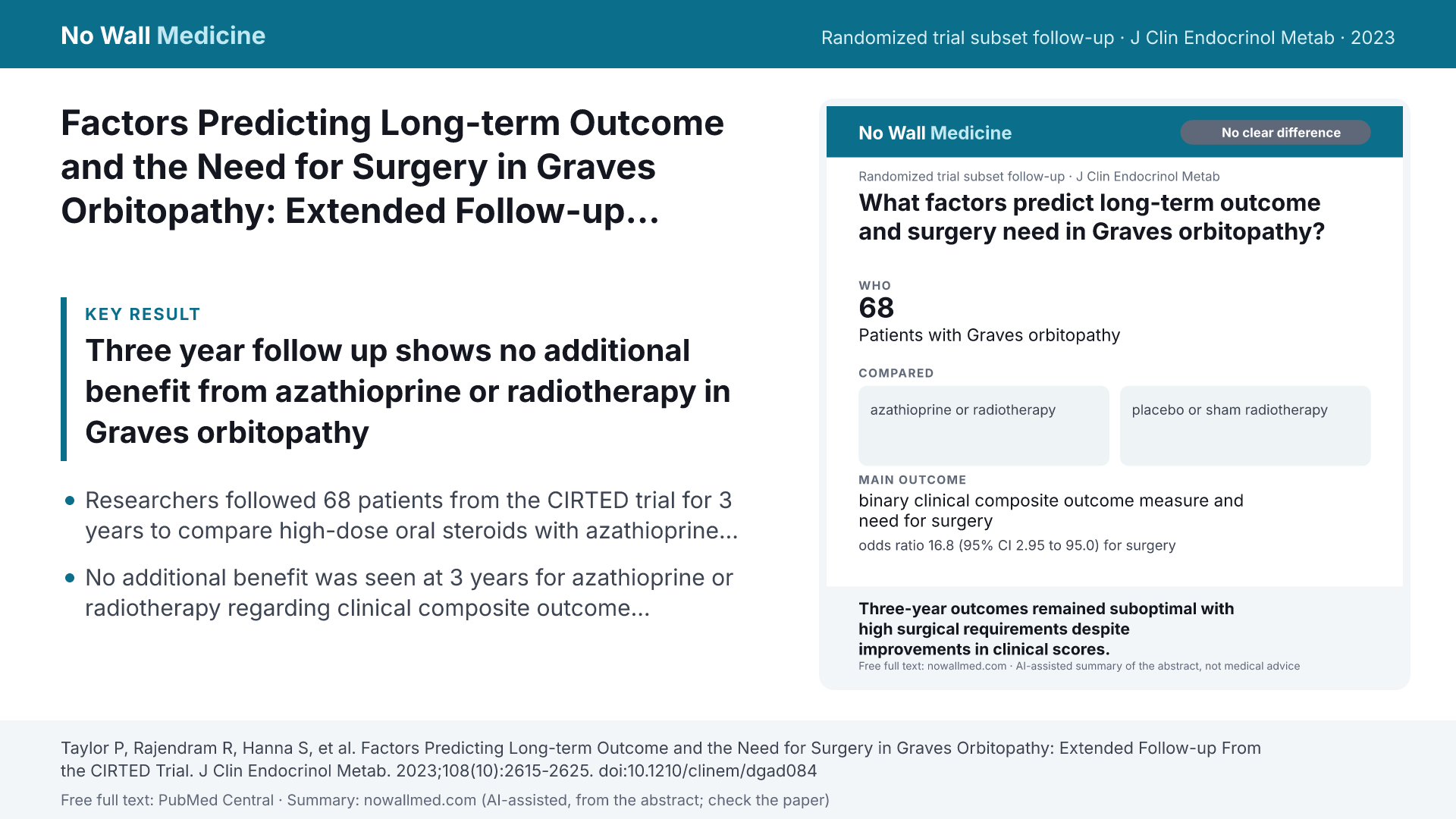
Three year follow up shows no additional benefit from azathioprine or radiotherapy in Graves orbitopathy
Factors Predicting Long-term Outcome and the Need for Surgery in Graves Orbitopathy: Extended Follow-up From the CIRTED Trial
Randomized trial subset follow-upNo clear difference
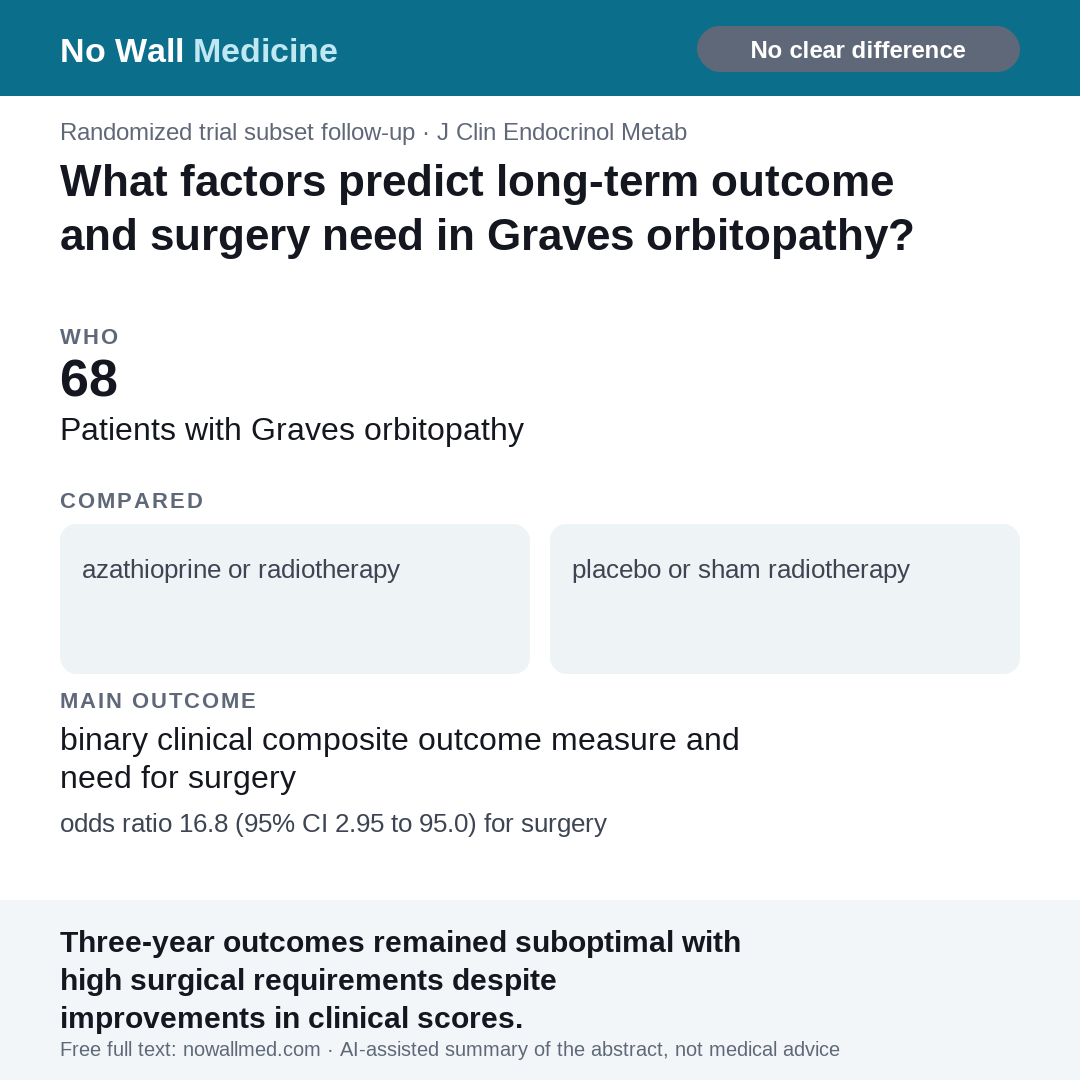
What factors predict long-term outcome and surgery need in Graves orbitopathy?
Who
68
Patients with Graves orbitopathy
Compared
azathioprine or radiotherapy
placebo or sham radiotherapy
Main outcome
binary clinical composite outcome measure and need for surgery
Result: odds ratio 16.8 (95% CI 2.95 to 95.0) for surgery
Bottom line: Three-year outcomes remained suboptimal with high surgical requirements despite improvements in clinical scores.
Limitation: Data were available from only 54% of randomized subjects.
J Clin Endocrinol Metab · 2023-03-28Download image
Clinical question: What factors predict long-term outcome and surgery need in Graves orbitopathy?
Why it matters: It is unknown if medical therapies for Graves orbitopathy, an eye disease caused by an overactive thyroid, provide benefits beyond 18 months of follow-up.
Key points
- Researchers followed 68 patients from the CIRTED trial for 3 years to compare high-dose oral steroids with azathioprine or placebo and radiotherapy or sham radiotherapy.
- No additional benefit was seen at 3 years for azathioprine or radiotherapy regarding clinical composite outcome measures, modified European Group on Graves' Orbitopathy scores, or Ophthalmopathy Index.
- A disease duration of greater than 6 months before treatment was associated with an increased need for surgery, which occurred in 37.5% of 64 individuals.
Limitation the authors note: The 3 year follow-up data was only available for 54% of the 126 randomized subjects.
Headline and key points written with AI from the paper’s abstract, with every number checked against it. Read the paper before relying on them.
Was this summary helpful?
Subject terms
Cite this article
Taylor P, Rajendram R, Hanna S, et al. Factors Predicting Long-term Outcome and the Need for Surgery in Graves Orbitopathy: Extended Follow-up From the CIRTED Trial. J Clin Endocrinol Metab. 2023. doi:10.1210/clinem/dgad084
Spotted a mistake? Suggest a correction