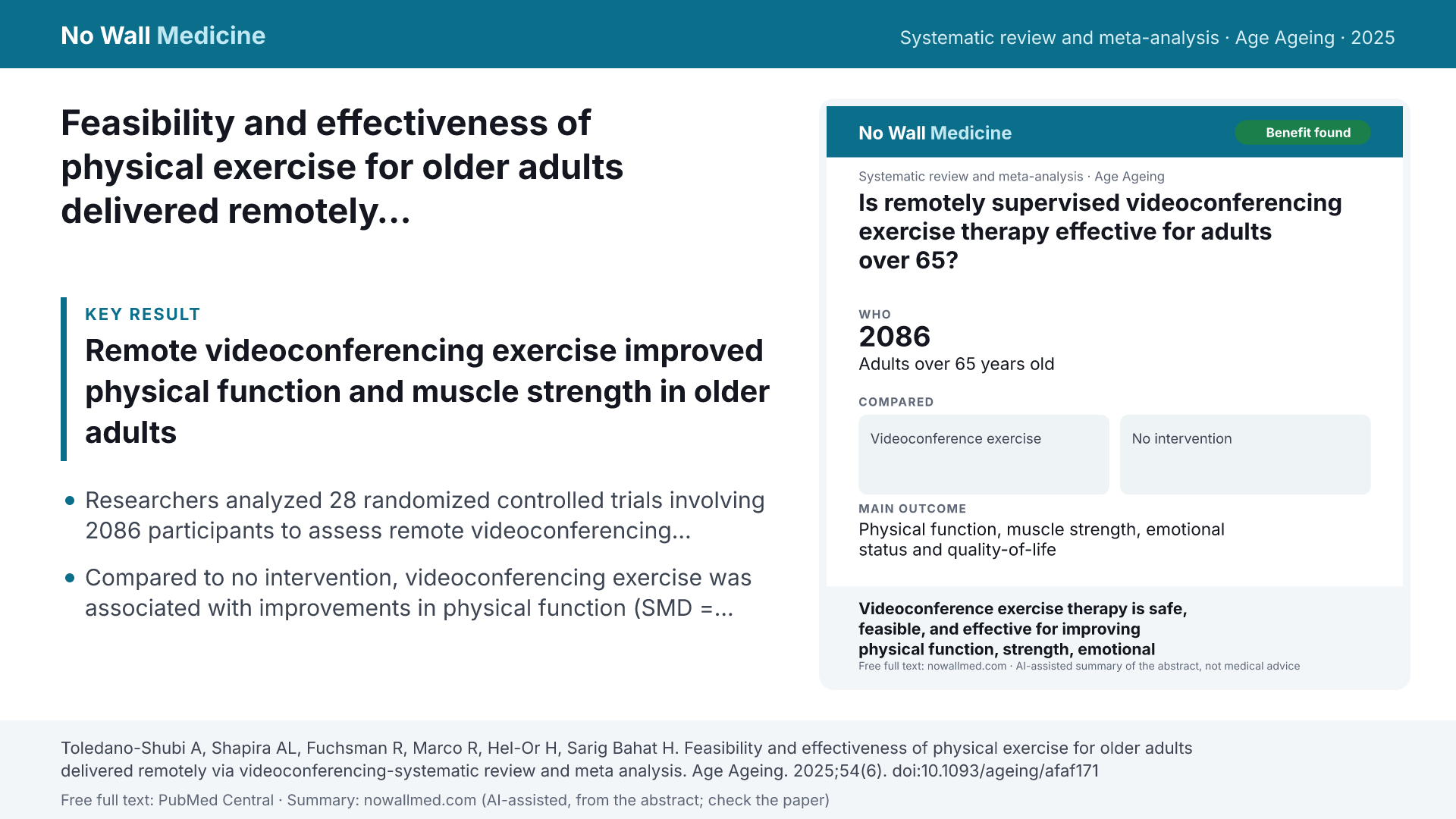
Remote videoconferencing exercise improved physical function and muscle strength in older adults
Feasibility and effectiveness of physical exercise for older adults delivered remotely via videoconferencing-systematic review and meta analysis
Systematic review and meta-analysisBenefit found
Is remotely supervised videoconferencing exercise therapy effective for adults over 65?
Who
2086
Adults over 65 years old
Compared
Videoconference exercise
No intervention
Main outcome
Physical function, muscle strength, emotional status and quality-of-life
Result: physical function SMD 0.82 (95% CI 0.46-1.19); muscle strength SMD 0.86 (95% CI 0.46-1.26); emotional status SMD 0.72 (95% CI 0.35-1.09); quality-of-life SMD 0.61 (95% CI 0.19-1.03)
Bottom line: Videoconference exercise therapy is safe, feasible, and effective for improving physical function, strength, emotional status, and quality-of-life.
Limitation: High heterogeneity in outcome measures and small sample sizes may affect generalizability.
Age Ageing · 2025-06-24Download image
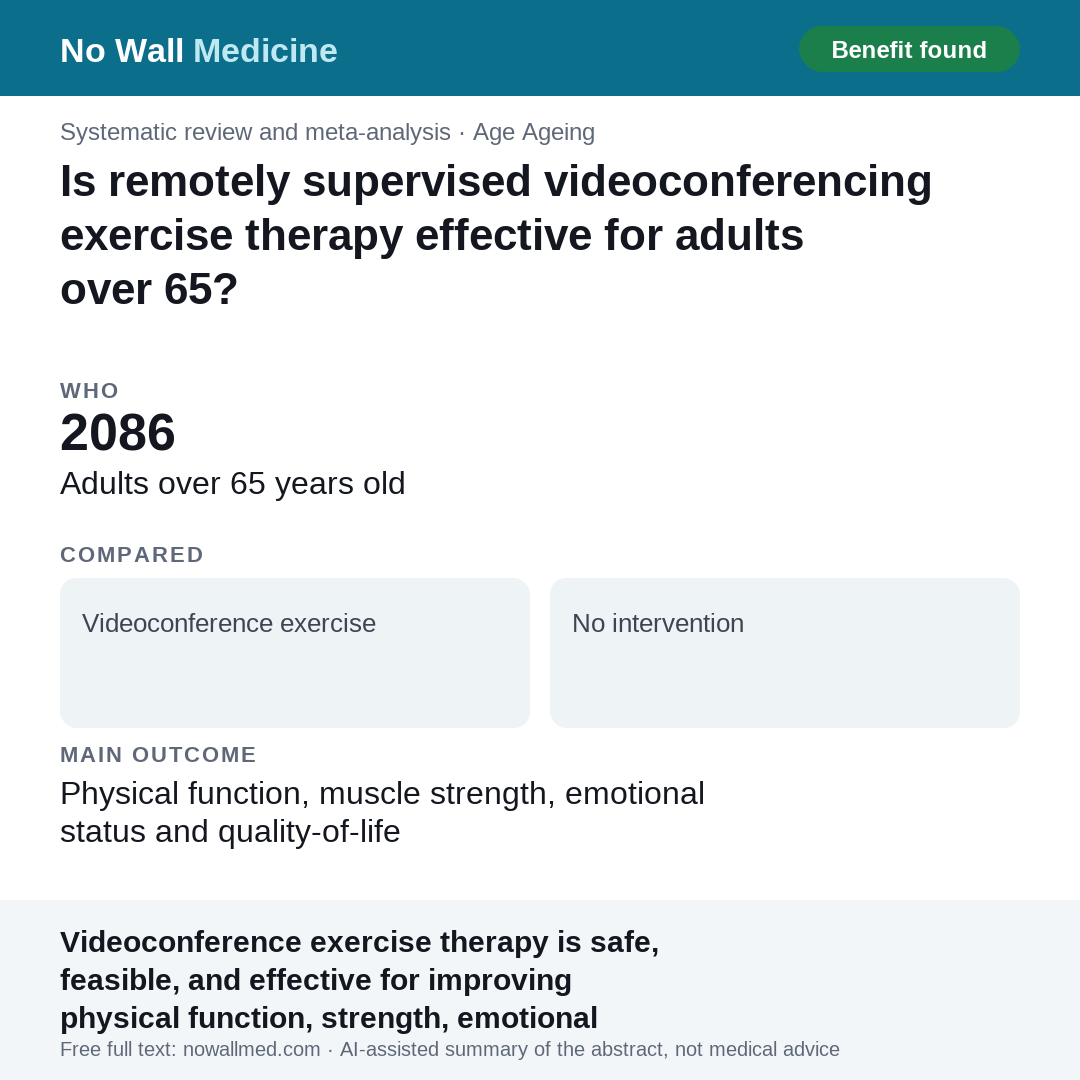
Clinical question: Is remotely supervised videoconferencing exercise therapy effective for adults over 65?
Why it matters: It was unknown if remotely supervised exercise via videoconferencing is a feasible and effective way to support physical activity in adults over 65.
Key points
- Researchers analyzed 28 randomized controlled trials involving 2086 participants to assess remote videoconferencing exercise for adults over 65.
- Compared to no intervention, videoconferencing exercise was associated with improvements in physical function (SMD = 0.82), muscle strength (SMD = 0.86), emotional status (SMD = 0.72), and quality-of-life (SMD = 0.61).
- The average attendance rate was 79.7% and the completion rate was 92.8%, with adverse events being comparable to control groups.
Limitation the authors note: Only 25% of studies met the highest methodological standards, and high heterogeneity in outcome measures and small sample sizes may affect generalizability.
Headline and key points written with AI from the paper’s abstract, with every number checked against it. Read the paper before relying on them.
Was this summary helpful?
Subject terms
Cite this article
Toledano-Shubi A, Shapira AL, Fuchsman R, Marco R, Hel-Or H, Sarig Bahat H. Feasibility and effectiveness of physical exercise for older adults delivered remotely via videoconferencing-systematic review and meta analysis. Age Ageing. 2025. doi:10.1093/ageing/afaf171
Spotted a mistake? Suggest a correction