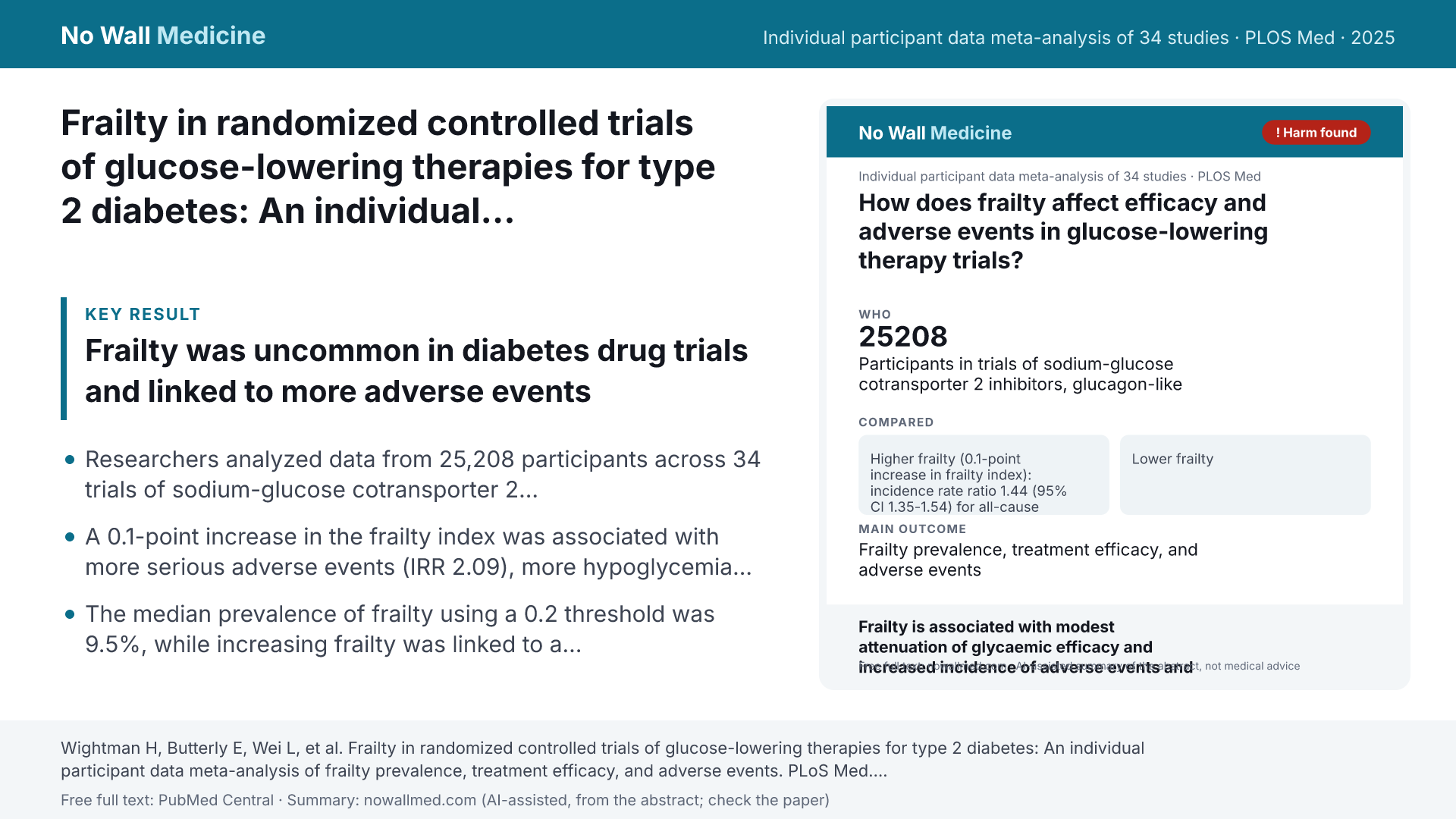
Frailty was uncommon in diabetes drug trials and linked to more adverse events
Frailty in randomized controlled trials of glucose-lowering therapies for type 2 diabetes: An individual participant data meta-analysis of frailty prevalence, treatment efficacy, and adverse events
Individual participant data meta-analysis of 34 trialsHarm found
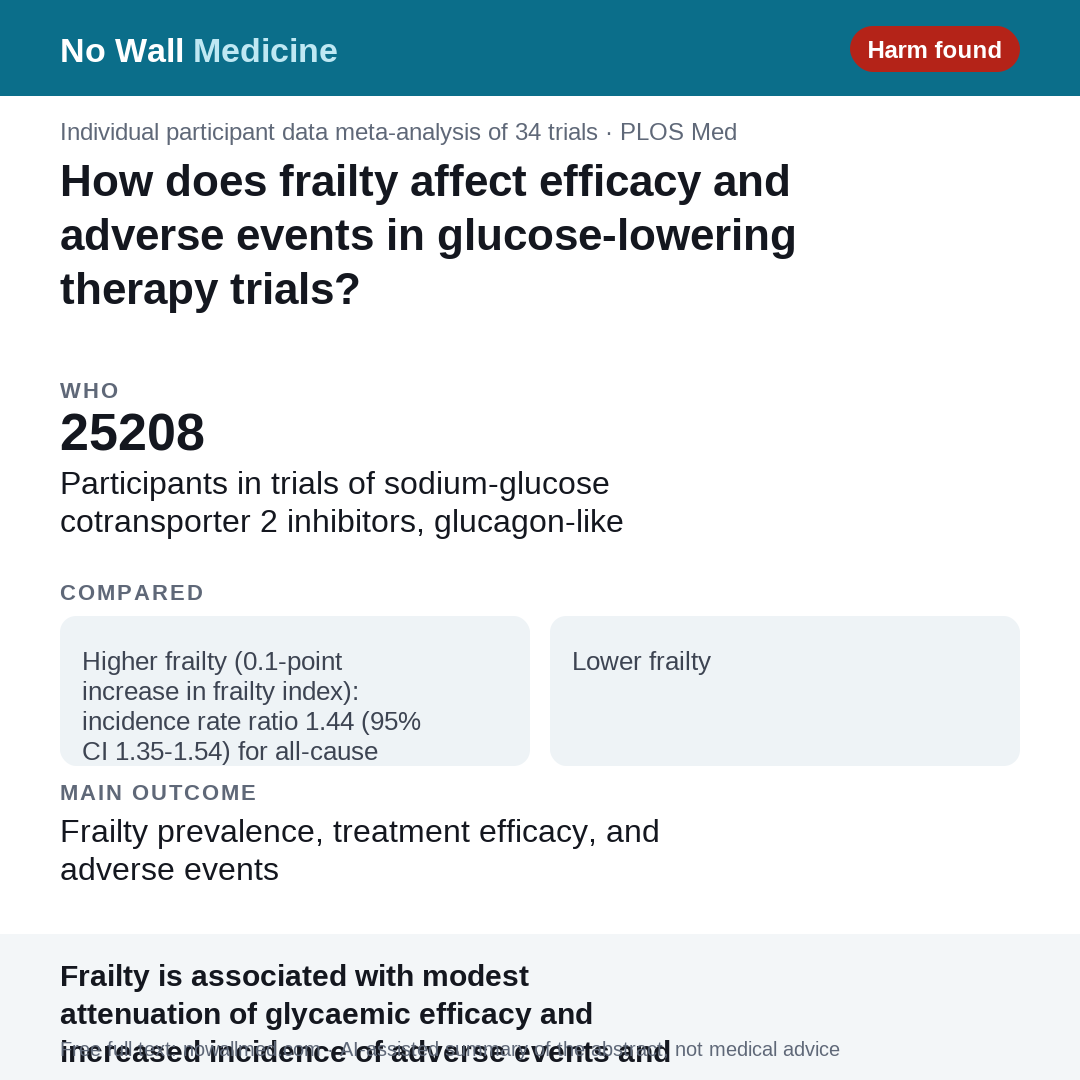
How does frailty affect efficacy and adverse events in glucose-lowering therapy trials?
Who
25208
Participants in trials of sodium-glucose cotransporter 2 inhibitors, glucagon-like peptide-1 receptor agonists, and dipeptidyl peptidase 4 inhibitors
Compared
Higher frailty (0.1-point increase in frailty index): incidence rate ratio 1.44 (95% CI 1.35-1.54) for all-cause adverse events
Lower frailty
Main outcome
Frailty prevalence, treatment efficacy, and adverse events
Result: incidence rate ratio 1.44 (95% CI 1.35-1.54) for all-cause adverse events
Bottom line: Frailty is associated with modest attenuation of glycaemic efficacy and increased incidence of adverse events and cardiovascular events.
Limitation: Large cardiovascular outcome trials did not include data on functional status to assess frailty.
PLOS Med · 2025-04-07Download image
Clinical question: How does frailty affect efficacy and adverse events in glucose-lowering therapy trials?
Why it matters: The representation of frailty in clinical trials for newer glucose-lowering therapies is unclear, and the balance of risks and benefits for these patients remains uncertain.
Key points
- Researchers analyzed data from 25,208 participants across 34 trials of sodium-glucose cotransporter 2 inhibitors, glucagon-like peptide-1 receptor agonists, and dipeptidyl peptidase 4 inhibitors.
- A 0.1-point increase in the frailty index was associated with more serious adverse events (IRR 2.09), more hypoglycemia (IRR 1.21), and a higher baseline risk of major adverse cardiovascular events (HR 3.01).
- The median prevalence of frailty using a 0.2 threshold was 9.5%, while increasing frailty was linked to a small attenuation in blood sugar lowering efficacy that was below clinical significance.
Limitation the authors note: Large cardiovascular outcome trials did not include data on functional status, so the researchers were unable to assess frailty in those specific trials.
Headline and key points written with AI from the paper’s abstract, with every number checked against it. Read the paper before relying on them.
Was this summary helpful?
Subject terms
Cite this article
Wightman H, Butterly E, Wei L, McChrystal R, Sattar N, Adler A. Frailty in randomized controlled trials of glucose-lowering therapies for type 2 diabetes: An individual participant data meta-analysis of frailty prevalence, treatment efficacy, and adverse events. PLOS Med. 2025. doi:10.1371/journal.pmed.1004553
Spotted a mistake? Suggest a correction