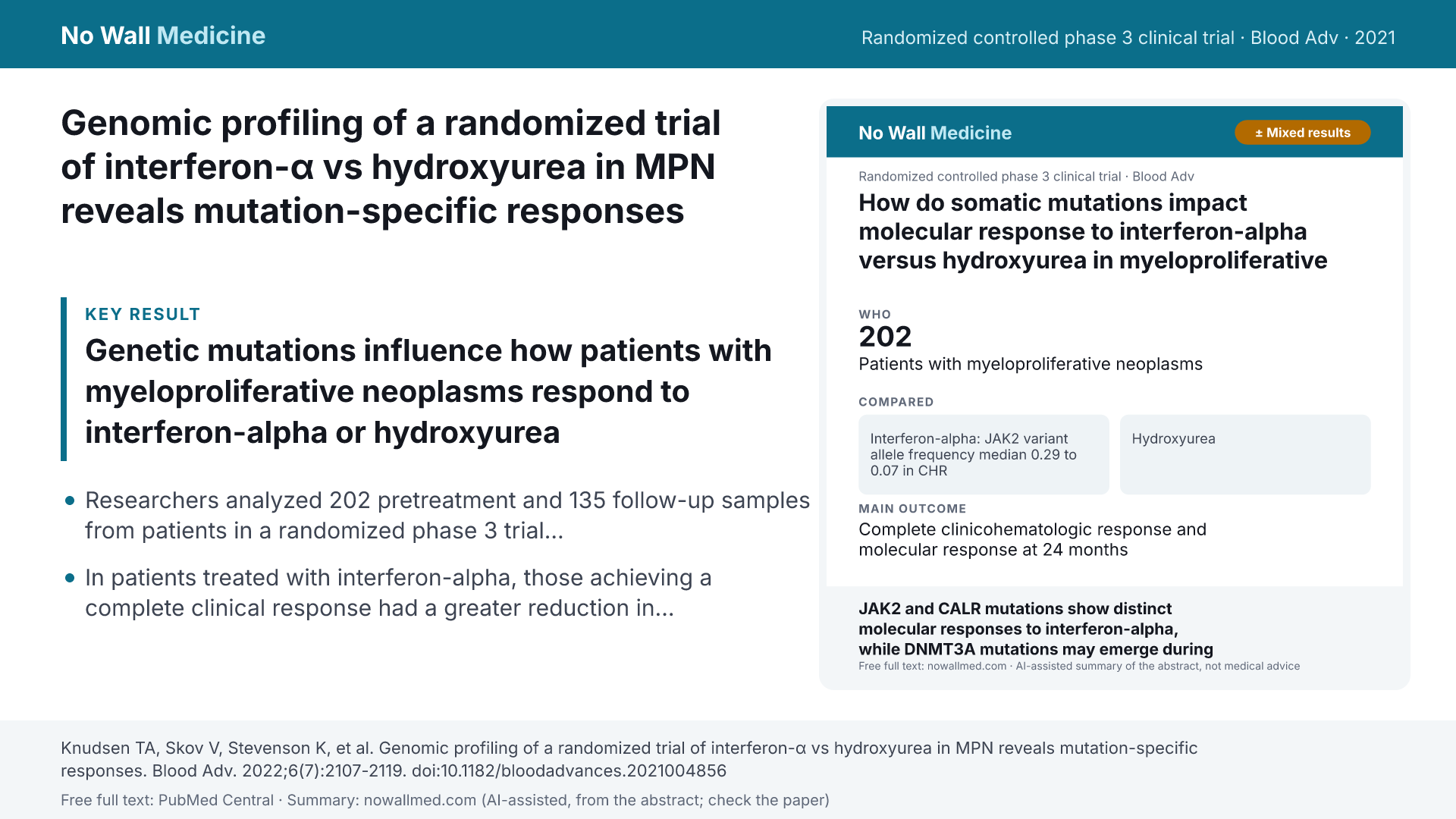
Genetic mutations influence how patients with myeloproliferative neoplasms respond to interferon-alpha or hydroxyurea
Genomic profiling of a randomized trial of interferon-α vs hydroxyurea in MPN reveals mutation-specific responses
Randomized controlled phase 3 clinical trialMixed results
How do somatic mutations impact molecular response to interferon-alpha versus hydroxyurea in myeloproliferative neoplasms?
Who
202
Patients with myeloproliferative neoplasms
Compared
Interferon-alpha: JAK2 variant allele frequency median 0.29 to 0.07 in CHR
Hydroxyurea
Main outcome
Complete clinicohematologic response and molecular response at 24 months
Bottom line: JAK2 and CALR mutations show distinct molecular responses to interferon-alpha, while DNMT3A mutations may emerge during treatment.
Blood Adv · 2021-09-11Download image
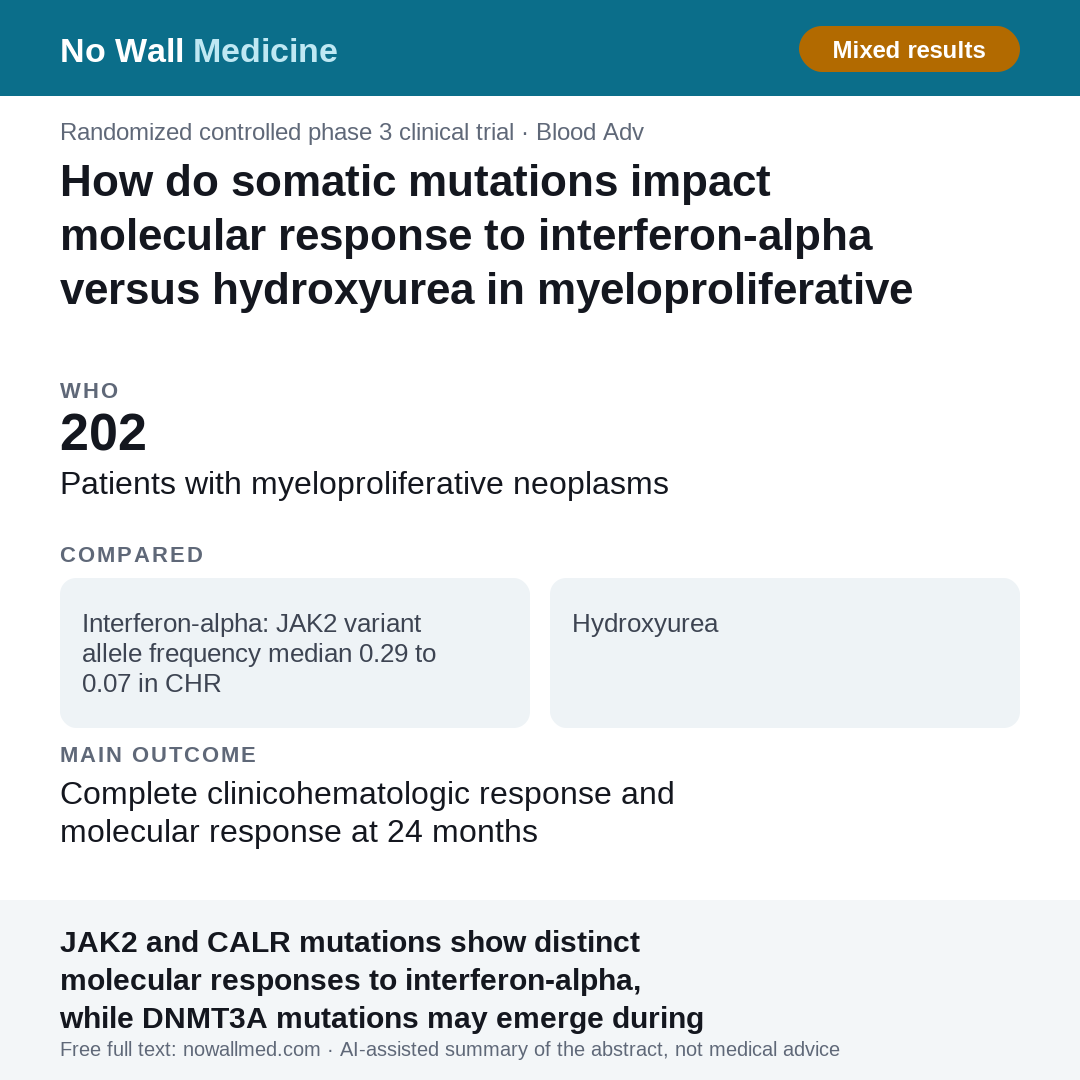
Clinical question: How do somatic mutations impact molecular response to interferon-alpha versus hydroxyurea in myeloproliferative neoplasms?
Why it matters: It is unknown how specific somatic mutations impact the molecular response to cytoreductive treatments in patients with myeloproliferative neoplasms.
Key points
- Researchers analyzed 202 pretreatment and 135 follow-up samples from patients in a randomized phase 3 trial comparing interferon-alpha to hydroxyurea for myeloproliferative neoplasms.
- In patients treated with interferon-alpha, those achieving a complete clinical response had a greater reduction in JAK2 mutation levels (median 0.29 to 0.07) than those who did not (median 0.27 to 0.14).
- New mutations in the DNMT3A gene were observed more frequently in patients treated with interferon-alpha compared to those treated with hydroxyurea.
Headline and key points written with AI from the paper’s abstract, with every number checked against it. Read the paper before relying on them.
Was this summary helpful?
Abstract
Although somatic mutations influence the pathogenesis, phenotype, and outcome of myeloproliferative neoplasms (MPNs), little is known about their impact on molecular response to cytoreductive treatment. We performed targeted next-generation sequencing (NGS) on 202 pretreatment samples obtained from patients with MPN enrolled in the DALIAH trial (A Study of Low Dose Interferon Alpha Versus Hydroxyurea in Treatment of Chronic Myeloid Neoplasms; #NCT01387763), a randomized controlled phase 3 clinical trial, and 135 samples obtained after 24 months of therapy with recombinant interferon-alpha (IFNα) or hydroxyurea. The primary aim was to evaluate the association between complete clinicohematologic response (CHR) at 24 months and molecular response through sequential assessment of 120 genes using NGS. Among JAK2-mutated patients treated with IFNα, those with CHR had a greater reduction in the JAK2 variant allele frequency (median, 0.29 to 0.07; P < .0001) compared with those not achieving CHR (median, 0.27 to 0.14; P < .0001). In contrast, the CALR variant allele frequency did not significantly decline in those achieving CHR or in those not achieving CHR. Treatment-emergent mutations in DNMT3A were observed more commonly in patients treated with IFNα compared with hydroxyurea (P = .04). Furthermore, treatment-emergent DNMT3A mutations were significantly enriched in IFNα-treated patients not attaining CHR (P = .02). A mutation in TET2, DNMT3A, or ASXL1 was significantly associated with prior stroke (age-adjusted odds ratio, 5.29; 95% confidence interval, 1.59-17.54; P = .007), as was a mutation in TET2 alone (age-adjusted odds ratio, 3.03; 95% confidence interval, 1.03-9.01; P = .044). At 24 months, we found mutation-specific response patterns to IFNα: (1) JAK2- and CALR-mutated MPN exhibited distinct molecular responses; and (2) DNMT3A-mutated clones/subclones emerged on treatment.
Abstract reproduced under the article’s CC BY NC ND licence.
Subject terms
Cite this article
Knudsen TA, Skov V, Stevenson K, et al. Genomic profiling of a randomized trial of interferon-α vs hydroxyurea in MPN reveals mutation-specific responses. Blood Adv. 2021. doi:10.1182/bloodadvances.2021004856
Spotted a mistake? Suggest a correction