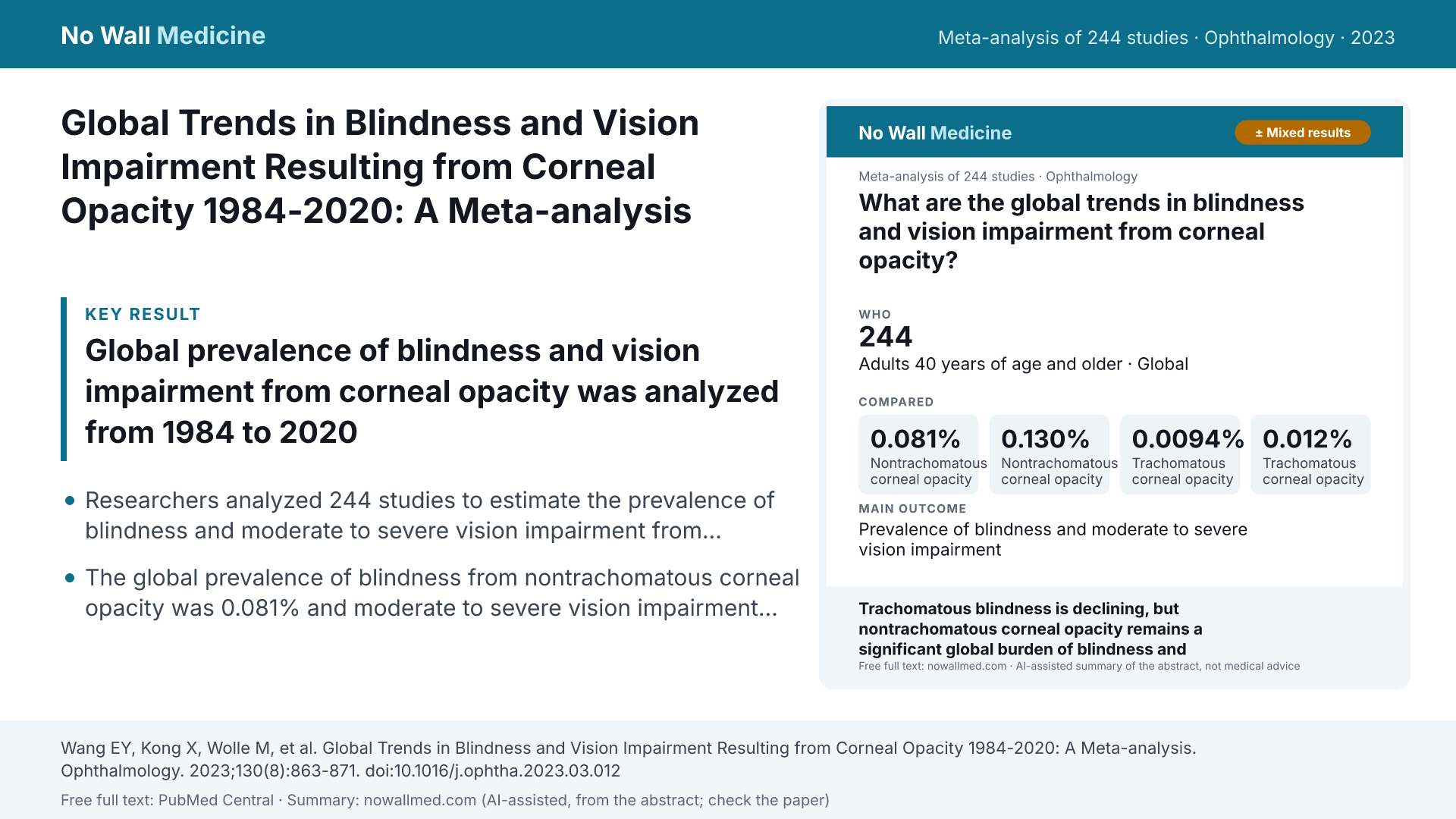
Global prevalence of blindness and vision impairment from corneal opacity was analyzed from 1984 to 2020
Global Trends in Blindness and Vision Impairment Resulting from Corneal Opacity 1984-2020: A Meta-analysis
Meta-analysis of 244 studiesMixed results
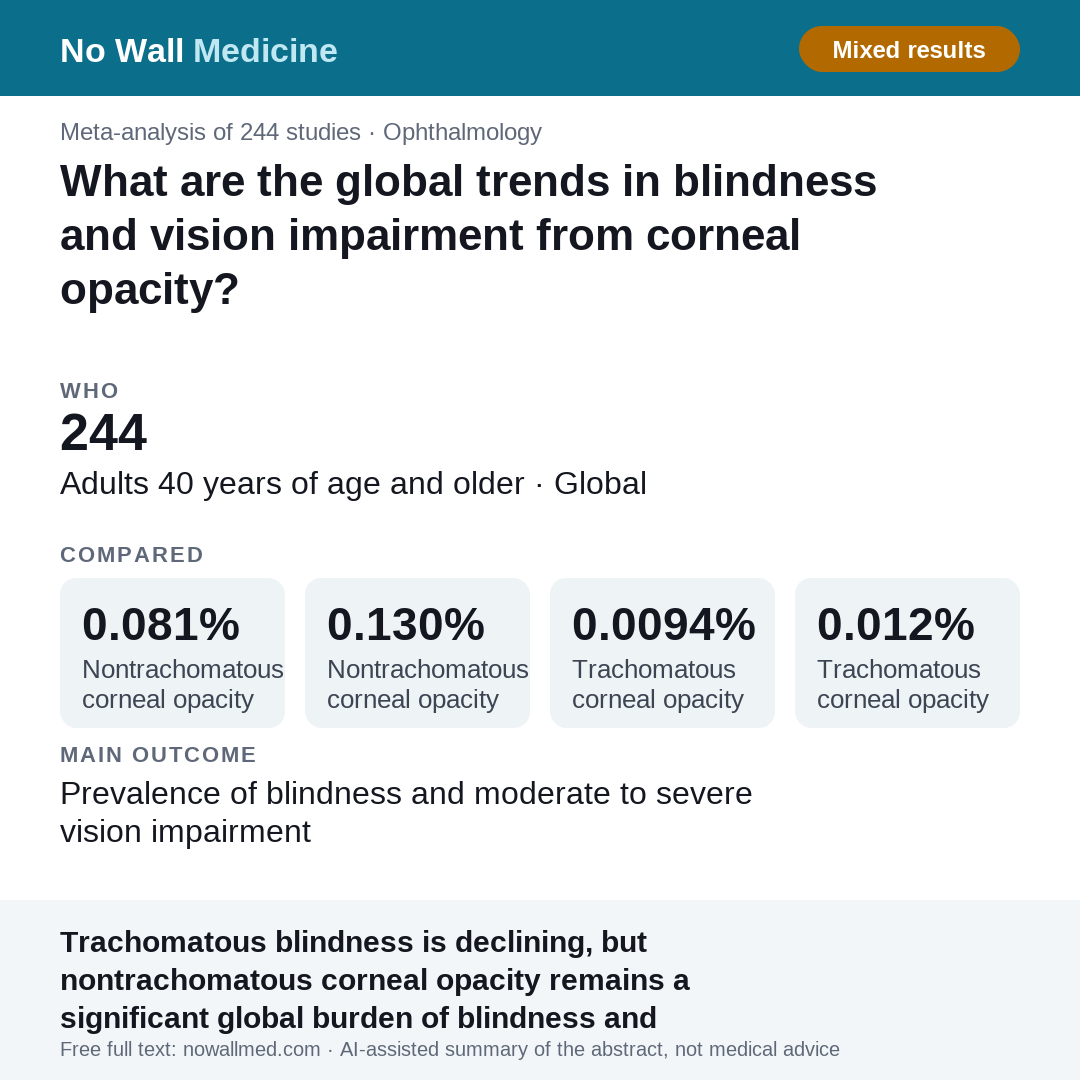
What are the global trends in blindness and vision impairment from corneal opacity?
Who
244
Adults 40 years of age and older · Global
Compared
0.081%Nontrachomatous corneal opacity blindness (95% CI, 0.049%-0.315%)
0.130%Nontrachomatous corneal opacity moderate to severe vision impairment (95% CI, 0.087%-0.372%)
0.0094%Trachomatous corneal opacity blindness (95% CI, 0%-0.0693%)
0.012%Trachomatous corneal opacity moderate to severe vision impairment (95% CI, 0%-0.0761%)
Main outcome
Prevalence of blindness and moderate to severe vision impairment
Bottom line: Trachomatous blindness is declining, but nontrachomatous corneal opacity remains a significant global burden of blindness and vision impairment.
Ophthalmology · 2023-03-22Download image
Clinical question: What are the global trends in blindness and vision impairment from corneal opacity?
Key points
- Researchers analyzed 244 studies to estimate the prevalence of blindness and moderate to severe vision impairment from corneal opacity in adults aged 40 years and older.
- The global prevalence of blindness from nontrachomatous corneal opacity was 0.081% and moderate to severe vision impairment was 0.130% for adults aged 40 years and older.
- Blindness from trachomatous corneal opacity decreased over time with a prevalence rate ratio of 0.91.
Headline and key points written with AI from the paper’s abstract, with every number checked against it. Read the paper before relying on them.
Was this summary helpful?
Subject terms
Cite this article
Wang EY, Kong X, Wolle M, et al. Global Trends in Blindness and Vision Impairment Resulting from Corneal Opacity 1984-2020: A Meta-analysis. Ophthalmology. 2023. doi:10.1016/j.ophtha.2023.03.012
Spotted a mistake? Suggest a correction