Wearable collision warning device reduced obstacle contacts for people with severe vision impairments
Home-Use Evaluation of a Wearable Collision Warning Device for Individuals With Severe Vision Impairments: A Randomized Clinical Trial
Double-masked randomized clinical trialBenefit found
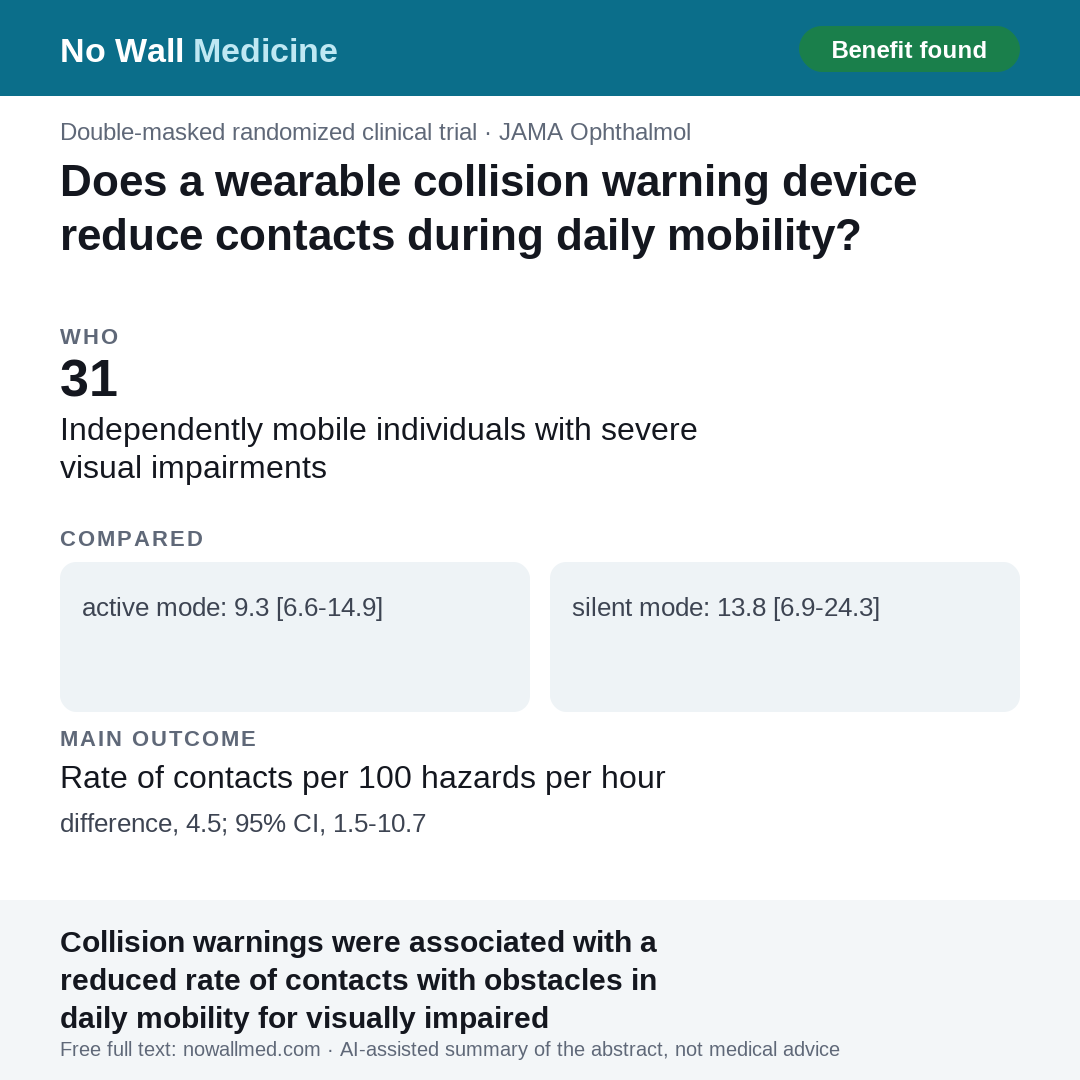
Does a wearable collision warning device reduce contacts during daily mobility?
Who
31
Independently mobile individuals with severe visual impairments
Compared
active mode: 9.3 [6.6-14.9]
silent mode: 13.8 [6.9-24.3]
Main outcome
Rate of contacts per 100 hazards per hour
Result: difference, 4.5; 95% CI, 1.5-10.7
Bottom line: Collision warnings were associated with a reduced rate of contacts with obstacles in daily mobility for visually impaired individuals.
JAMA Ophthalmol · 2021-07-23Download image
Clinical question: Does a wearable collision warning device reduce contacts during daily mobility?
Why it matters: There is scant rigorous evidence about the real-world mobility benefit of electronic mobility aids for people who are blind or visually impaired.
Key points
- The study followed 31 independently mobile individuals with severe visual impairments using a chest-mounted camera device for 4 weeks.
- The median number of contacts per 100 hazards per hour was 9.3 [6.6-14.9] in active mode compared to 13.8 [6.9-24.3] in silent mode.
- The device provided alerts via two vibrating wristbands to help users avoid detected collision threats.
Headline and key points written with AI from the paper’s abstract, with every number checked against it. Read the paper before relying on them.
Was this summary helpful?
Subject terms
Cite this article
Pundlik S, Baliutaviciute V, Moharrer M, Bowers AR, Luo G. Home-Use Evaluation of a Wearable Collision Warning Device for Individuals With Severe Vision Impairments: A Randomized Clinical Trial. JAMA Ophthalmol. 2021. doi:10.1001/jamaophthalmol.2021.2624
Spotted a mistake? Suggest a correction
Top studies every Monday
The week’s key trials and guidelines in your specialties, plus any topics you follow. By email, free.
Get the weekly digest