G-CSF did not improve survival in patients with acute-on-chronic liver failure
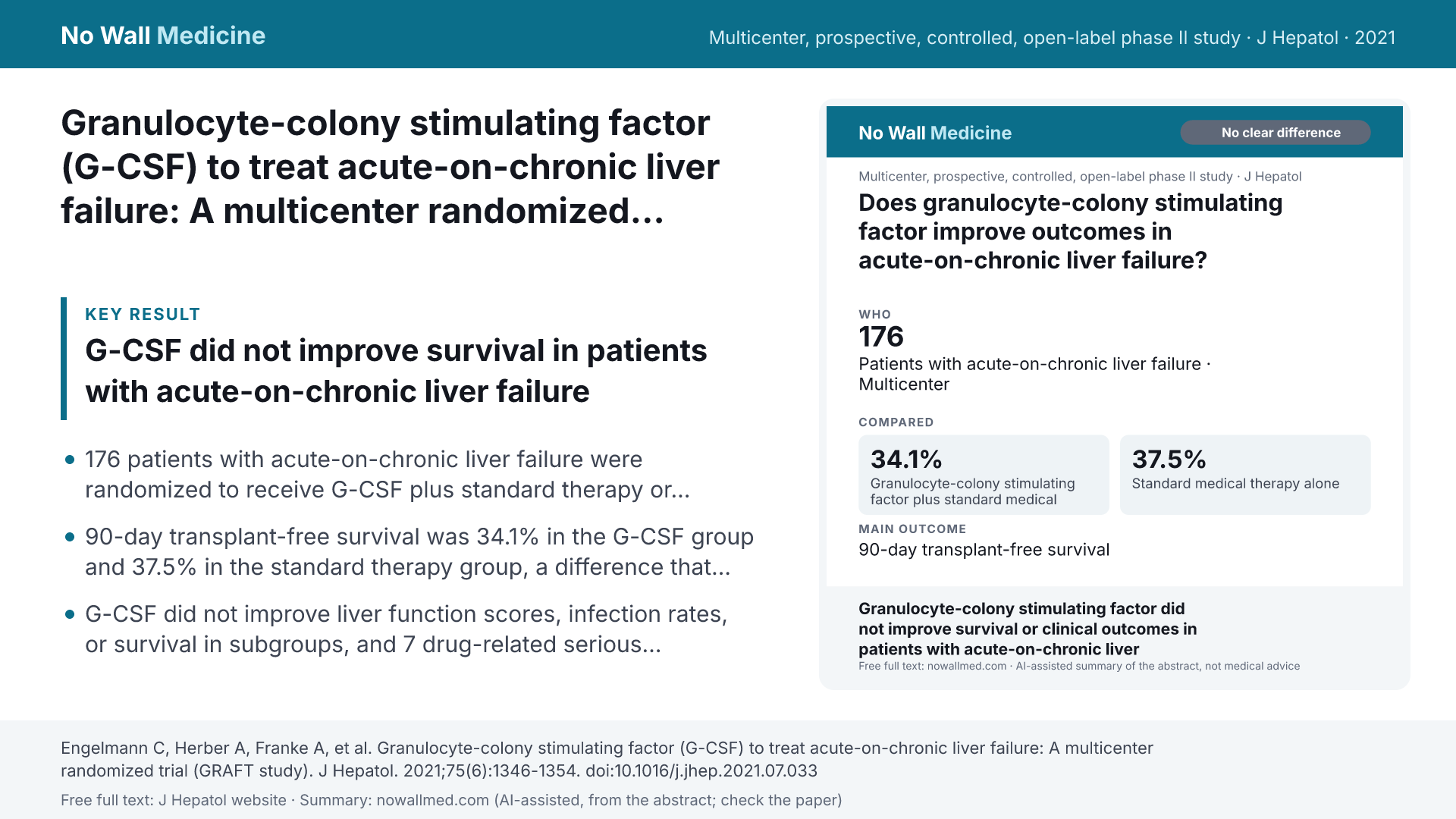
Granulocyte-colony stimulating factor (G-CSF) to treat acute-on-chronic liver failure: A multicenter randomized trial (GRAFT study)
Multicenter, prospective, controlled, open-label phase II studyNo clear difference
Does granulocyte-colony stimulating factor improve outcomes in acute-on-chronic liver failure?
Who
176
Patients with acute-on-chronic liver failure · Multicenter
Compared
34.1%Granulocyte-colony stimulating factor plus standard medical therapy
37.5%Standard medical therapy alone
Main outcome
90-day transplant-free survival
Result: hazard ratio 1.05 (95% CI 0.711-1.551)
Bottom line: Granulocyte-colony stimulating factor did not improve survival or clinical outcomes in patients with acute-on-chronic liver failure.
J Hepatol · 2021-08-05 · Save PNG
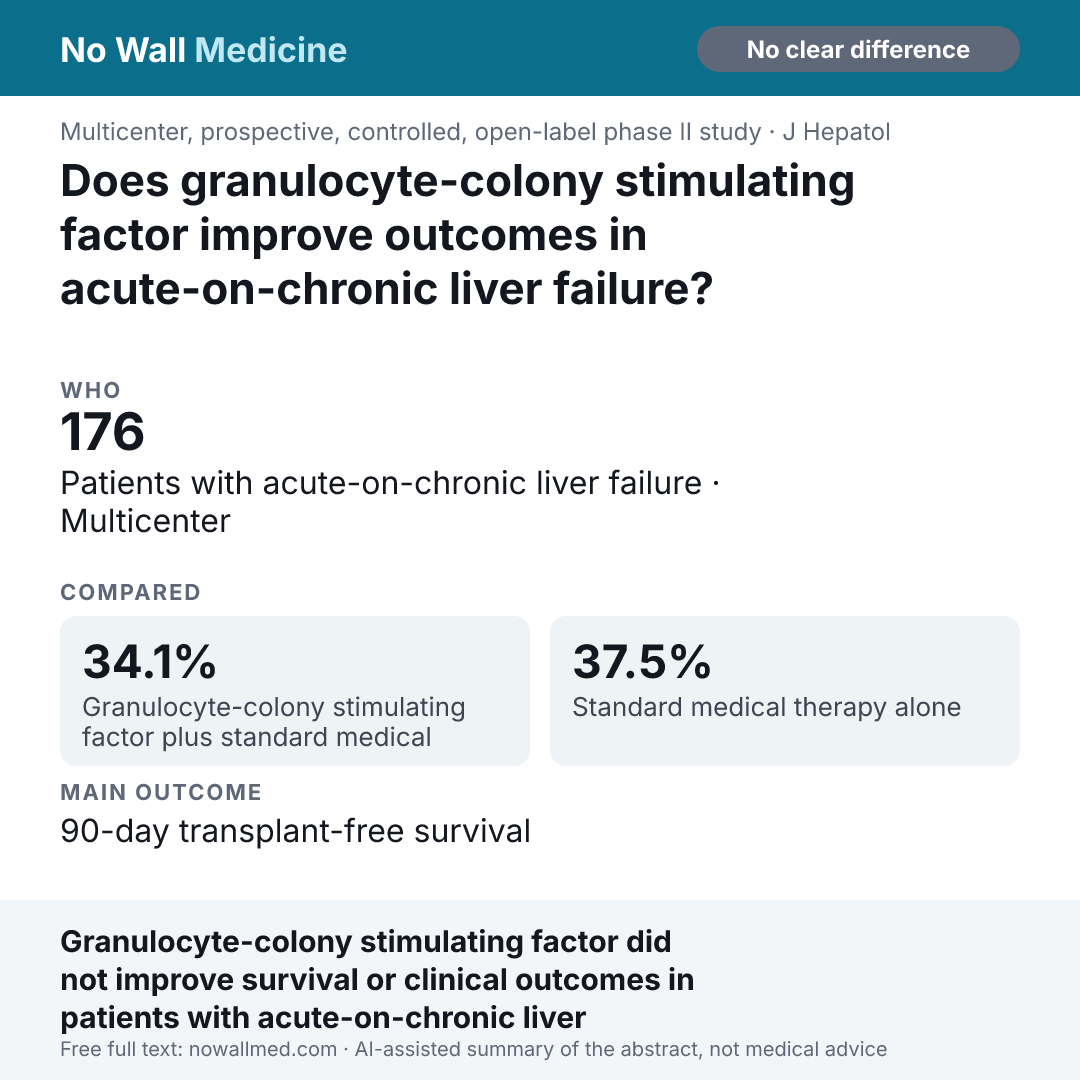
Clinical question: Does granulocyte-colony stimulating factor improve outcomes in acute-on-chronic liver failure?
Why it matters: Previous small single-center studies suggested G-CSF might help, but its safety and efficacy in a larger controlled setting were unproven.
Key points
- 176 patients with acute-on-chronic liver failure were randomized to receive G-CSF plus standard therapy or standard therapy alone.
- 90-day transplant-free survival was 34.1% in the G-CSF group and 37.5% in the standard therapy group, a difference that was not statistically significant.
- G-CSF did not improve liver function scores, infection rates, or survival in subgroups, and 7 drug-related serious adverse reactions occurred.
Limitation the authors note: The study was prematurely terminated due to futility after conditional power calculation.
Headline and key points written with AI from the paper’s abstract, with every number checked against it. Read the paper before relying on them.
Was this summary helpful?
Abstract
Background & aims
Based on positive results from small single center studies, granulocyte-colony stimulating factor (G-CSF) is being widely used for the treatment of patients with acute-on-chronic liver failure (ACLF). Herein, we aimed to evaluate the safety and efficacy of G-CSF in patients with ACLF.Methods
In this multicenter, prospective, controlled, open-label phase II study, 176 patients with ACLF (EASL-CLIF criteria) were randomized to receive G-CSF (5 μg/kg daily for the first 5 days and every third day thereafter until day 26) plus standard medical therapy (SMT) (n = 88) or SMT alone. The primary efficacy endpoint was 90-day transplant-free survival analyzed by Cox regression modeling. The key secondary endpoints were overall and transplant-free survival after 360 days, the development of ACLF-related complications, and the course of liver function scores during the entire observation period.Results
Patients treated with G-CSF had a 90-day transplant-free survival rate of 34.1% compared to 37.5% in the SMT group (hazard ratio [HR] 1.05; 95% CI 0.711-1.551; p = 0.805). Transplant-free and overall survival at 360 days did not differ between the 2 arms (HR 0.998; 95% CI 0.697-1.430; p = 0.992 and HR 1.058; 95% CI 0.727-1.548; p = 0.768, respectively). G-CSF did not improve liver function scores, the occurrence of infections, or survival in subgroups of patients without infections, with alcohol-related ACLF, or with ACLF defined by the APASL criteria. Sixty-one serious adverse events were reported in the G-CSF+SMT group and 57 were reported in the SMT group. In total, 7 drug-related serious adverse reactions occurred in the G-CSF group. The study was prematurely terminated due to futility after conditional power calculation.Conclusions
In contrast to previous findings, G-CSF had no significant beneficial effect on patients with ACLF in this multicenter controlled trial, which suggests that it should not be used as a standard treatment for ACLF. CLINICALTRIALS.Gov number
NCT02669680 LAY SUMMARY: Granulocyte-colony stimulating factor was considered as a novel treatment for acute-on-chronic liver failure (ACLF). We performed the first randomized, multicenter, controlled phase II trial, which showed that G-CSF did not improve survival or other clinical endpoints in patients with ACLF. Therefore, G-CSF should not be used to treat liver disease outside clinical studies.
Abstract reproduced under the article’s CC BY-NC-ND licence.
Subject terms
Headline, design, result, key points, caveat and citation as plain text.
Cite this article
Engelmann C, Herber A, Franke A, et al. Granulocyte-colony stimulating factor (G-CSF) to treat acute-on-chronic liver failure: A multicenter randomized trial (GRAFT study). J Hepatol. 2021. doi:10.1016/j.jhep.2021.07.033
Spotted a mistake? Suggest a correction