Accelerated troponin testing protocol reduces cardiac testing and emergency department stay for suspected heart attacks
Health Care Resource Utilization for Patients With Suspected Myocardial Infarction: A Secondary Analysis of the RACE-IT Randomized Clinical Trial
Stepped-wedge randomized clinical implementation trialBenefit found
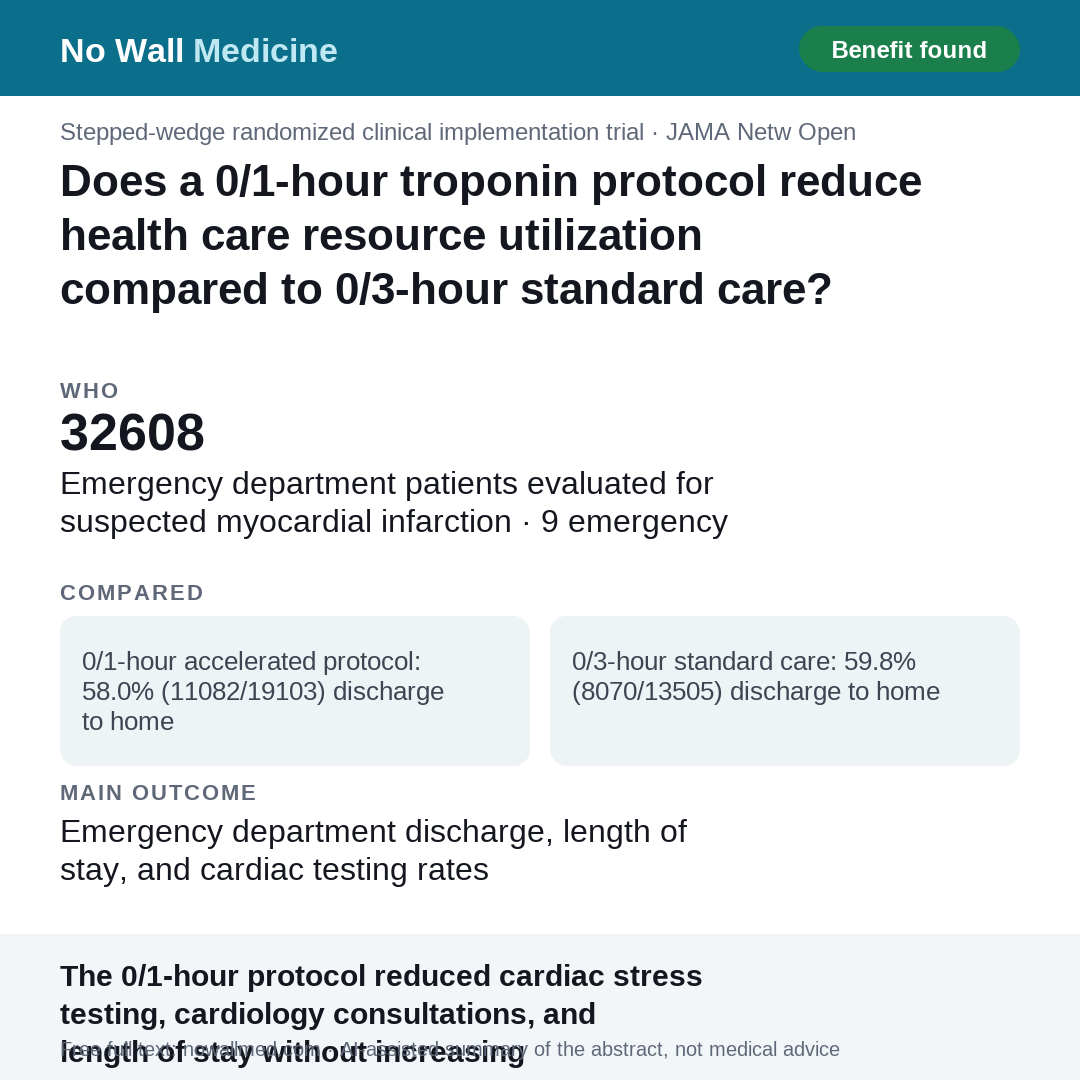
Does a 0/1-hour troponin protocol reduce health care resource utilization compared to 0/3-hour standard care?
Who
32608
Emergency department patients evaluated for suspected myocardial infarction · 9 emergency departments in Michigan
Compared
0/1-hour accelerated protocol: 58.0% (11082/19103) discharge to home
0/3-hour standard care: 59.8% (8070/13505) discharge to home
Main outcome
Emergency department discharge, length of stay, and cardiac testing rates
Result: AOR 0.62 (95% CI 0.49-0.78) for cardiac stress testing
Bottom line: The 0/1-hour protocol reduced cardiac stress testing, cardiology consultations, and length of stay without increasing revascularization rates.
JAMA Netw Open · 2025-04-01Download image
Clinical question: Does a 0/1-hour troponin protocol reduce health care resource utilization compared to 0/3-hour standard care?
Why it matters: It is unknown if using an accelerated 0/1-hour high-sensitivity cardiac troponin I protocol reduces the use of healthcare resources compared to the standard 0/3-hour protocol.
In absolute numbers
0/1-hour accelerated protocol: 58% · 0/3-hour standard care: 59.8% → a difference of 1.8 percentage points, so about 56 people would need the treatment for 1 more to benefit (number needed to treat) over the trial’s follow-up.
Worked out by us from the two group results above, not reported by the authors. Check the paper for the exact outcome and timing.
Key points
- Researchers analyzed 32,608 emergency department patients to compare a 0/1-hour high-sensitivity cardiac troponin I protocol against a traditional 0/3-hour standard care protocol.
- The accelerated protocol was associated with lower rates of cardiac stress testing (3.3% vs 3.9%), cardiology consultations (8.6% vs 12.2%), and left heart catheterization (1.0% vs 1.2%).
- The median emergency department length of stay decreased by 20 minutes, while discharge to home rates and cardiac revascularization rates showed no significant difference.
Headline and key points written with AI from the paper’s abstract, with every number checked against it. Read the paper before relying on them.
Was this summary helpful?
Subject terms
Cite this article
Miller J, Cook B, Gunaga S, Fadel R, Gandolfo C, Emakhu J. Health Care Resource Utilization for Patients With Suspected Myocardial Infarction: A Secondary Analysis of the RACE-IT Randomized Clinical Trial. JAMA Netw Open. 2025. doi:10.1001/jamanetworkopen.2025.6930
Spotted a mistake? Suggest a correction
Top studies every Monday
The week’s key trials and guidelines in your specialties, plus any topics you follow. By email, free.
Get the weekly digest