Heart rate variability biofeedback increased myocardial flow reserve during mental stress in coronary artery disease patients
Heart Rate Variability Biofeedback and Mental Stress Myocardial Flow Reserve: A Randomized Clinical Trial
Randomized clinical trialBenefit found
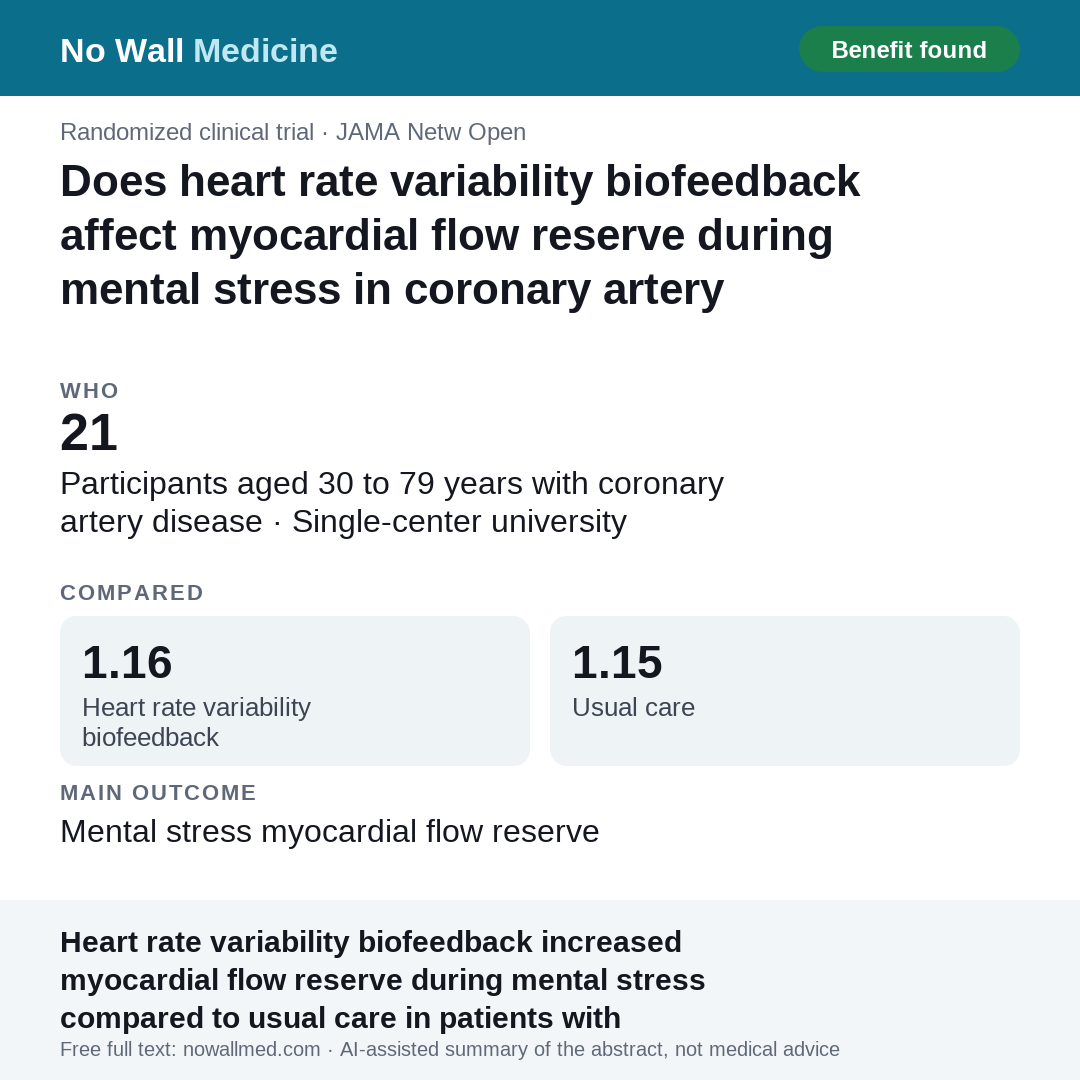
Does heart rate variability biofeedback affect myocardial flow reserve during mental stress in coronary artery disease?
Who
21
Participants aged 30 to 79 years with coronary artery disease · Single-center university hospital
Compared
1.16Heart rate variability biofeedback (95% CI, 1.06-1.26)
1.15Usual care (95% CI, 0.94-1.40)
Main outcome
Mental stress myocardial flow reserve
Result: 0.10 (95% CI, 0.01-0.19) units greater than usual care
Bottom line: Heart rate variability biofeedback increased myocardial flow reserve during mental stress compared to usual care in patients with coronary artery disease.
JAMA Netw Open · 2025-10-01Download image
Clinical question: Does heart rate variability biofeedback affect myocardial flow reserve during mental stress in coronary artery disease?
Why it matters: It is unclear how heart rate variability biofeedback, a self-regulation technique using breathing and visualization, affects blood flow to the heart during psychological stress.
Key points
- The study followed 21 participants aged 30 to 79 years with coronary artery disease, comparing six weeks of heart rate variability biofeedback to usual care.
- The heart rate variability biofeedback group showed a change in myocardial flow reserve that was 0.10 (95% CI, 0.01-0.19) units greater than the usual care group.
- While the difference between groups was significant, the changes within each individual group were not statistically significant.
Limitation the authors note: This was a single-center pilot randomized clinical trial.
Headline and key points written with AI from the paper’s abstract, with every number checked against it. Read the paper before relying on them.
Was this summary helpful?
Subject terms
Cite this article
Shah AJ, Raggi P, She H, Quyyumi AA, Levantsevych O, Johnson M. Heart Rate Variability Biofeedback and Mental Stress Myocardial Flow Reserve: A Randomized Clinical Trial. JAMA Netw Open. 2025. doi:10.1001/jamanetworkopen.2025.38416
Spotted a mistake? Suggest a correction
Top studies every Monday
The week’s key trials and guidelines in your specialties, plus any topics you follow. By email, free.
Get the weekly digest