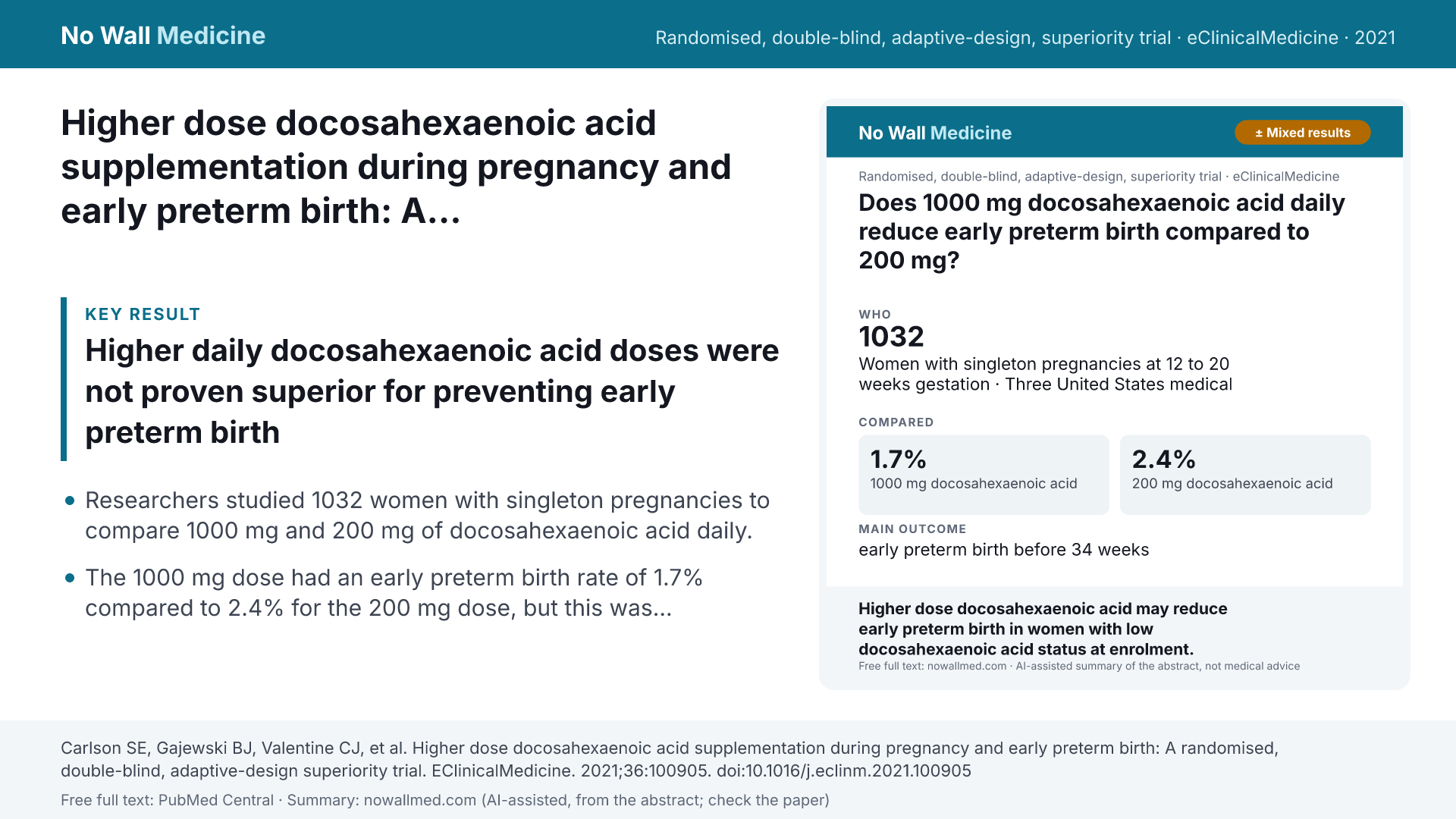
Higher daily docosahexaenoic acid doses were not proven superior for preventing early preterm birth
Higher dose docosahexaenoic acid supplementation during pregnancy and early preterm birth: A randomised, double-blind, adaptive-design superiority trial
Obstetrics & GynecologyAdult and pediatric
Randomised, double-blind, adaptive-design, superiority trialMixed results
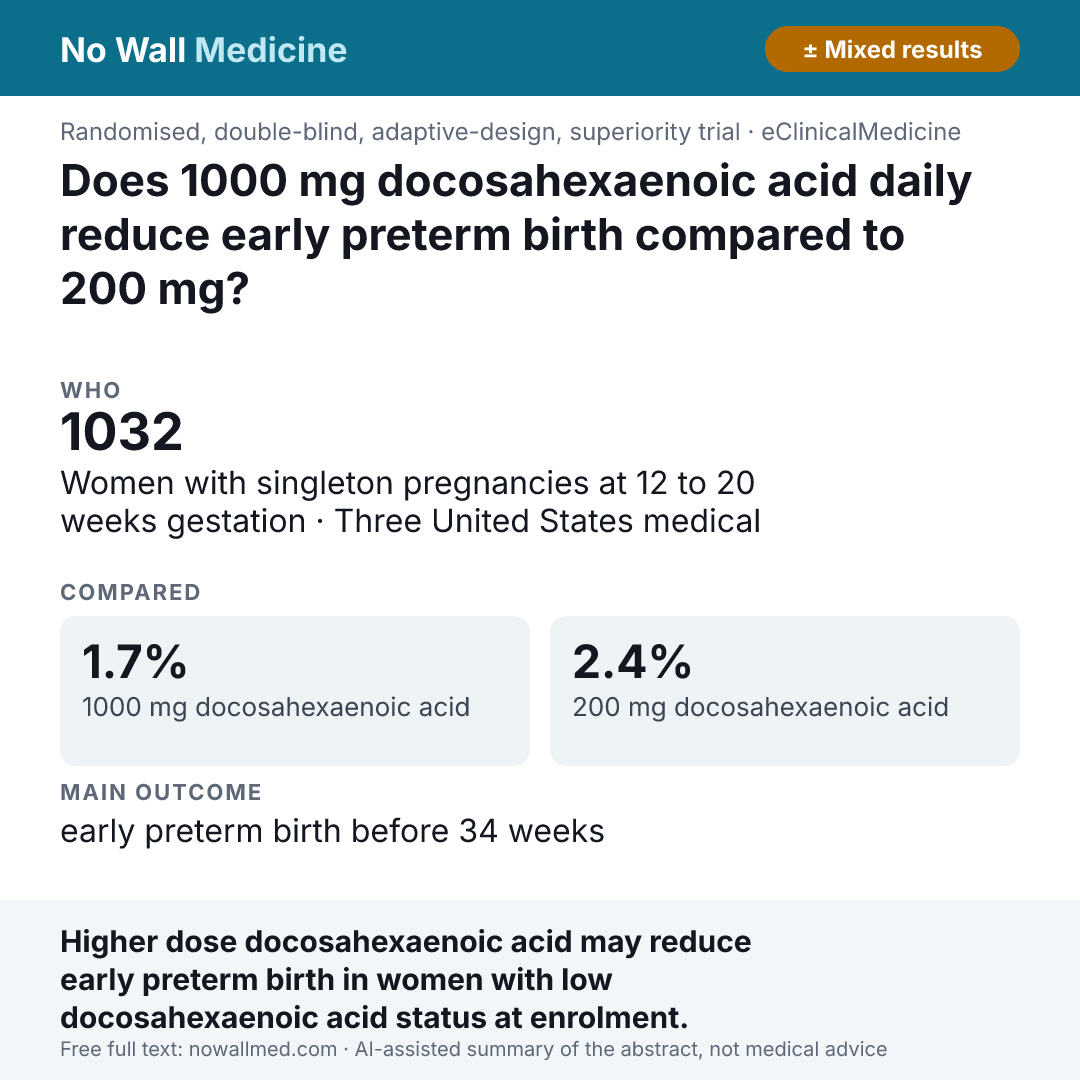
Does 1000 mg docosahexaenoic acid daily reduce early preterm birth compared to 200 mg?
Who
1032
Women with singleton pregnancies at 12 to 20 weeks gestation · Three United States medical centres
Compared
1.7%1000 mg docosahexaenoic acid (9/540)
2.4%200 mg docosahexaenoic acid (12/492)
Main outcome
early preterm birth before 34 weeks
Bottom line: Higher dose docosahexaenoic acid may reduce early preterm birth in women with low docosahexaenoic acid status at enrolment.
Funded by: National Institutes of Health Child Health and Human Development
eClinicalMedicine · 2021-05-17 · Save PNG
Same trial (NCT02626299)
Papers we list that report this registered trial, oldest first. Read a secondary analysis alongside the main results.
- Main results Mixed results
This paper eClinicalMedicine 2021-05 - Related analysis
High dose docosahexaenoic acid adherence was associated with lower rates of early preterm birth Clin Nutr 2023-01 - Related analysis Benefit found
DHA supplementation was associated with lower preterm birth risk and higher birth weight in a clinical trial Clin Nutr 2023-09 - Secondary analysis Benefit found
High-dose omega-3 fatty acids may reduce early preterm birth based on specific genetic variants PLOS Med 2026-10
Clinical question: Does 1000 mg docosahexaenoic acid daily reduce early preterm birth compared to 200 mg?
Key points
- Researchers studied 1032 women with singleton pregnancies to compare 1000 mg and 200 mg of docosahexaenoic acid daily.
- The 1000 mg dose had an early preterm birth rate of 1.7% compared to 2.4% for the 200 mg dose, but this was not statistically significant (pp=0.81).
- In women with low docosahexaenoic acid levels at enrollment, the 1000 mg dose rate was 2.0% versus 4.1% for the 200 mg dose (pp=0.93).
Headline and key points written with AI from the paper’s abstract, with every number checked against it. Read the paper before relying on them.
Was this summary helpful?
Headline, design, result, key points, caveat and citation as plain text.
Cite this article
Carlson SE, Gajewski BJ, Valentine CJ, et al. Higher dose docosahexaenoic acid supplementation during pregnancy and early preterm birth: A randomised, double-blind, adaptive-design superiority trial. EClinicalMedicine. 2021;36:100905. doi:10.1016/j.eclinm.2021.100905
Spotted a mistake? Suggest a correction