Virtual home-based rehabilitation improved motor and cognitive function in patients after a stroke
Home-based (virtual) rehabilitation improves motor and cognitive function for stroke patients: a randomized controlled trial of the Elements (EDNA-22) system
Randomized controlled trialBenefit found
Does the EDNA-22 system improve motor and cognitive function in stroke patients?
Who
17
Acute-care patients with upper-extremity dysfunction following unilateral stroke
Compared
EDNA training: g = 0.90 for Box and Blocks Task
Active control: g = 0.42 for 9-Hole Pegboard Test
Main outcome
Motor, cognitive, and functional behaviour performance
Bottom line: Home-based EDNA-22 training yields significant gains in motor and cognitive performance compared to active control training.
J Neuroeng Rehabil · 2021-11-25Download image
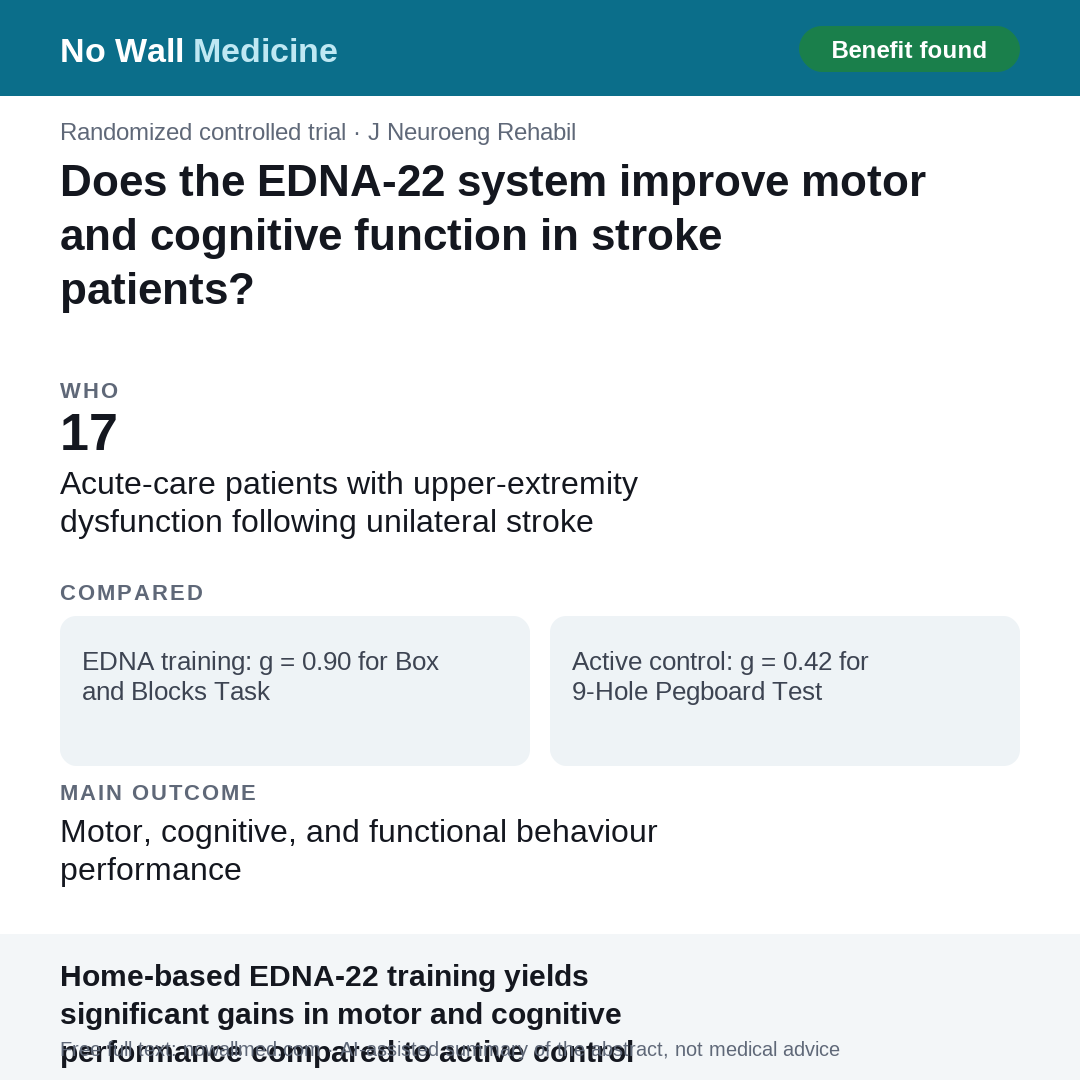
Clinical question: Does the EDNA-22 system improve motor and cognitive function in stroke patients?
Why it matters: Home-based rehabilitation of arm function is a significant gap in service provision for adults who have experienced a stroke.
Key points
- The study compared 17 acute-care patients with arm dysfunction using either the EDNA-22 virtual system or an active control training program for 8 weeks.
- The EDNA group showed significant improvements in the Box and Blocks Task (g = 0.90) and the Montreal Cognitive Assessment (g = 0.70).
- Both groups showed mild-to-moderate effects on the 9-Hole Pegboard Test, while functional behavior improvements in the EDNA group were not significant.
Limitation the authors note: The changes in performance were corroborated only tentatively in the reports of caregivers.
Headline and key points written with AI from the paper’s abstract, with every number checked against it. Read the paper before relying on them.
Was this summary helpful?
Subject terms
Cite this article
Wilson PH, Rogers JM, Vogel K, Steenbergen B, McGuckian TB, Duckworth J. Home-based (virtual) rehabilitation improves motor and cognitive function for stroke patients: a randomized controlled trial of the Elements (EDNA-22) system. J Neuroeng Rehabil. 2021. doi:10.1186/s12984-021-00956-7
Spotted a mistake? Suggest a correction
Top studies every Monday
The week’s key trials and guidelines in your specialties, plus any topics you follow. By email, free.
Get the weekly digest