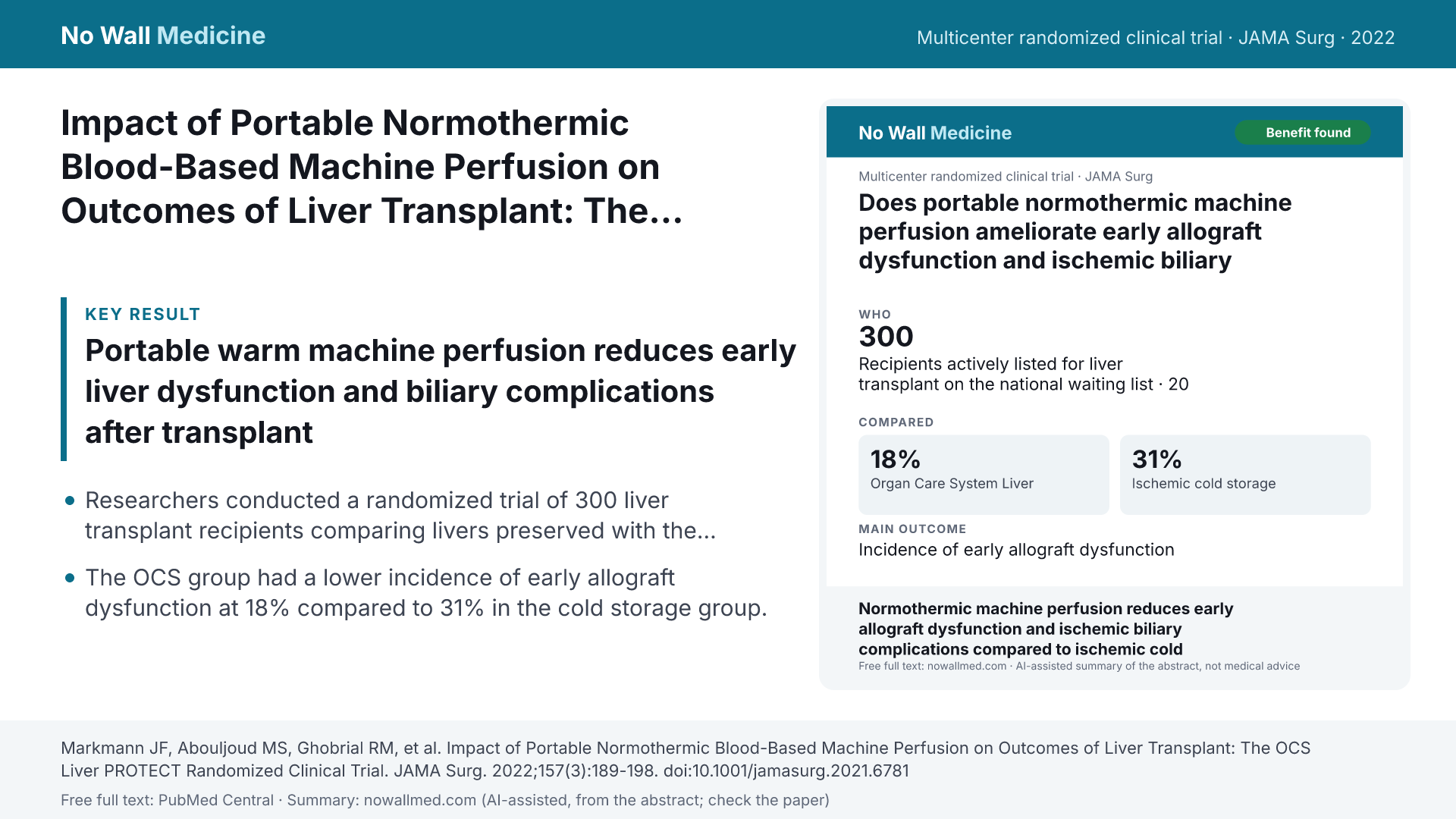
Portable warm machine perfusion reduces early liver dysfunction and biliary complications after transplant
Impact of Portable Normothermic Blood-Based Machine Perfusion on Outcomes of Liver Transplant: The OCS Liver PROTECT Randomized Clinical Trial
Multicenter randomized clinical trialBenefit found
Does portable normothermic machine perfusion ameliorate early allograft dysfunction and ischemic biliary complications?
Who
300
Recipients actively listed for liver transplant on the national waiting list · 20 US liver transplant programs
Compared
18%Organ Care System Liver
31%Ischemic cold storage
Main outcome
Incidence of early allograft dysfunction
Bottom line: Normothermic machine perfusion reduces early allograft dysfunction and ischemic biliary complications compared to ischemic cold storage.
JAMA Surg · 2022-01-06Download image
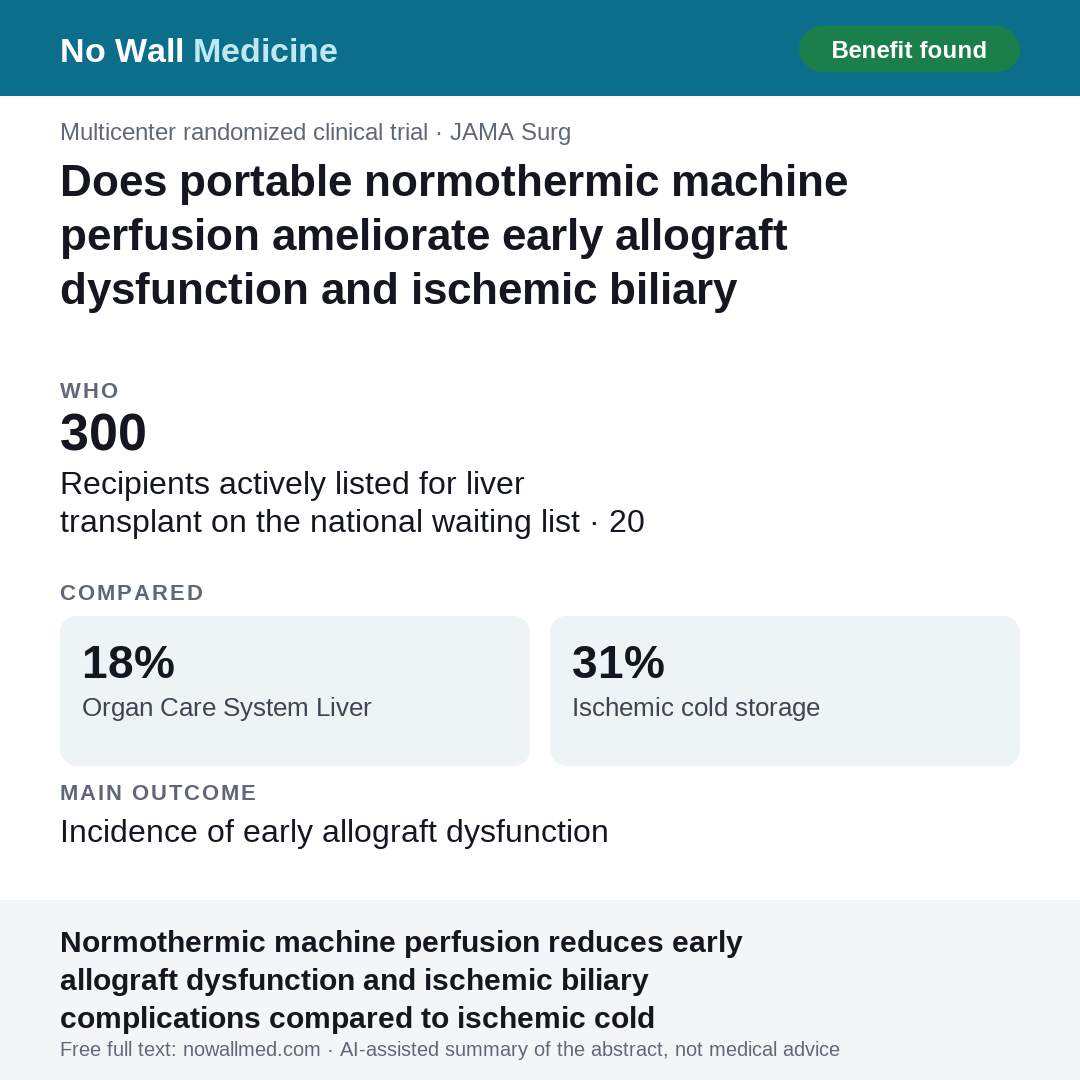
Clinical question: Does portable normothermic machine perfusion ameliorate early allograft dysfunction and ischemic biliary complications?
Why it matters: Ischemic cold storage of livers for transplant is associated with serious posttransplant complications and the underuse of available donor livers.
Key points
- Researchers conducted a randomized trial of 300 liver transplant recipients comparing livers preserved with the Organ Care System (OCS) to those using conventional ischemic cold storage.
- The OCS group had a lower incidence of early allograft dysfunction at 18% compared to 31% in the cold storage group.
- Livers preserved with OCS were associated with lower rates of ischemic biliary complications at 6 months (1.3% vs 8.5%) and 12 months (2.6% vs 9.9%).
Headline and key points written with AI from the paper’s abstract, with every number checked against it. Read the paper before relying on them.
Was this summary helpful?
Subject terms
Cite this article
Markmann JF, Abouljoud MS, Ghobrial RM, et al. Impact of Portable Normothermic Blood-Based Machine Perfusion on Outcomes of Liver Transplant: The OCS Liver PROTECT Randomized Clinical Trial. JAMA Surg. 2022. doi:10.1001/jamasurg.2021.6781
Spotted a mistake? Suggest a correction