Robotic assistance levels and initial impairment severity influence upper limb recovery after a stroke
Impact of the robotic-assistance level on upper extremity function in stroke patients receiving adjunct robotic rehabilitation: sub-analysis of a randomized clinical trial
Sub-analysis of a randomized clinical trialMixed results
Does robotic assistance level affect upper extremity function in stroke survivors?
Who
30
30 subacute stroke survivors with mild-to-severe upper extremity hemiplegia
Compared
high robotic assistance group
low robotic assistance group
Main outcome
upper extremity functional improvement
Bottom line: Robotic assistance level and impairment severity interact to affect upper extremity functional outcomes.
Limitation: This was an exploratory sub-analysis of a previous randomized clinical trial.
J Neuroeng Rehabil · 2022-02-25Download image
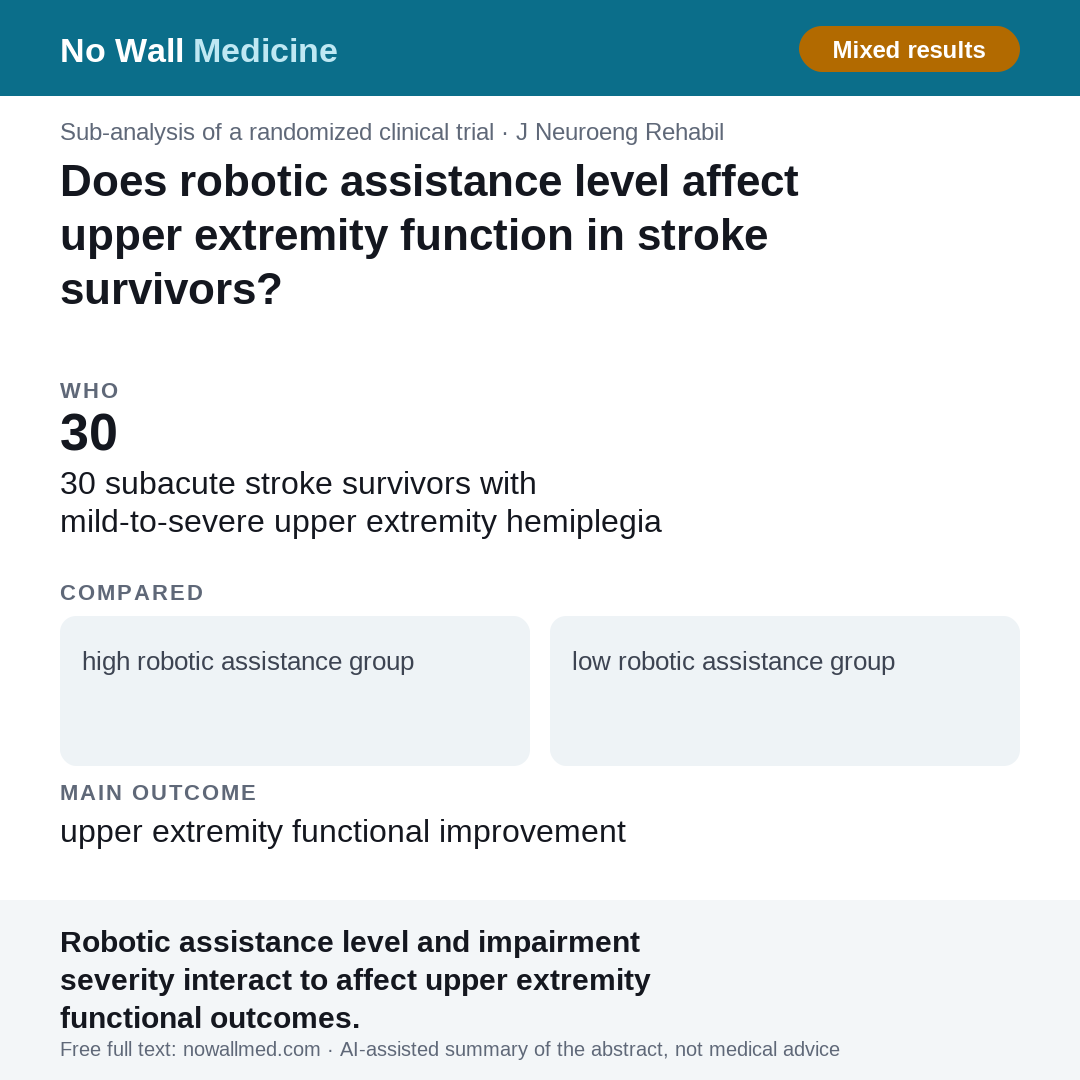
Clinical question: Does robotic assistance level affect upper extremity function in stroke survivors?
Why it matters: It is unclear whether the amount of assistance provided by a robot during training affects how much upper limb function improves in stroke survivors.
Key points
- Researchers analyzed 30 subacute stroke survivors with mild-to-severe upper extremity hemiplegia, or one-sided weakness, who received robotic therapy.
- Significant interactions between assistance levels and impairment severity were found for proximal Fugl-Meyer Assessment, Wolf Motor Function Test performance-time, and Wolf Motor Function Test functional assessment scale.
- The overall Fugl-Meyer Assessment score did not show a significant difference between the high and low robotic assistance groups (p = 0.103).
Headline and key points written with AI from the paper’s abstract, with every number checked against it. Read the paper before relying on them.
Was this summary helpful?
Subject terms
Cite this article
Takebayashi T, Takahashi K, Okita Y, Kubo H, Hachisuka K, Domen K. Impact of the robotic-assistance level on upper extremity function in stroke patients receiving adjunct robotic rehabilitation: sub-analysis of a randomized clinical trial. J Neuroeng Rehabil. 2022. doi:10.1186/s12984-022-00986-9
Spotted a mistake? Suggest a correction
Top studies every Monday
The week’s key trials and guidelines in your specialties, plus any topics you follow. By email, free.
Get the weekly digest