Contralaterally controlled functional electrical stimulation showed different effects on hand dexterity and impairment after stroke
Contralaterally Controlled Functional Electrical Stimulation for Upper Extremity Recovery Following Stroke: A Multisite Randomized Controlled Trial
Assessor-blinded randomized controlled trialMixed results
Does contralaterally controlled functional electrical stimulation improve hand function in chronic stroke survivors?
Who
132
Stroke survivors with chronic hand hemiparesis and moderate-to-severe weakness · 4 sites in the United States
Compared
Contralaterally controlled functional electrical stimulation
Cyclic neuromuscular electrical stimulation
Task-oriented training
Main outcome
Change in the box and blocks test score
Bottom line: Contralaterally controlled functional electrical stimulation reduced impairment more than other treatments but did not improve dexterity more.
Stroke · 2025-11-13Download image
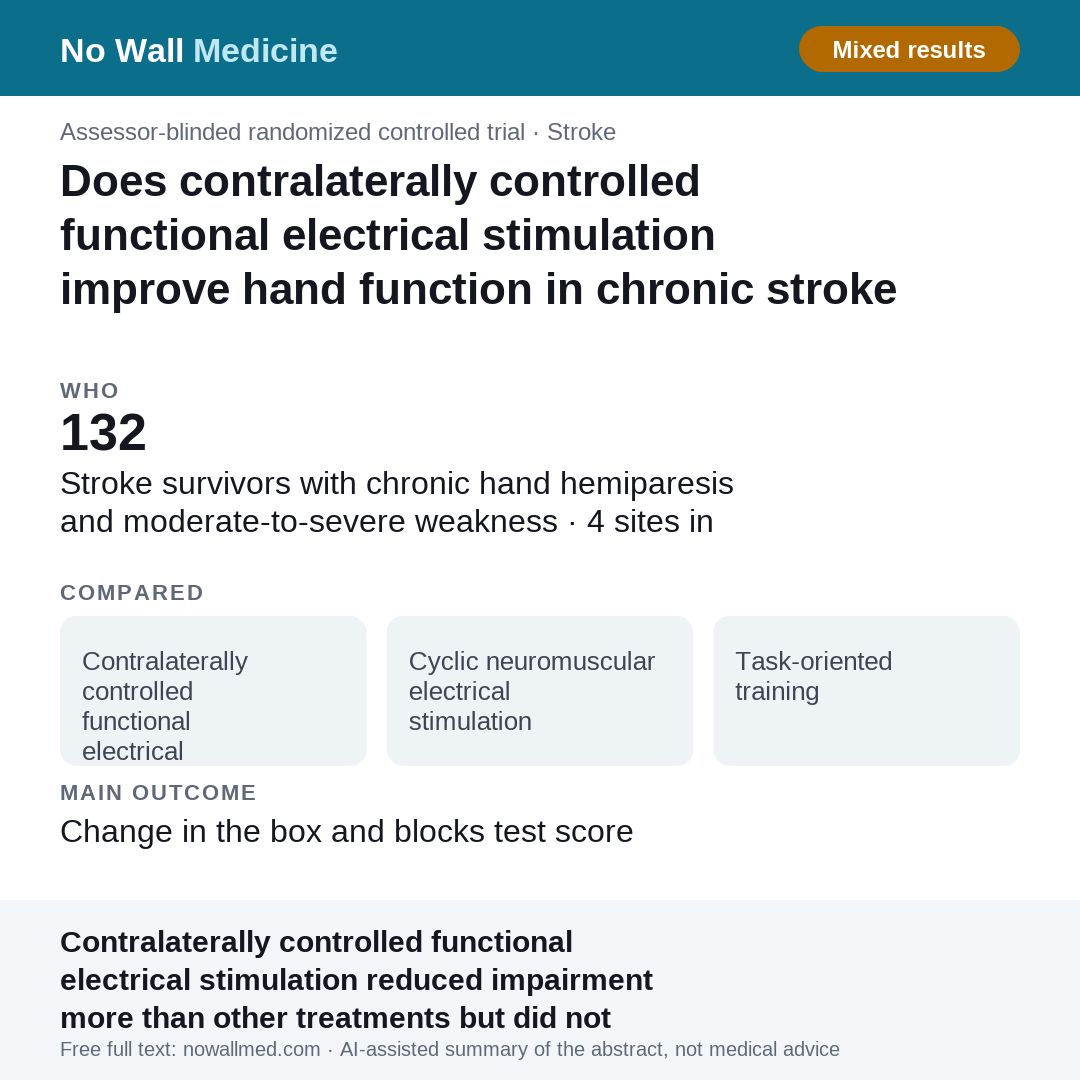
Clinical question: Does contralaterally controlled functional electrical stimulation improve hand function in chronic stroke survivors?
Why it matters: It is unclear how contralaterally controlled functional electrical stimulation compares to cyclic neuromuscular electrical stimulation or task-oriented training for hand recovery in chronic stroke survivors.
Key points
- Researchers studied 113 stroke survivors with chronic hand weakness across 4 sites, comparing contralaterally controlled functional electrical stimulation, cyclic neuromuscular electrical stimulation, and task-oriented training.
- Contralaterally controlled functional electrical stimulation showed no significant difference in box and blocks test scores at 6 months compared to the other two treatments.
- Contralaterally controlled functional electrical stimulation was associated with higher Fugl-Meyer scores and a 67% responder rate compared to 42% for cyclic neuromuscular electrical stimulation.
Headline and key points written with AI from the paper’s abstract, with every number checked against it. Read the paper before relying on them.
Topics
Cite this article
Knutson JS, Friedl AS, Hansen KM, Harley MY, Hogan SD, Cunningham DA. Contralaterally Controlled Functional Electrical Stimulation for Upper Extremity Recovery Following Stroke: A Multisite Randomized Controlled Trial. Stroke. 2025. doi:10.1161/STROKEAHA.125.052891
Spotted a mistake? Suggest a correction