Community health education groups were associated with better maternal and newborn health outcomes in Kenya
Improving maternal, newborn and child health outcomes through a community-based women's health education program: a cluster randomised controlled trial in western Kenya
Cluster randomised controlled trialBenefit found
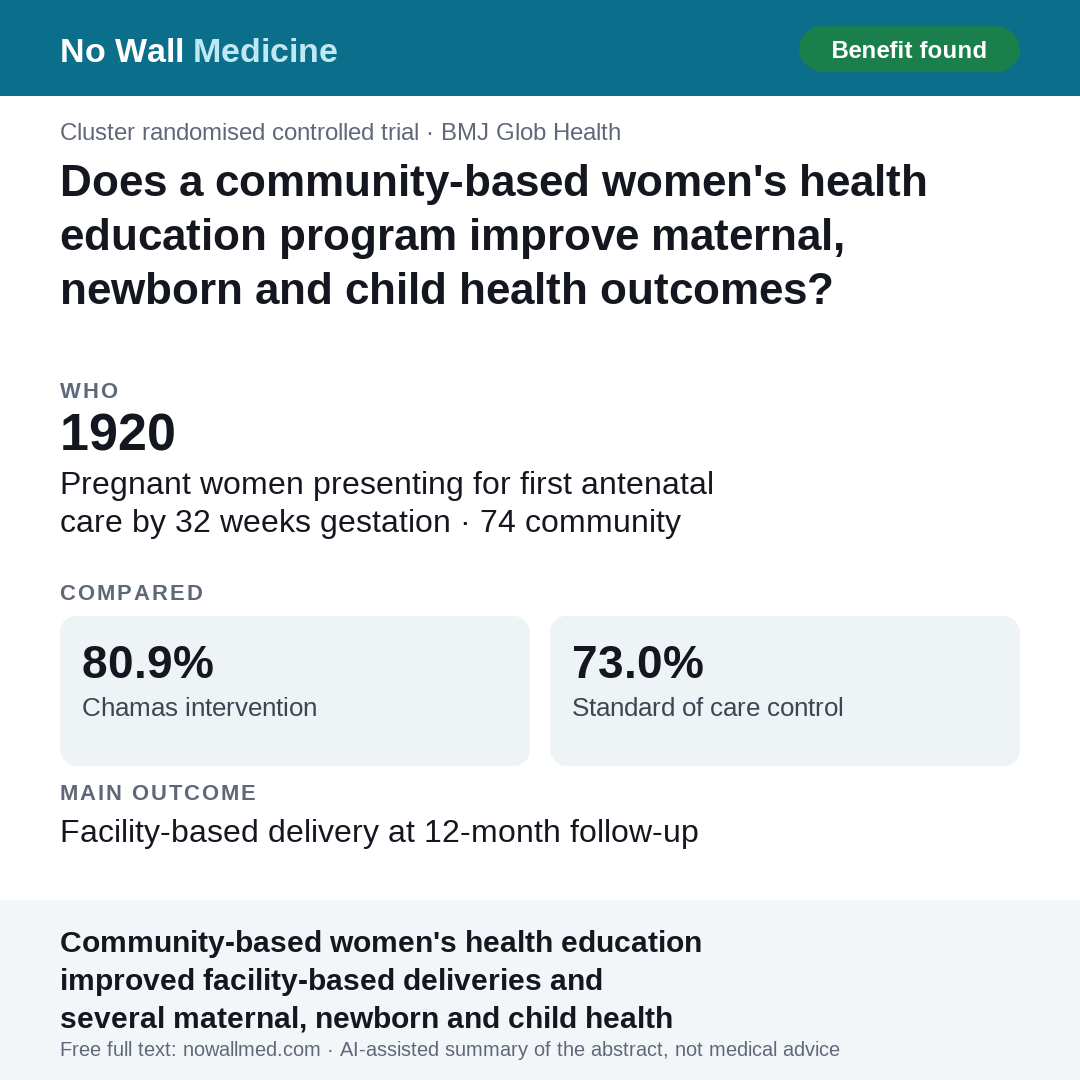
Does a community-based women's health education program improve maternal, newborn and child health outcomes?
Who
1920
Pregnant women presenting for first antenatal care by 32 weeks gestation · 74 community health units in Trans Nzoia County, Kenya
Compared
80.9%Chamas intervention
73.0%Standard of care control
Main outcome
Facility-based delivery at 12-month follow-up
Result: risk difference 7.4%, 95% CI 3.0 to 12.5
Bottom line: Community-based women's health education improved facility-based deliveries and several maternal, newborn and child health outcomes.
BMJ Glob Health · 2020-12-09Download image
Clinical question: Does a community-based women's health education program improve maternal, newborn and child health outcomes?
Why it matters: Evidence regarding the effectiveness of community-based women's health education programs for maternal, newborn, and child health is lacking in sub-Saharan Africa.
Key points
- Researchers conducted a cluster randomized controlled trial involving 1920 pregnant women across 74 community health units in western Kenya.
- The group-based education program was associated with higher rates of exclusive breastfeeding, contraceptive adoption, and infant immunization completion.
- Facility-based deliveries were 80.9% in the intervention group compared to 73.0% in the control group, though the difference was not statistically significant (p=0.057).
Headline and key points written with AI from the paper’s abstract, with every number checked against it. Read the paper before relying on them.
Was this summary helpful?
Abstract
Introduction
Community-based women's health education groups may improve maternal, newborn and child health (MNCH); however, evidence from sub-Saharan Africa is lacking. Chamas for Change (Chamas) is a community health volunteer (CHV)-led, group-based health education programme for pregnant and postpartum women in western Kenya. We evaluated Chamas' effect on facility-based deliveries and other MNCH outcomes. Methods
We conducted a cluster randomised controlled trial involving 74 community health units in Trans Nzoia County. We included pregnant women who presented to health facilities for their first antenatal care visits by 32 weeks gestation. We randomised clusters 1:1 without stratification or matching; we masked data collectors, investigators and analysts to allocation. Intervention clusters were invited to bimonthly, group-based, CHV-led health lessons (Chamas); control clusters had monthly, individual CHV home visits (standard of care). The primary outcome was facility-based delivery at 12-month follow-up. We conducted an intention-to-treat approach with multilevel logistic regression models using individual-level data. Results
Between 27 November 2017 and 8 March 2018, we enrolled 1920 participants from 37 intervention and 37 control clusters. A total of 1550 (80.7%) participants completed the study with 822 (82.5%) and 728 (78.8%) in the intervention and control arms, respectively. Facility-based deliveries improved in the intervention arm (80.9% vs 73.0%; risk difference (RD) 7.4%, 95% CI 3.0 to 12.5, OR=1.58, 95% CI 0.97 to 2.55, p=0.057). Chamas participants also demonstrated higher rates of 48 hours postpartum visits (RD 15.3%, 95% CI 12.0 to 19.6), exclusive breastfeeding (RD 11.9%, 95% CI 7.2 to 16.9), contraceptive adoption (RD 7.2%, 95% CI 2.6 to 12.9) and infant immunisation completion (RD 15.6%, 95% CI 11.5 to 20.9). Conclusion
Chamas participation was associated with significantly improved MNCH outcomes compared with the standard of care. This trial contributes robust data from sub-Saharan Africa to support community-based, women's health education groups for MNCH in resource-limited settings.Trial registration numberNCT03187873.
Abstract reproduced under the article’s CC BY NC licence.
Subject terms
Cite this article
Maldonado LY, Bone J, Scanlon ML, Anusu G, Chelagat S, Jumah A. Improving maternal, newborn and child health outcomes through a community-based women's health education program: a cluster randomised controlled trial in western Kenya. BMJ Glob Health. 2020. doi:10.1136/bmjgh-2020-003370
Spotted a mistake? Suggest a correction
Top studies every Monday
The week’s key trials and guidelines in your specialties, plus any topics you follow. By email, free.
Get the weekly digest