Prenatal exposure to ADHD medications was not linked to neurodevelopmental disorders in offspring
In utero exposure to methylphenidate, amphetamines and atomoxetine and offspring neurodevelopmental disorders - a population-based cohort study and meta-analysis
Psychiatry & Mental HealthAdult and pediatric
Population-based cohort study and meta-analysisNo clear difference
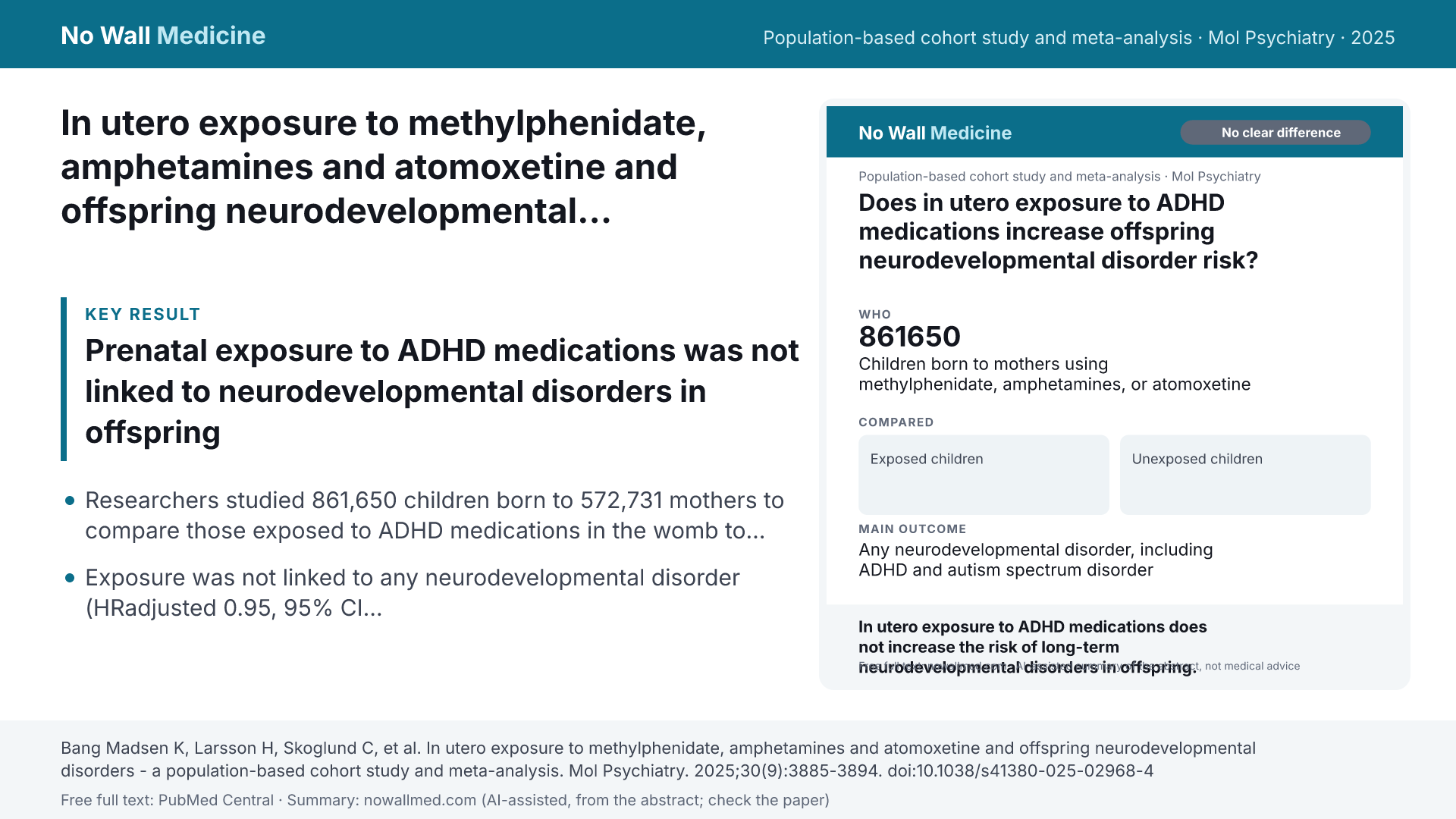
Does in utero exposure to ADHD medications increase offspring neurodevelopmental disorder risk?
Who
861650
Children born to mothers using methylphenidate, amphetamines, or atomoxetine · Sweden and Denmark
Compared
Exposed children
Unexposed children
Main outcome
Any neurodevelopmental disorder, including ADHD and autism spectrum disorder
Result: pooled hazard ratio 1.00 (95% CI 0.83;1.20)
Bottom line: In utero exposure to ADHD medications does not increase the risk of long-term neurodevelopmental disorders in offspring.
Mol Psychiatry · 2025-03-27Download image

Clinical question: Does in utero exposure to ADHD medications increase offspring neurodevelopmental disorder risk?
Why it matters: It is unknown if exposure to methylphenidate, amphetamines, and atomoxetine during pregnancy increases the risk of neurodevelopmental disorders in children.
Key points
- Researchers studied 861,650 children born to 572,731 mothers to compare those exposed to ADHD medications in the womb to those whose mothers stopped medication before conception.
- Exposure was not linked to any neurodevelopmental disorder (HRadjusted 0.95, 95% CI 0.82-1.11), attention-deficit/hyperactivity disorder (HRadjusted 0.92, 95% CI 0.78-1.08), or autism spectrum disorder (HRadjusted 0.86, 95% CI 0.63-1.18).
- A meta-analysis combining this data with a Danish study showed a pooled hazard ratio of 1.00, 95% CI 0.83-1.20 for any neurodevelopmental disorder.
Headline and key points written with AI from the paper’s abstract, with every number checked against it. Read the paper before relying on them.
Was this summary helpful?
Subject terms
Cite this article
Bang Madsen K, Larsson H, Skoglund C, et al. In utero exposure to methylphenidate, amphetamines and atomoxetine and offspring neurodevelopmental disorders - a population-based cohort study and meta-analysis. Mol Psychiatry. 2025. doi:10.1038/s41380-025-02968-4
Spotted a mistake? Suggest a correction