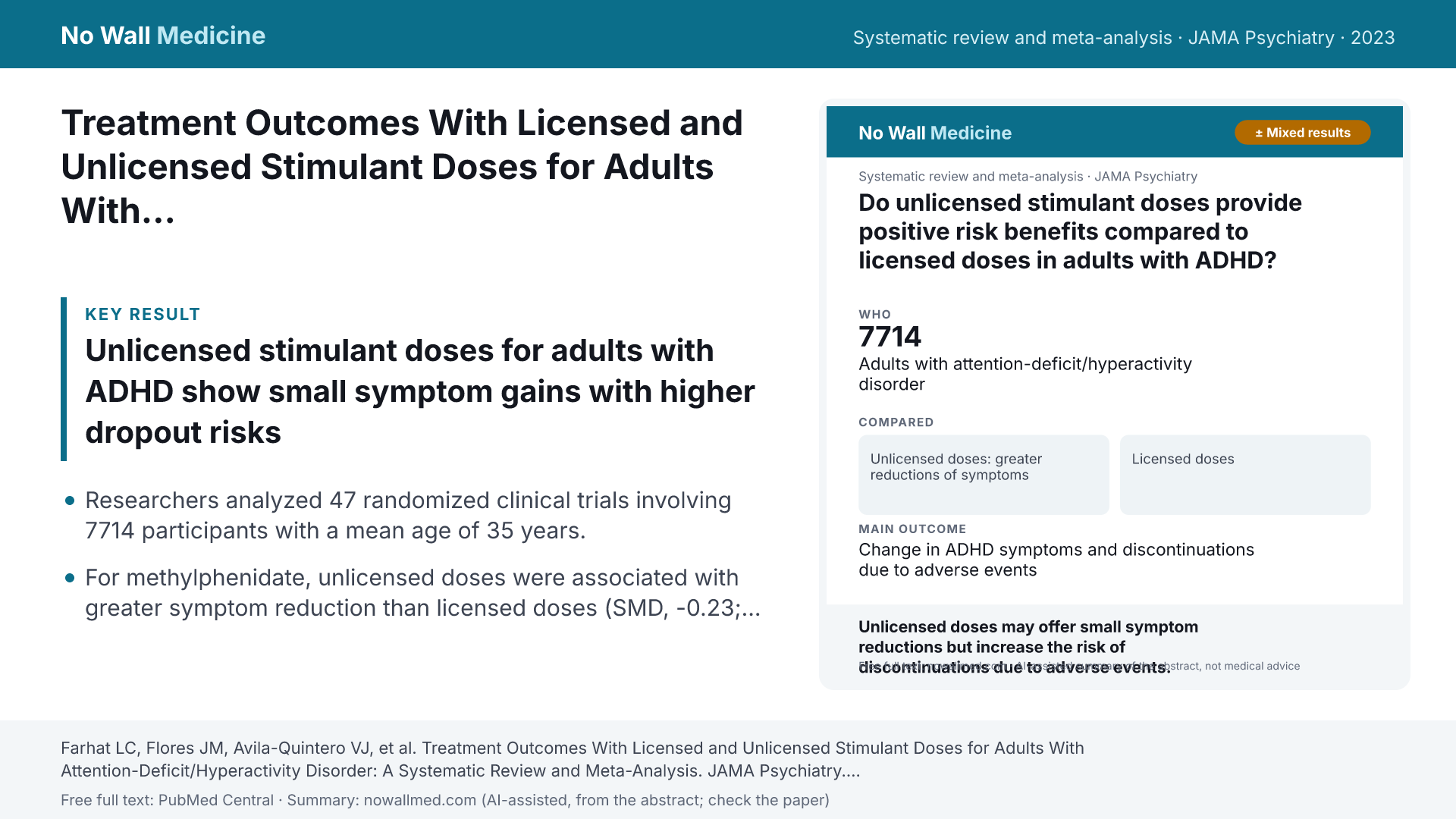
Unlicensed stimulant doses for adults with ADHD show small symptom gains with higher dropout risks
Treatment Outcomes With Licensed and Unlicensed Stimulant Doses for Adults With Attention-Deficit/Hyperactivity Disorder: A Systematic Review and Meta-Analysis
Systematic review and meta-analysisMixed results
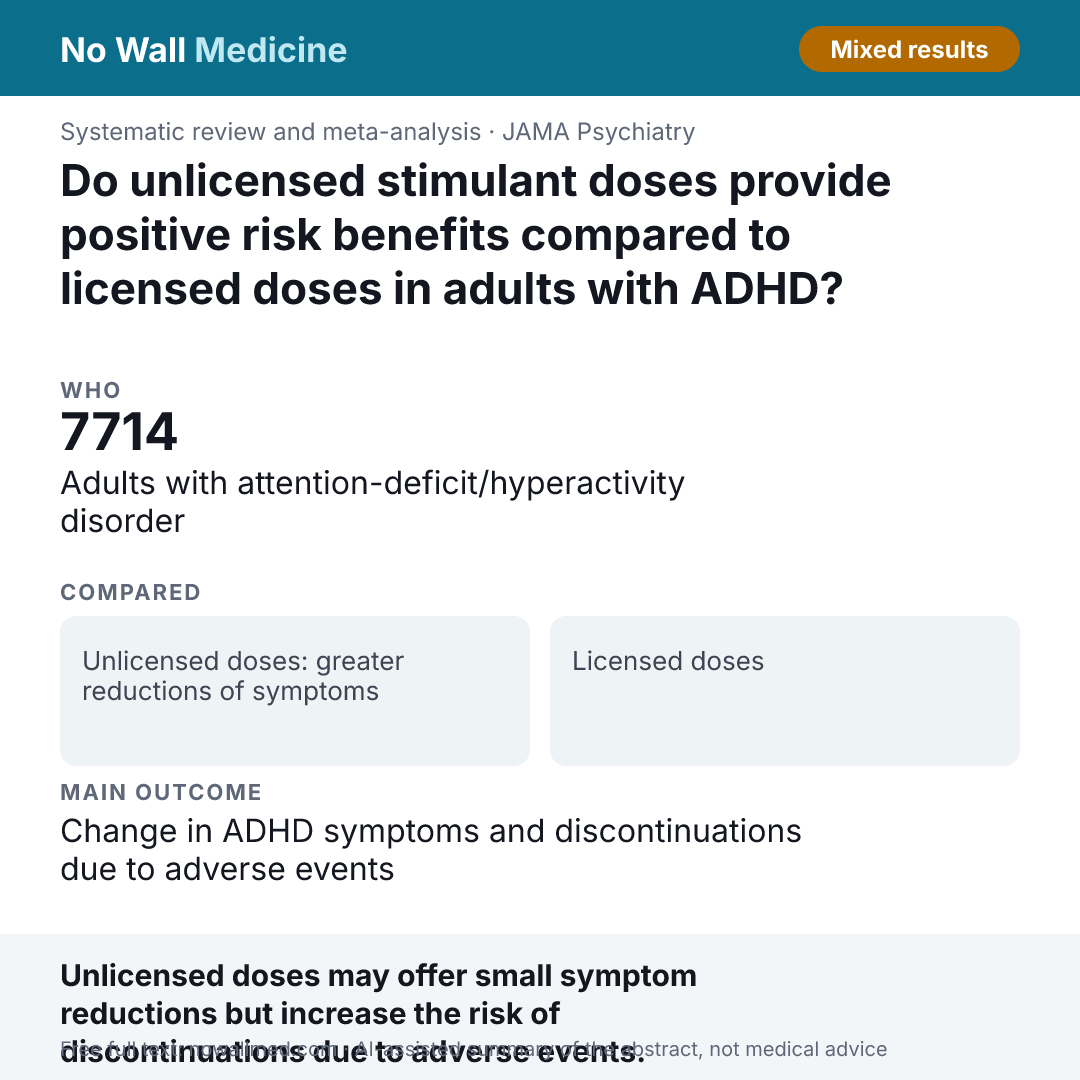
Do unlicensed stimulant doses provide positive risk benefits compared to licensed doses in adults with ADHD?
Who
7714
Adults with attention-deficit/hyperactivity disorder
Compared
Unlicensed doses: greater reductions of symptoms
Licensed doses
Main outcome
Change in ADHD symptoms and discontinuations due to adverse events
Result: standardized mean difference -0.23 (95% CI -0.44 to -0.02)
Bottom line: Unlicensed doses may offer small symptom reductions but increase the risk of discontinuations due to adverse events.
Limitation: The findings are averages and will not generalize to every patient.
JAMA Psychiatry · 2023-10-25 · Save PNG
Clinical question: Do unlicensed stimulant doses provide positive risk benefits compared to licensed doses in adults with ADHD?
Key points
- Researchers analyzed 47 randomized clinical trials involving 7714 participants with a mean age of 35 years.
- For methylphenidate, unlicensed doses were associated with greater symptom reduction than licensed doses (SMD, -0.23; 95% CI, -0.44 to -0.02), but with an increased risk of dropping out due to side effects (odds ratio, 2.02; 95% CI, 1.19-3.43).
- For amphetamines, dose increases did not indicate additional symptom reductions and no difference was found between unlicensed and licensed doses (SMD, -0.08; 95% CI, -0.24 to 0.08).
Limitation the authors note: The findings are based on group averages and will not generalize to every patient.
Headline and key points written with AI from the paper’s abstract, with every number checked against it. Read the paper before relying on them.
Was this summary helpful?
Subject terms
Headline, design, result, key points, caveat and citation as plain text.
Cite this article
Farhat LC, Flores JM, Avila-Quintero VJ, et al. Treatment Outcomes With Licensed and Unlicensed Stimulant Doses for Adults With Attention-Deficit/Hyperactivity Disorder: A Systematic Review and Meta-Analysis. JAMA Psychiatry. 2024;81(2):157-166. doi:10.1001/jamapsychiatry.2023.3985
Spotted a mistake? Suggest a correction