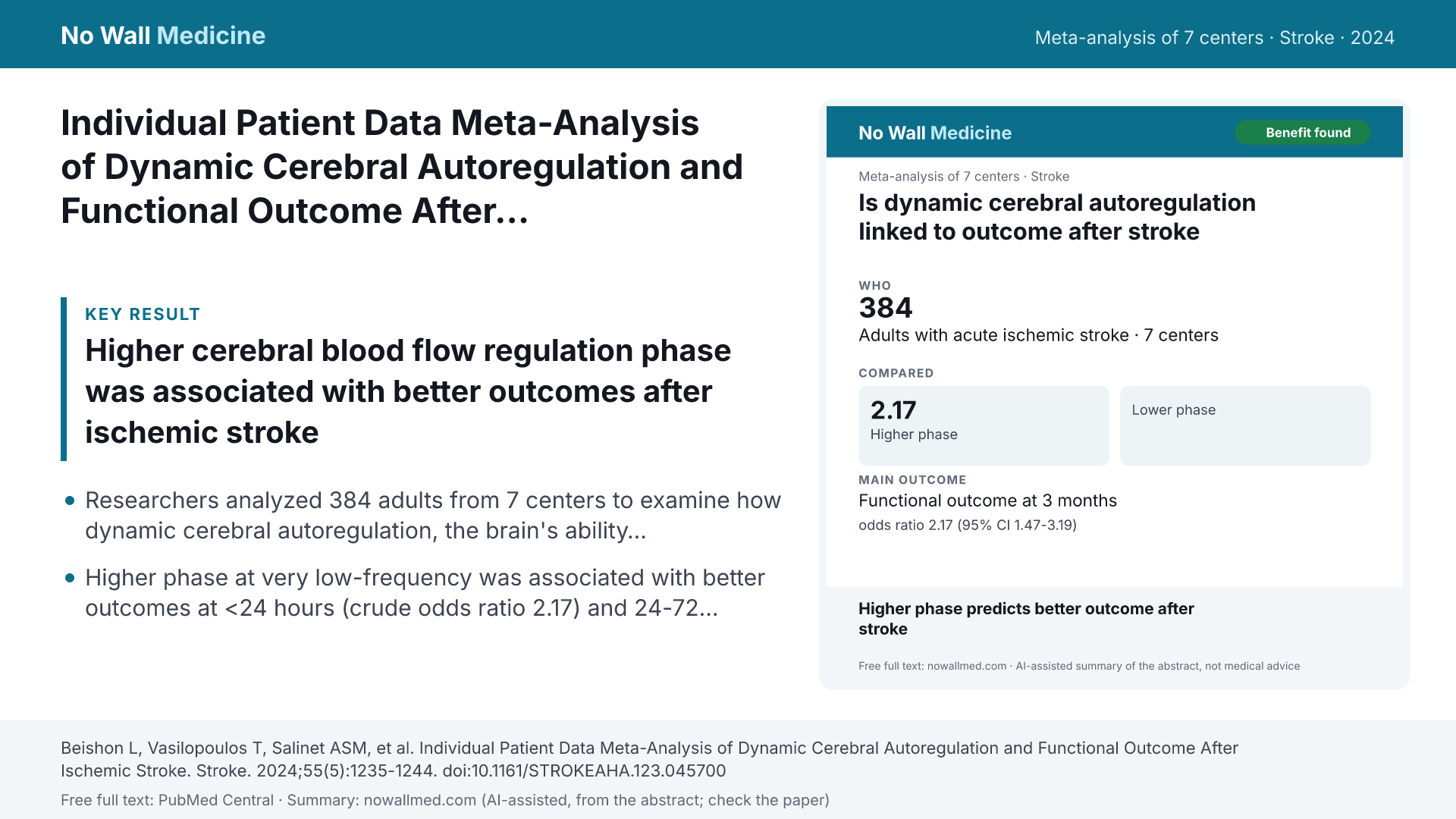
Higher cerebral blood flow regulation phase was associated with better outcomes after ischemic stroke
Individual Patient Data Meta-Analysis of Dynamic Cerebral Autoregulation and Functional Outcome After Ischemic Stroke
Meta-analysis of 7 centersBenefit found
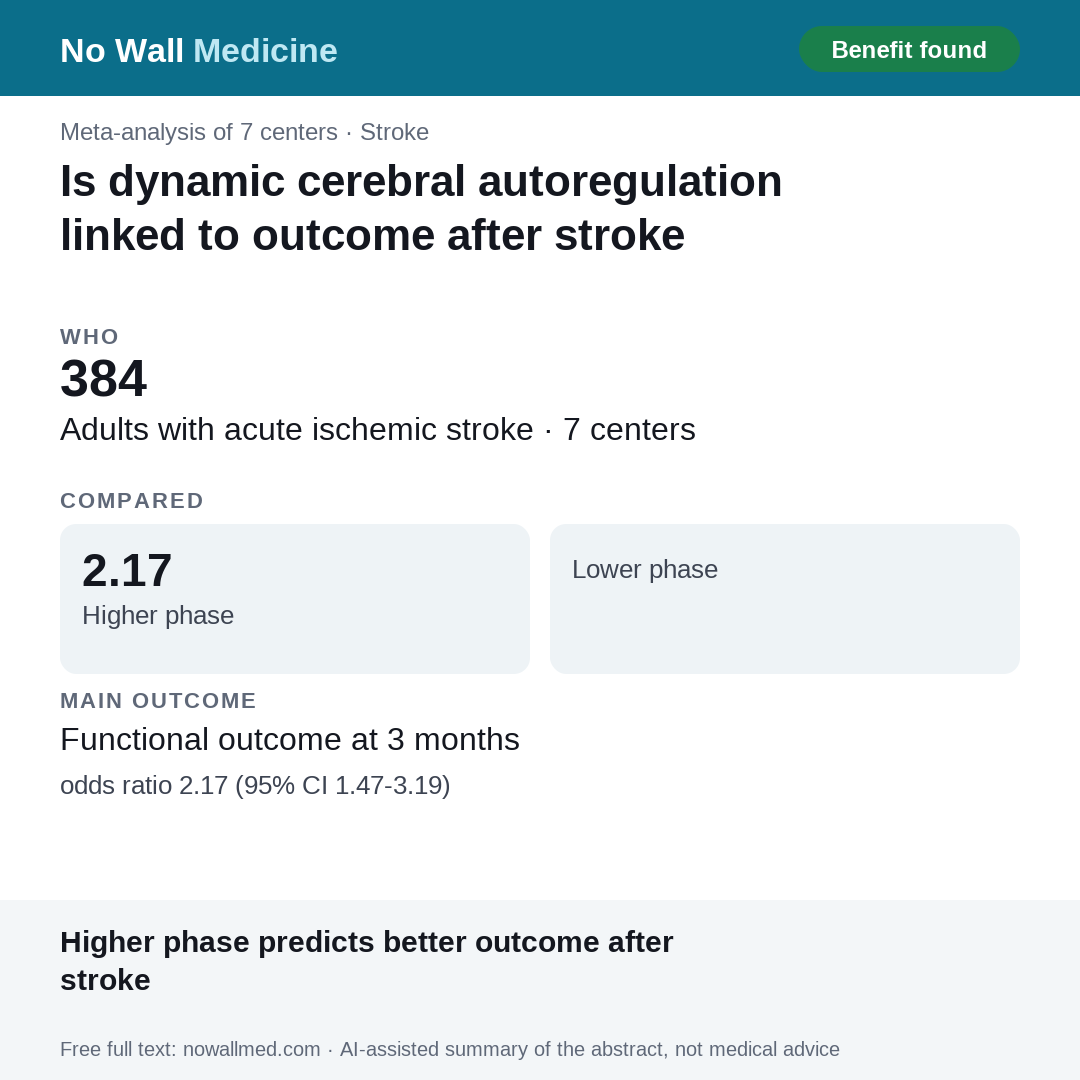
Is dynamic cerebral autoregulation linked to outcome after stroke
Who
384
Adults with acute ischemic stroke · 7 centers
Compared
2.17Higher phase (95% CI 1.47-3.19)
Lower phase
Main outcome
Functional outcome at 3 months
Result: odds ratio 2.17 (95% CI 1.47-3.19)
Bottom line: Higher phase predicts better outcome after stroke
Limitation: small sample sizes and heterogeneity
Stroke · 2024-03-21Download image
Why it matters: The relationship between dynamic cerebral autoregulation and functional recovery after an acute ischemic stroke remains unclear due to small sample sizes and inconsistent previous findings.
Key points
- Researchers analyzed 384 adults from 7 centers to examine how dynamic cerebral autoregulation, the brain's ability to maintain constant blood flow, relates to recovery after stroke.
- Higher phase at very low-frequency was associated with better outcomes at <24 hours (crude odds ratio 2.17) and 24-72 hours (crude odds ratio 1.95).
- Higher phase at low-frequency was associated with better outcomes at 3 months (crude odds ratio 3.03) after the stroke occurred.
Headline and key points written with AI from the paper’s abstract, with every number checked against it. Read the paper before relying on them.
Was this summary helpful?
Subject terms
Cite this article
Beishon L, Vasilopoulos T, Salinet ASM, Levis B, Barnes S, Hills E. Individual Patient Data Meta-Analysis of Dynamic Cerebral Autoregulation and Functional Outcome After Ischemic Stroke. Stroke. 2024. doi:10.1161/STROKEAHA.123.045700
Spotted a mistake? Suggest a correction