Induction chemotherapy followed by chemoradiotherapy improves survival in locally advanced cervical cancer
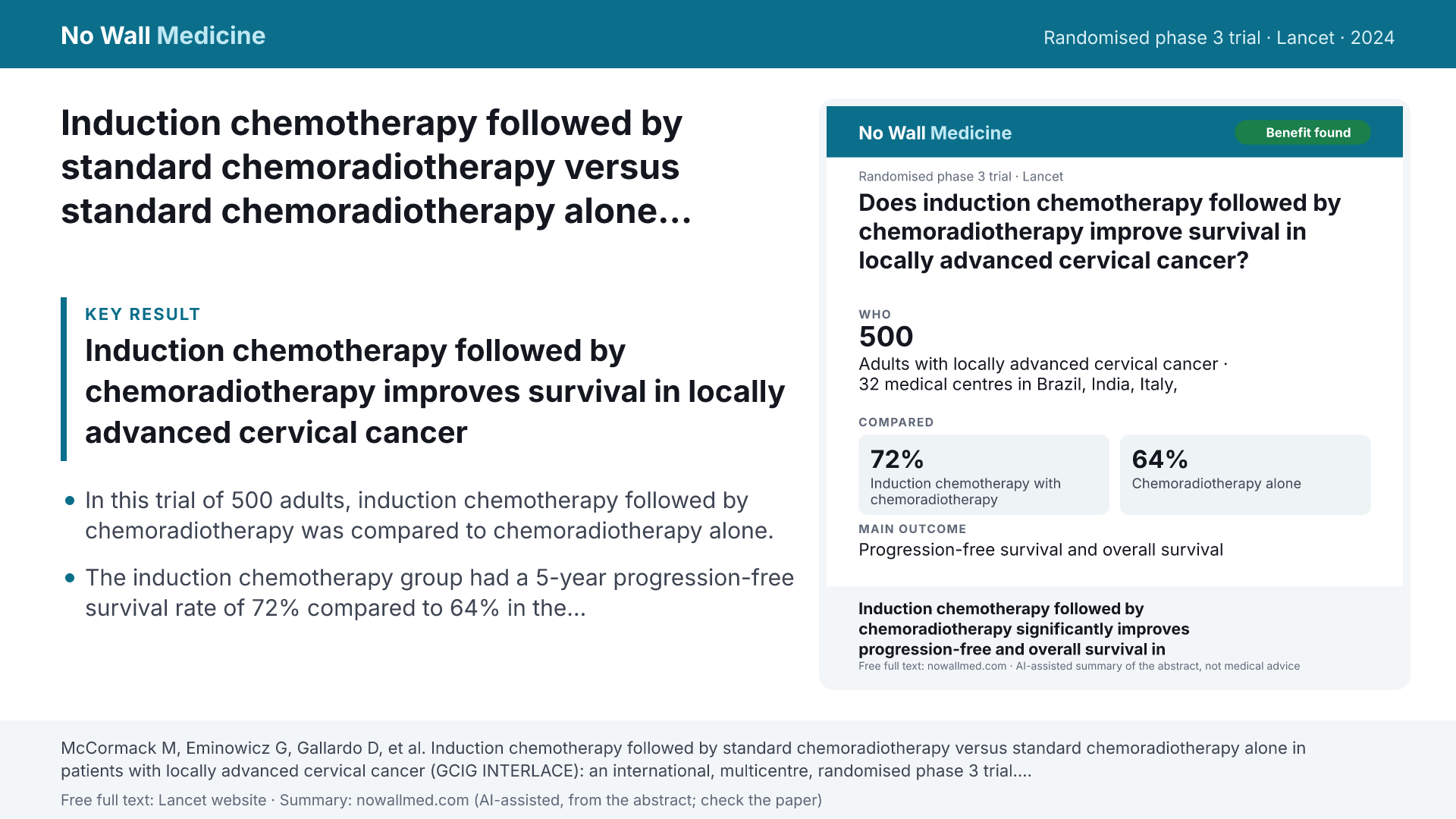
Induction chemotherapy followed by standard chemoradiotherapy versus standard chemoradiotherapy alone in patients with locally advanced cervical cancer (GCIG INTERLACE): an international, multicentre, randomised phase 3 trial
Randomised phase 3 trialBenefit found
Does induction chemotherapy followed by chemoradiotherapy improve survival in locally advanced cervical cancer?
Who
500
Adults with locally advanced cervical cancer · 32 medical centres in Brazil, India, Italy, Mexico, and UK
Compared
72%Induction chemotherapy with chemoradiotherapy (5-year progression-free survival)
64%Chemoradiotherapy alone (5-year progression-free survival)
Main outcome
Progression-free survival and overall survival
Result: hazard ratio 0·65 (95% CI 0·46-0·91)
Bottom line: Induction chemotherapy followed by chemoradiotherapy significantly improves progression-free and overall survival in locally advanced cervical cancer.
Funded by: Cancer Research UK and University College London
Lancet · 2024-10-14Download image
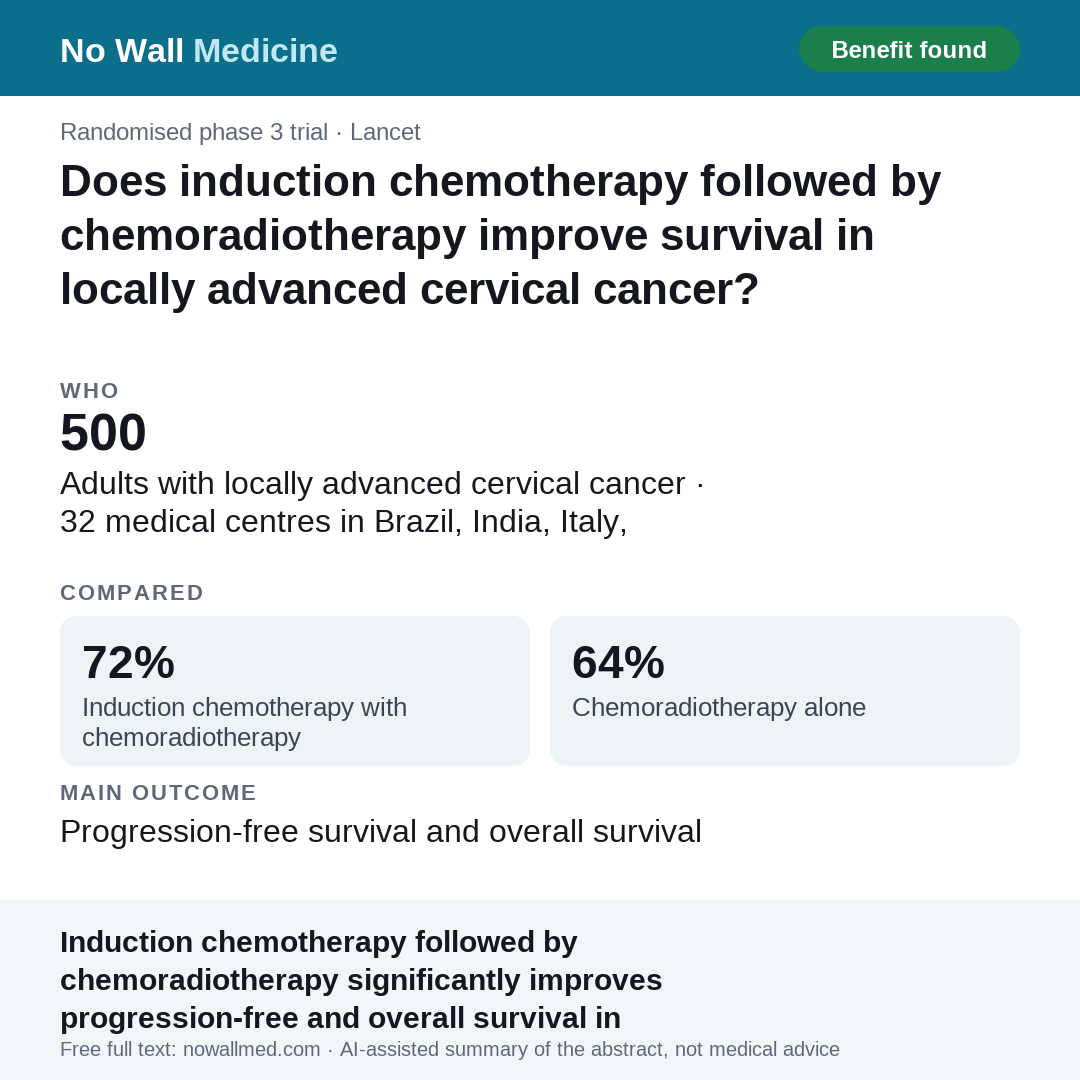
Clinical question: Does induction chemotherapy followed by chemoradiotherapy improve survival in locally advanced cervical cancer?
Why it matters: Many patients with locally advanced cervical cancer still relapse and die from metastatic disease despite receiving the standard of care, which is chemoradiotherapy.
Key points
- In this trial of 500 adults, induction chemotherapy followed by chemoradiotherapy was compared to chemoradiotherapy alone.
- The induction chemotherapy group had a 5-year progression-free survival rate of 72% compared to 64% in the chemoradiotherapy alone group.
- The 5-year overall survival rate was 80% in the induction chemotherapy group and 72% in the chemoradiotherapy alone group.
Headline and key points written with AI from the paper’s abstract, with every number checked against it. Read the paper before relying on them.
Was this summary helpful?
Abstract
Background
Locally advanced cervical cancer is treated with chemoradiotherapy (standard of care), but many patients still relapse and die from metastatic disease. We investigated chemoradiotherapy with or without induction chemotherapy to determine whether induction chemotherapy improves both progression-free survival and overall survival. Methods
The INTERLACE trial was a multicentre, randomised phase 3 trial done at 32 medical centres in Brazil, India, Italy, Mexico, and the UK. Adults (aged ≥18 years) with locally advanced cervical cancer (FIGO 2008 stage IB1 disease with nodal involvement, or stage IB2, IIA, IIB, IIIB, or IVA disease) were randomly assigned (1:1), by minimisation, using a central electronic system, to standard cisplatin-based chemoradiotherapy (once-a-week intravenous cisplatin 40 mg/m2 for 5 weeks with 45·0-50·4 Gy external beam radiotherapy delivered in 20-28 fractions plus brachytherapy to achieve a minimum total 2 Gy equivalent dose of 78-86 Gy) alone or induction chemotherapy (once-a-week intravenous carboplatin area under the receiver operator curve 2 and paclitaxel 80 mg/m2 for 6 weeks) followed by standard cisplatin-based chemoradiotherapy. Stratification factors were recruiting site, stage, nodal status, three-dimensional conformal radiotherapy or intensity modulated radiotherapy, age, tumour size, and histology (squamous vs non-squamous). Primary endpoints were progression-free survival and overall survival within the intention-to-treat population. This trial is registered with ClinicalTrials.gov, NCT01566240, and EUDRACT, 2011-001300-35. Findings
Between Nov 8, 2012, and Nov 17, 2022, 500 eligible patients were enrolled and randomly assigned to the chemoradiotherapy alone group (n=250) or the induction chemotherapy with chemoradiotherapy group. Of 500 patients, 354 (70%) had stage IIB disease and 56 (11%) stage IIIB disease. Pelvic lymph nodes were positive in 215 (43%) patients. 230 (92%) patients who received induction chemotherapy had at least five cycles. Median interval between induction chemotherapy and chemoradiotherapy was 7 days. Four or more cycles of cisplatin were given to 212 (85%) participants in the induction chemotherapy with chemoradiotherapy group and to 224 (90%) of participants in the chemoradiotherapy alone group. 462 (92%) participants received external beam radiotherapy and brachytherapy with a median overall treatment time of 45 days. After a median follow-up of 67 months, 5-year progression-free survival rates were 72% in the induction chemotherapy with chemoradiotherapy group and 64% in the chemoradiotherapy alone group with a hazard ratio (HR) of 0·65 (95% CI 0·46-0·91, p=0·013). 5-year overall survival rates were 80% in the induction chemotherapy with chemoradiotherapy group and 72% in the chemoradiotherapy alone group, with an HR of 0·60 (95% CI 0·40-0·91, p=0·015). Grade 3 or greater adverse events were reported in 147 (59%) of 250 individuals in the induction chemotherapy with chemoradiotherapy group versus 120 (48%) of 250 individuals in the chemoradiotherapy alone group. Interpretation
Short-course induction chemotherapy followed by chemoradiotherapy significantly improves survival of patients with locally advanced cervical cancer. Funding
Cancer Research UK and University College London-University College London Hospitals Biomedical Research Centre.
Abstract reproduced under the article’s CC BY licence.
Subject terms
Cite this article
McCormack M, Eminowicz G, Gallardo D, et al. Induction chemotherapy followed by standard chemoradiotherapy versus standard chemoradiotherapy alone in patients with locally advanced cervical cancer (GCIG INTERLACE): an international, multicentre, randomised phase 3 trial. Lancet. 2024. doi:10.1016/S0140-6736(24)01438-7
Spotted a mistake? Suggest a correction