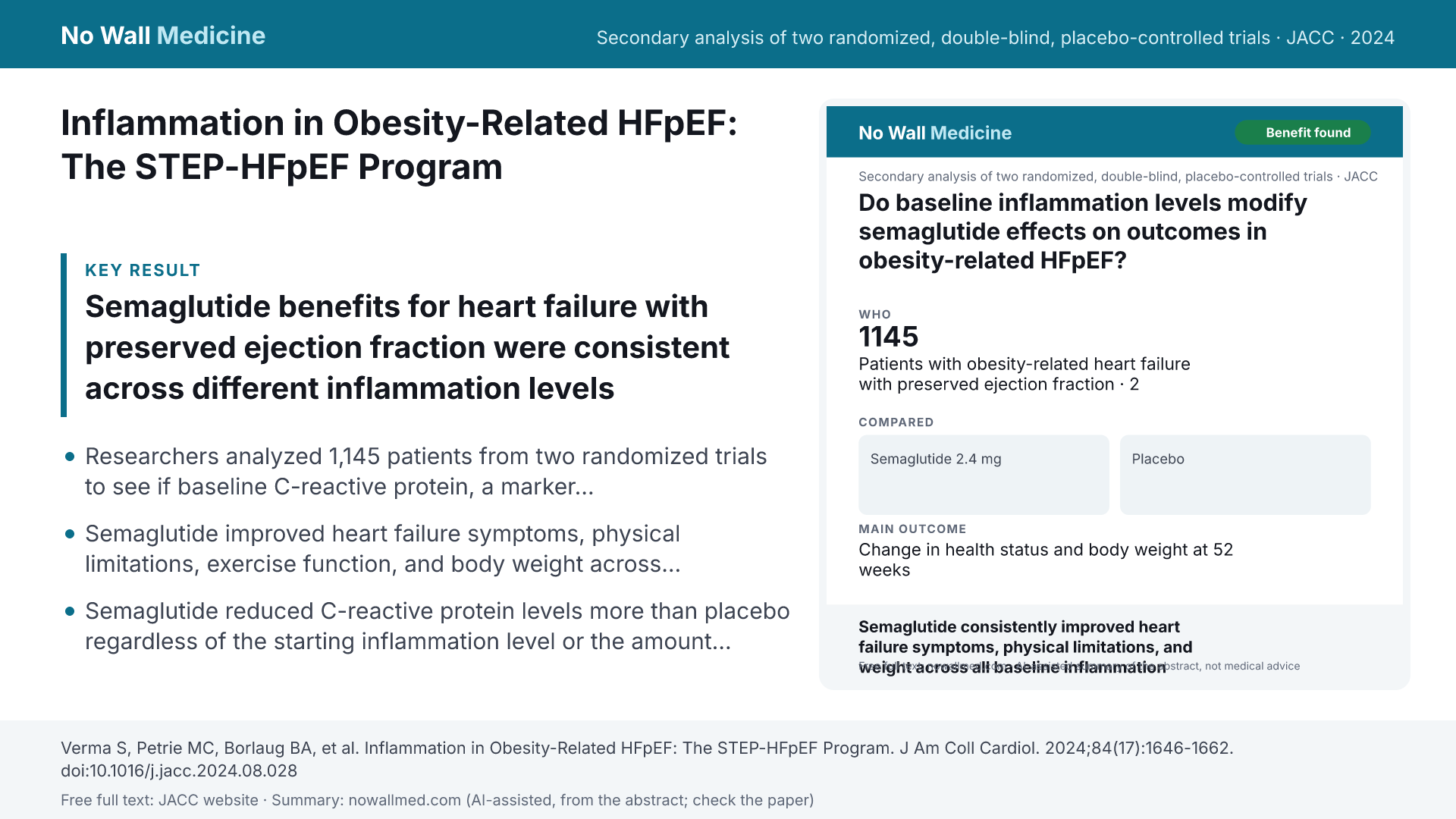
Semaglutide benefits for heart failure with preserved ejection fraction were consistent across different inflammation levels
Inflammation in Obesity-Related HFpEF: The STEP-HFpEF Program
Secondary analysis of two randomized, double-blind, placebo-controlled trialsBenefit found
Do baseline inflammation levels modify semaglutide effects on outcomes in obesity-related HFpEF?
Who
1145
Patients with obesity-related heart failure with preserved ejection fraction · 2 international sites
Compared
Semaglutide 2.4 mg
Placebo
Main outcome
Change in health status and body weight at 52 weeks
Bottom line: Semaglutide consistently improved heart failure symptoms, physical limitations, and weight across all baseline inflammation levels.
JACC · 2024-08-30Download image
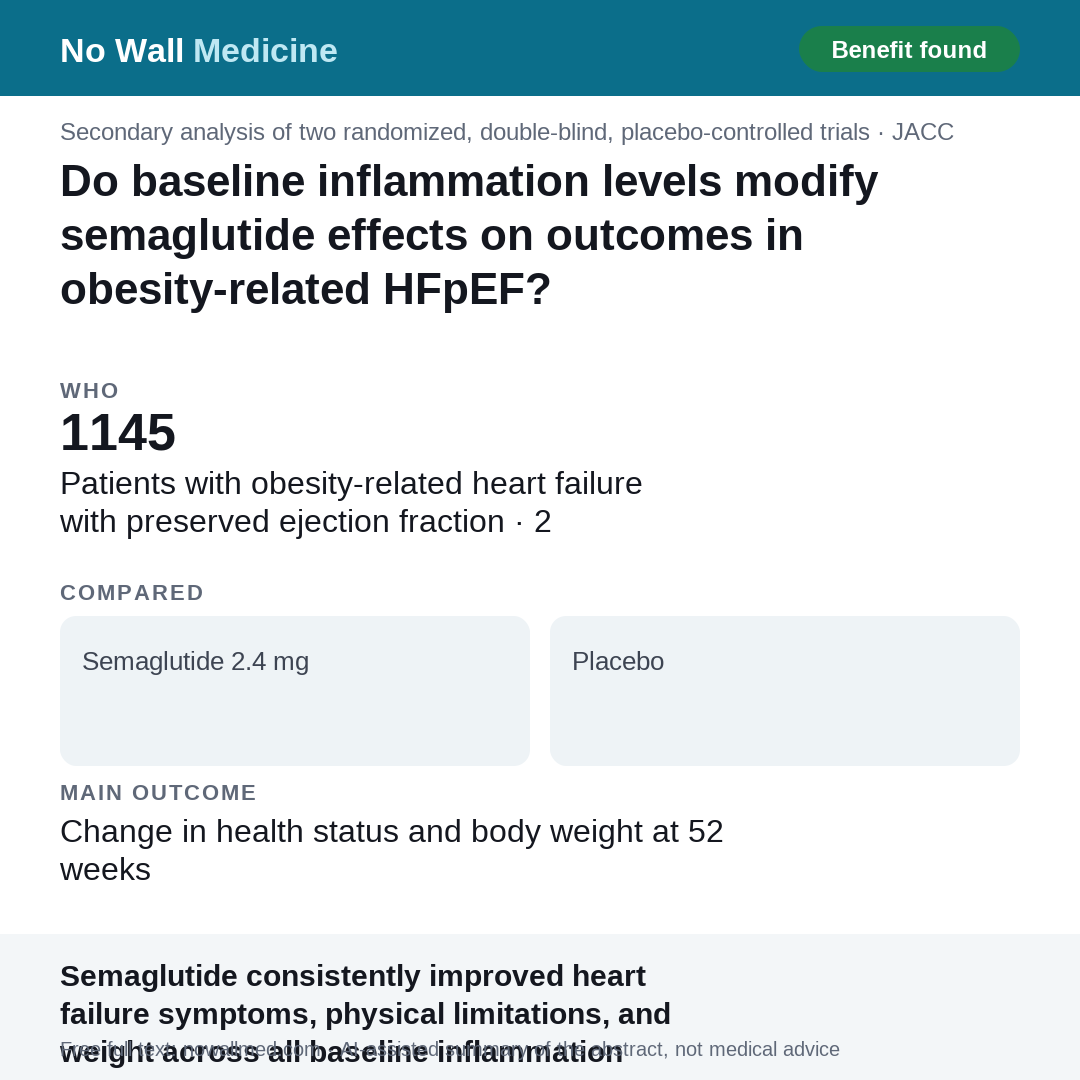
Clinical question: Do baseline inflammation levels modify semaglutide effects on outcomes in obesity-related HFpEF?
Why it matters: The prevalence of inflammation in obesity-related heart failure with preserved ejection fraction and whether baseline inflammation levels change the effectiveness of semaglutide were unknown.
Key points
- Researchers analyzed 1,145 patients from two randomized trials to see if baseline C-reactive protein, a marker of inflammation, changed how semaglutide worked.
- Semaglutide improved heart failure symptoms, physical limitations, exercise function, and body weight across all inflammation categories, including the 71% of patients with C-reactive protein levels ≥2 mg/L.
- Semaglutide reduced C-reactive protein levels more than placebo regardless of the starting inflammation level or the amount of weight lost.
Headline and key points written with AI from the paper’s abstract, with every number checked against it. Read the paper before relying on them.
Was this summary helpful?
Subject terms
Cite this article
Verma S, Petrie MC, Borlaug BA, Butler J, Davies MJ, Kitzman DW. Inflammation in Obesity-Related HFpEF: The STEP-HFpEF Program. JACC. 2024. doi:10.1016/j.jacc.2024.08.028
Spotted a mistake? Suggest a correction