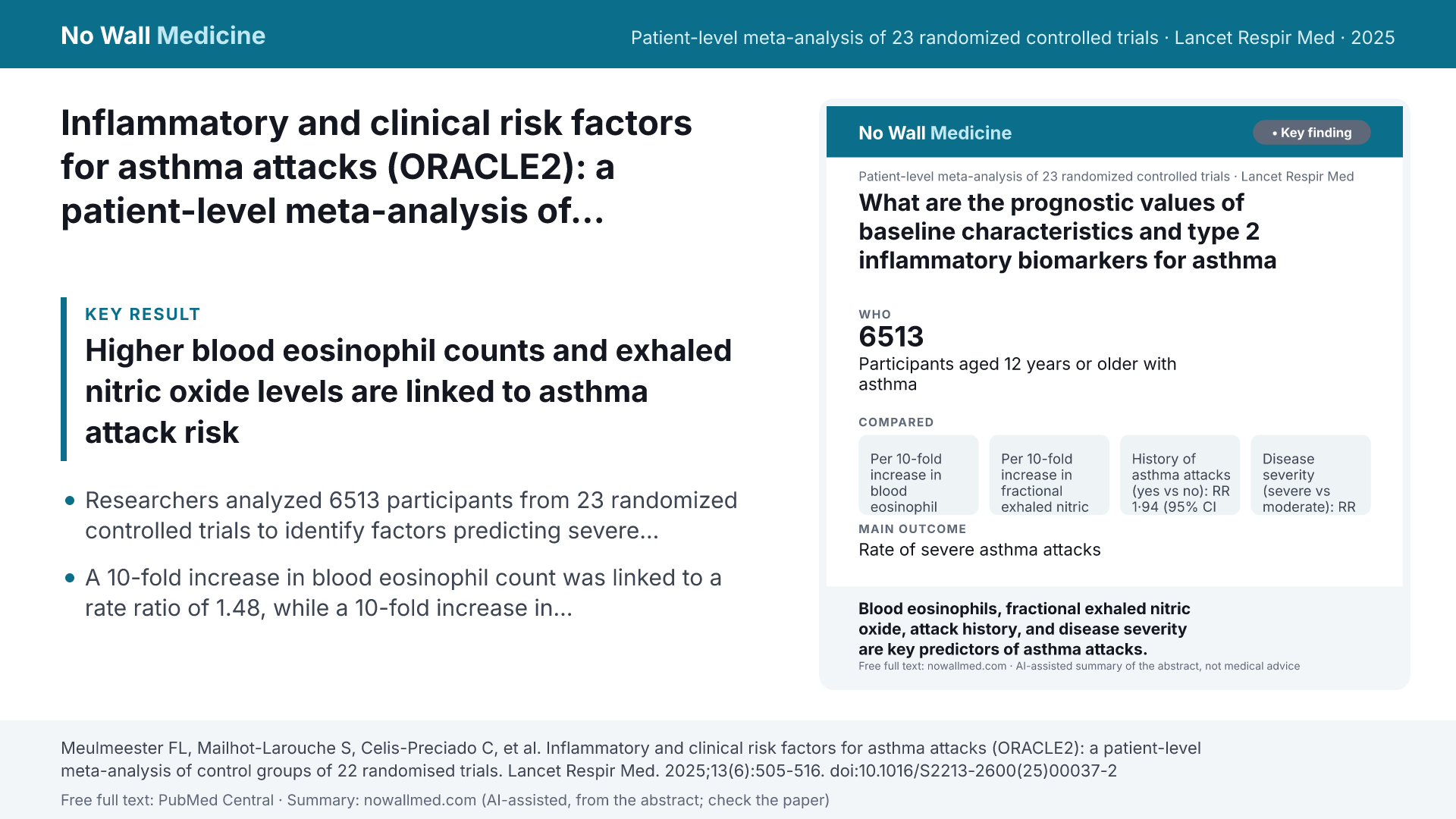
Higher blood eosinophil counts and exhaled nitric oxide levels are linked to asthma attack risk
Inflammatory and clinical risk factors for asthma attacks (ORACLE2): a patient-level meta-analysis of control groups of 22 randomised trials
Patient-level meta-analysis of 23 randomized controlled trialsBenefit found
What are the prognostic values of baseline characteristics and type 2 inflammatory biomarkers for asthma attacks?
Who
6513
Participants aged 12 years or older with asthma
Compared
Per 10-fold increase in blood eosinophil count: RR 1·48 (95% CI 1·30-1·68)
Per 10-fold increase in fractional exhaled nitric oxide: RR 1·44 (95% CI 1·26-1·65)
History of asthma attacks (yes vs no): RR 1·94 (95% CI 1·61-2·32)
Disease severity (severe vs moderate): RR 1·57 (95% CI 1·22-2·03)
Main outcome
Rate of severe asthma attacks
Result: RR 1·48 (95% CI 1·30-1·68) for blood eosinophil count
Bottom line: Blood eosinophils, fractional exhaled nitric oxide, attack history, and disease severity are key predictors of asthma attacks.
Limitation: Major differences in patient and disease characteristics between studies were indicated by the concordance statistic.
Lancet Respir Med · 2025-04-08Download image
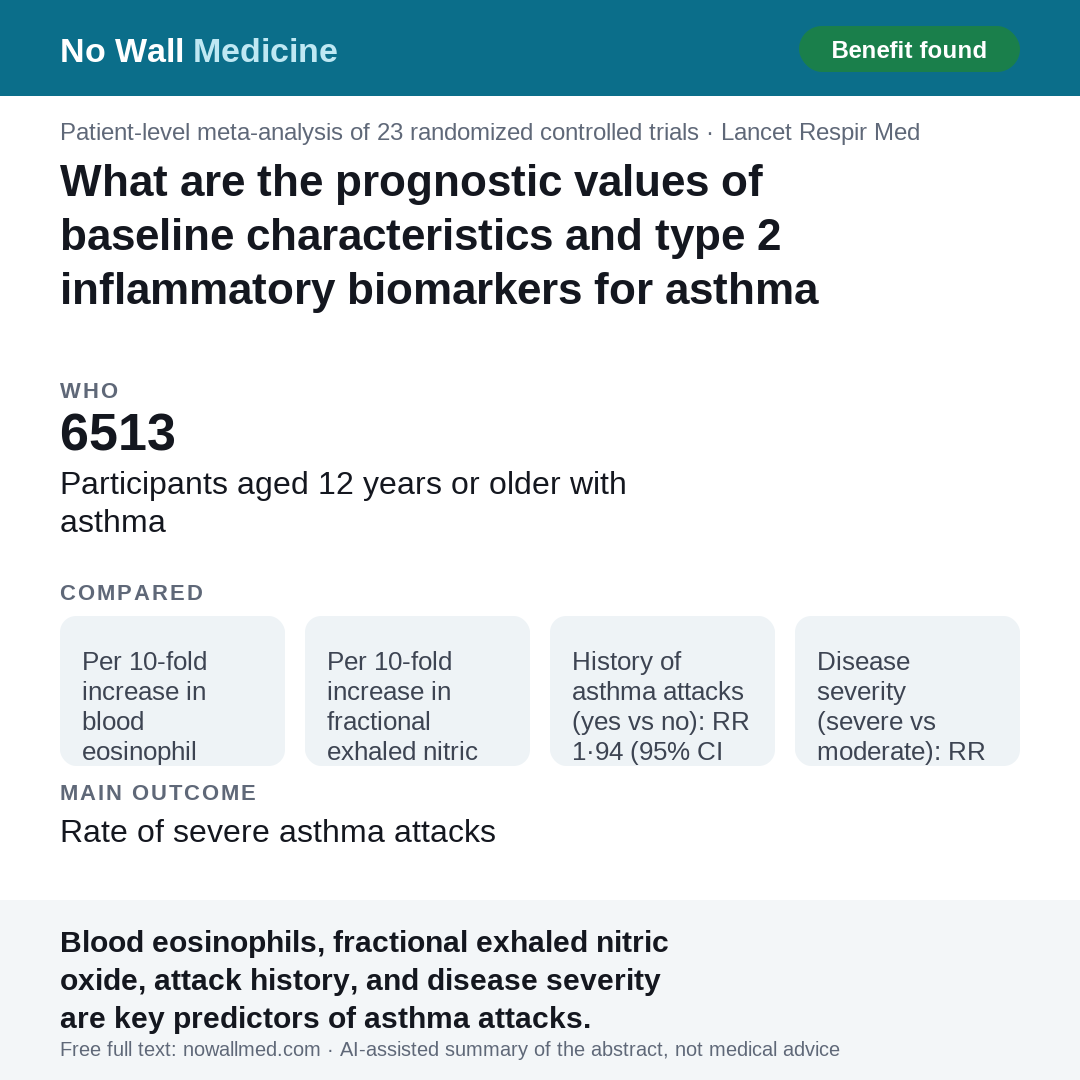
Clinical question: What are the prognostic values of baseline characteristics and type 2 inflammatory biomarkers for asthma attacks?
Why it matters: The incremental prognostic value of type 2 inflammatory biomarkers, such as blood eosinophil count and fractional exhaled nitric oxide, for predicting asthma attacks is unclear.
Key points
- Researchers analyzed 6513 participants from 23 randomized controlled trials to identify factors predicting severe asthma attacks.
- A 10-fold increase in blood eosinophil count was linked to a rate ratio of 1.48, while a 10-fold increase in fractional exhaled nitric oxide was linked to a rate ratio of 1.44.
- Other factors linked to higher risk included a history of attacks, severe disease, lower lung function, and higher symptom scores.
Limitation the authors note: The C-statistic ranged from 0.58 to 0.95, indicating major differences in patient and disease characteristics between studies.
Headline and key points written with AI from the paper’s abstract, with every number checked against it. Read the paper before relying on them.
Was this summary helpful?
Abstract
Background
Clinical risk factors for severe asthma attacks have been identified, but their incremental prognostic values are unclear. Additionally, the incremental contribution of type 2 inflammation, a common, treatable process, is undetermined. We aimed to quantify the prognostic value of baseline characteristics and type 2 inflammatory biomarkers, specifically blood eosinophil count and fractional exhaled nitric oxide (FeNO), to predict asthma attacks. Methods
In this systematic review and meta-analysis of randomised controlled trials (RCTs), Oxford Asthma Attack Risk Scale 2 (ORACLE2), we searched MEDLINE from Jan 1, 1993, to April 1, 2021, for trials investigating fixed treatment regimen effects on asthma attack rates for at least 6 months with baseline blood eosinophil count and FeNO. Eligible participants were aged 12 years or older with asthma (any severity) who had been randomly assigned to the control group of an RCT. Relevant trials were manually retrieved and reviewed by two independent reviewers (SC and IDP). Disagreements were discussed with five reviewers. Individual patient data (IPD) for meta-analysis were requested from study authors. We investigated the rate of severe asthma attacks (≥3 days of systemic corticosteroids) for at least 6 months and prognostic effects of baseline blood eosinophil count and FeNO in control group participants. Rate ratios (RRs) with 95% CIs were derived for annualised asthma attack rates from negative binomial models adjusted for key variables, including blood eosinophil count and FeNO, and interactions between these type 2 inflammatory biomarkers were explored. Certainty of evidence was assessed using GRADE. The heterogeneity of the included studies and potential for ecological bias were quantified by the concordance statistic (C-statistic). This study was registered with PROSPERO, CRD42021245337. Findings
We identified 976 potentially eligible studies. After automated screening, we manually reviewed 219 full-text articles. Of these, 19 publications comprising 23 RCTs were eligible. 6513 participants (4140 [64%] female; 2370 [36%] male; three missing) spanning 22 RCTs were included for data analysis. 5972 (92%) of 6513 patients had moderate-to-severe asthma. 4615 asthma attacks occurred during 5482 person-years of follow-up (annualised rate 0·84 per person-year). Higher blood eosinophil count or FeNO was linked to higher asthma attack risk (per 10-fold increase, RR 1·48 [95% CI 1·30-1·68] for blood eosinophil count and 1·44 [1·26-1·65] for FeNO; high-certainty evidence). Other prognostic factors were attack history (yes vs no, RR 1·94 [1·61-2·32]); disease severity (severe vs moderate, RR 1·57 [1·22-2·03]); FEV1 percentage predicted (FEV1%; per 10% decrease, RR 1·11 [1·08-1·15]); and 5-item Asthma Control Questionnaire score (ACQ-5; per 0·5 increase, RR 1·10 [1·07-1·13]). High blood eosinophil count and FeNO combined were associated with greater risk than either prognostic factor separately. Bronchodilator reversibility was associated with lower risk of severe asthma attacks (per 10% increase, RR 0·93 [0·90-0·96]), with the reduction observed primarily between 0% and 25%. Regarding heterogeneity of the included studies, the C-statistic ranged from 0·58 to 0·95, indicating major differences in patient and disease characteristics between studies. In the univariable meta-analysis per trial, we found substantial heterogeneity in associations between studies, with I2 statistics ranging from 0·56 to 0·97. Interpretation
Blood eosinophil count, FeNO, asthma attack history, disease severity, low lung function (low FEV1%), and symptoms (ACQ-5 score) are key predictors of asthma attacks. Conversely, we found that moderate bronchodilator reversibility was associated with reduced risk. These findings from high-quality multinational RCTs support incorporation of blood eosinophils and FeNO into clinical risk stratification for targeted risk reduction. More individualised clinical decision-making models should be explored. Funding
National Institute of Health and Care Research Oxford Biomedical Research Centre; Association pulmonaire du Québec; Fonds de recherche du Québec-Santé; Québec Air-Intersectorialité-Respiratoire-Son network; Stichting Astma Bestrijding; Leiden University Fund; and Academy of Medical Sciences.
Abstract reproduced under the article’s CC BY NC ND licence.
Subject terms
Cite this article
Meulmeester FL, Mailhot-Larouche S, Celis-Preciado C, Lemaire-Paquette S, Ramakrishnan S, Wechsler ME. Inflammatory and clinical risk factors for asthma attacks (ORACLE2): a patient-level meta-analysis of control groups of 22 randomised trials. Lancet Respir Med. 2025. doi:10.1016/S2213-2600(25)00037-2
Spotted a mistake? Suggest a correction