Intermittent fasting strategies showed no significant difference in weight loss compared to continuous energy restriction
Intermittent fasting for weight loss in night shift workers: a three-arm, superiority randomised clinical trial
Three-arm randomized superiority clinical trialNo clear difference
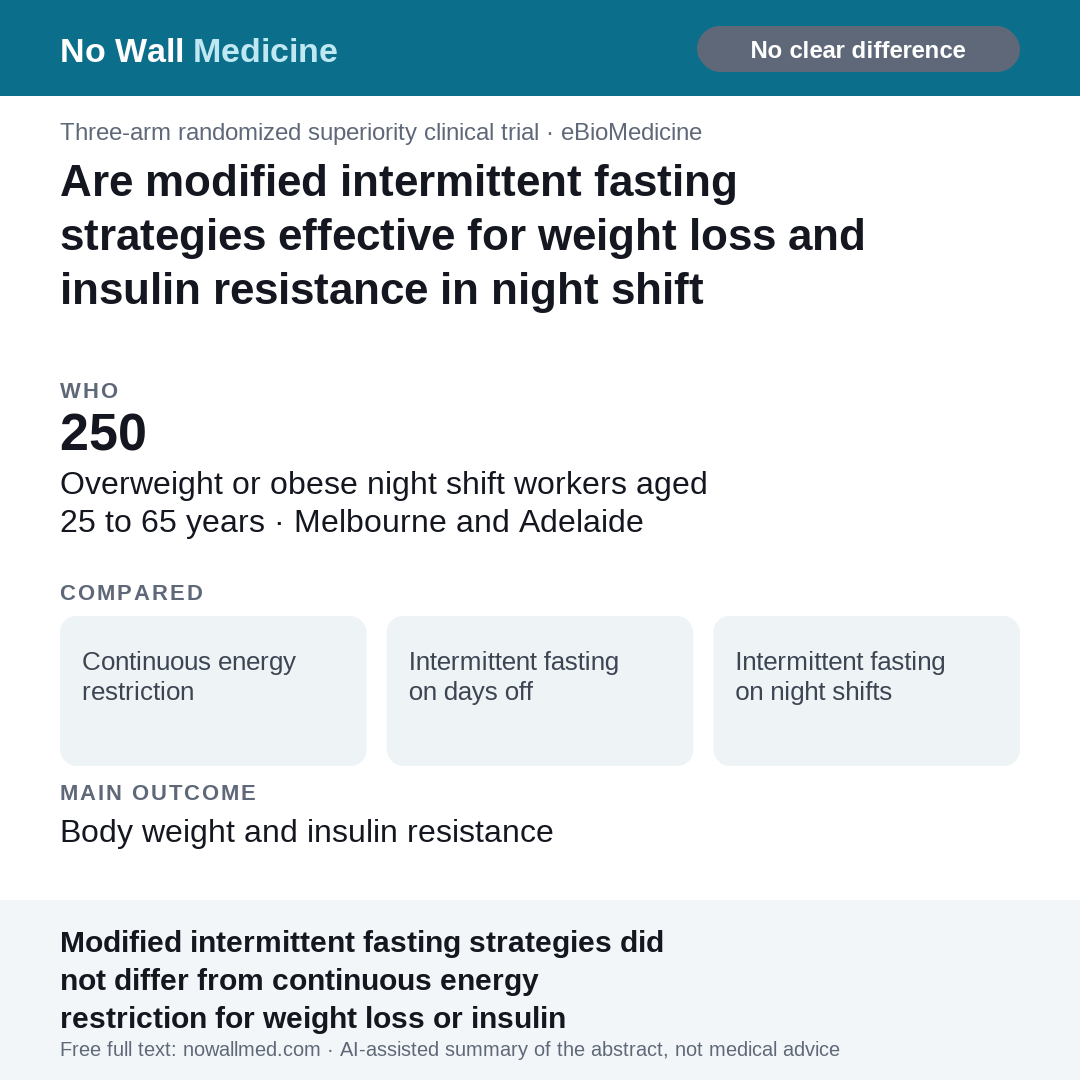
Are modified intermittent fasting strategies effective for weight loss and insulin resistance in night shift workers?
Who
250
Overweight or obese night shift workers aged 25 to 65 years · Melbourne and Adelaide
Compared
Continuous energy restriction
Intermittent fasting on days off
Intermittent fasting on night shifts
Main outcome
Body weight and insulin resistance
Result: MD = -0.2 kg (95% CI -6.4 to 5.9) and MD = -0.6 kg (95% CI -6.8 to 5.6)
Bottom line: Modified intermittent fasting strategies did not differ from continuous energy restriction for weight loss or insulin resistance.
Funded by: National Health and Medical Research Council
eBioMedicine · 2025-06-18Download image
Clinical question: Are modified intermittent fasting strategies effective for weight loss and insulin resistance in night shift workers?
Why it matters: Night shift work is associated with weight gain and increased risk of type 2 diabetes, but it is unclear if intermittent fasting is more effective than continuous energy restriction.
Key points
- Researchers studied 250 night shift workers with overweight or obesity, comparing continuous energy restriction to two modified intermittent fasting strategies over 24 weeks.
- No significant difference was found for body weight between the groups, with the difference for IF:2D versus continuous energy restriction being -0.2 kg and IF:2N being -0.6 kg.
- The IF:2D group had lower total cholesterol and low-density lipoprotein cholesterol compared to the continuous energy restriction group.
Headline and key points written with AI from the paper’s abstract, with every number checked against it. Read the paper before relying on them.
Topics
Cite this article
Bonham MP, Leung GKW, Rogers M, Davis R, Clark AB, Davis C. Intermittent fasting for weight loss in night shift workers: a three-arm, superiority randomised clinical trial. eBioMedicine. 2025. doi:10.1016/j.ebiom.2025.105803
Spotted a mistake? Suggest a correction
Top studies every Monday
The week’s key trials and guidelines in your specialties, by email. Free.
Get the weekly digest