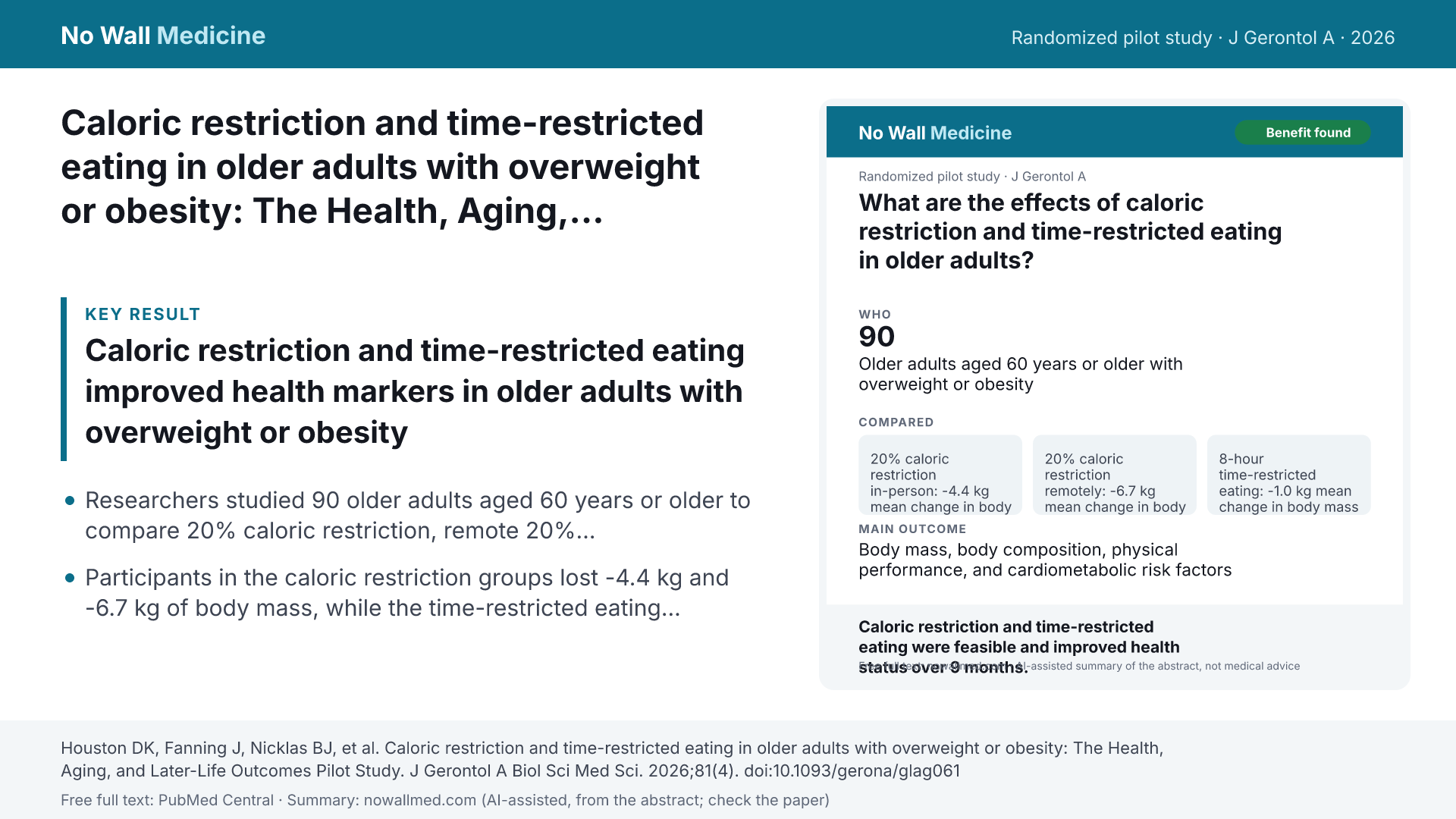
Caloric restriction and time-restricted eating improved health markers in older adults with overweight or obesity
Caloric restriction and time-restricted eating in older adults with overweight or obesity: The Health, Aging, and Later-Life Outcomes Pilot Study
Randomized pilot studyBenefit found
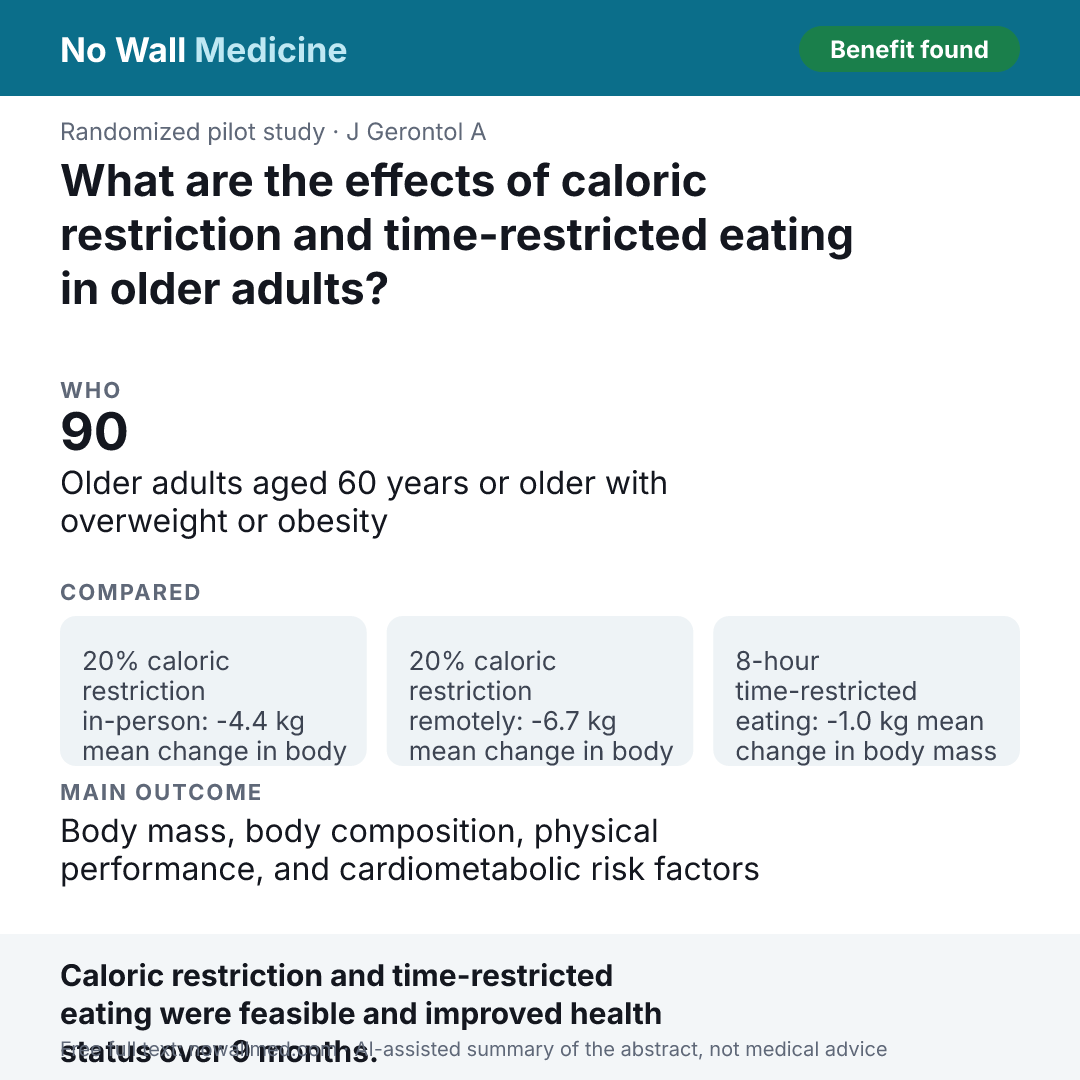
What are the effects of caloric restriction and time-restricted eating in older adults?
Who
90
Older adults aged 60 years or older with overweight or obesity
Compared
20% caloric restriction in-person: -4.4 kg mean change in body mass
20% caloric restriction remotely: -6.7 kg mean change in body mass
8-hour time-restricted eating: -1.0 kg mean change in body mass
Main outcome
Body mass, body composition, physical performance, and cardiometabolic risk factors
Bottom line: Caloric restriction and time-restricted eating were feasible and improved health status over 9 months.
Limitation: Interventions did not achieve the target caloric restriction.
J Gerontol A · 2026-03-02 · Save PNG
Clinical question: What are the effects of caloric restriction and time-restricted eating in older adults?
Why it matters: The long-term benefits of caloric restriction and time-restricted eating in humans remain unknown despite evidence in animal models.
Key points
- Researchers studied 90 older adults aged 60 years or older to compare 20% caloric restriction, remote 20% caloric restriction, and 8-hour time-restricted eating over 9 months.
- Participants in the caloric restriction groups lost -4.4 kg and -6.7 kg of body mass, while the time-restricted eating group lost -1.0 kg.
- All three groups showed improvements in glucose and cholesterol levels, and chair stand and 400-meter walk times improved in the remote caloric restriction and time-restricted eating groups.
Headline and key points written with AI from the paper’s abstract, with every number checked against it. Read the paper before relying on them.
Was this summary helpful?
Subject terms
Headline, design, result, key points, caveat and citation as plain text.
Cite this article
Houston DK, Fanning J, Nicklas BJ, et al. Caloric restriction and time-restricted eating in older adults with overweight or obesity: The Health, Aging, and Later-Life Outcomes Pilot Study. J Gerontol A Biol Sci Med Sci. 2026;81(4). doi:10.1093/gerona/glag061
Spotted a mistake? Suggest a correction