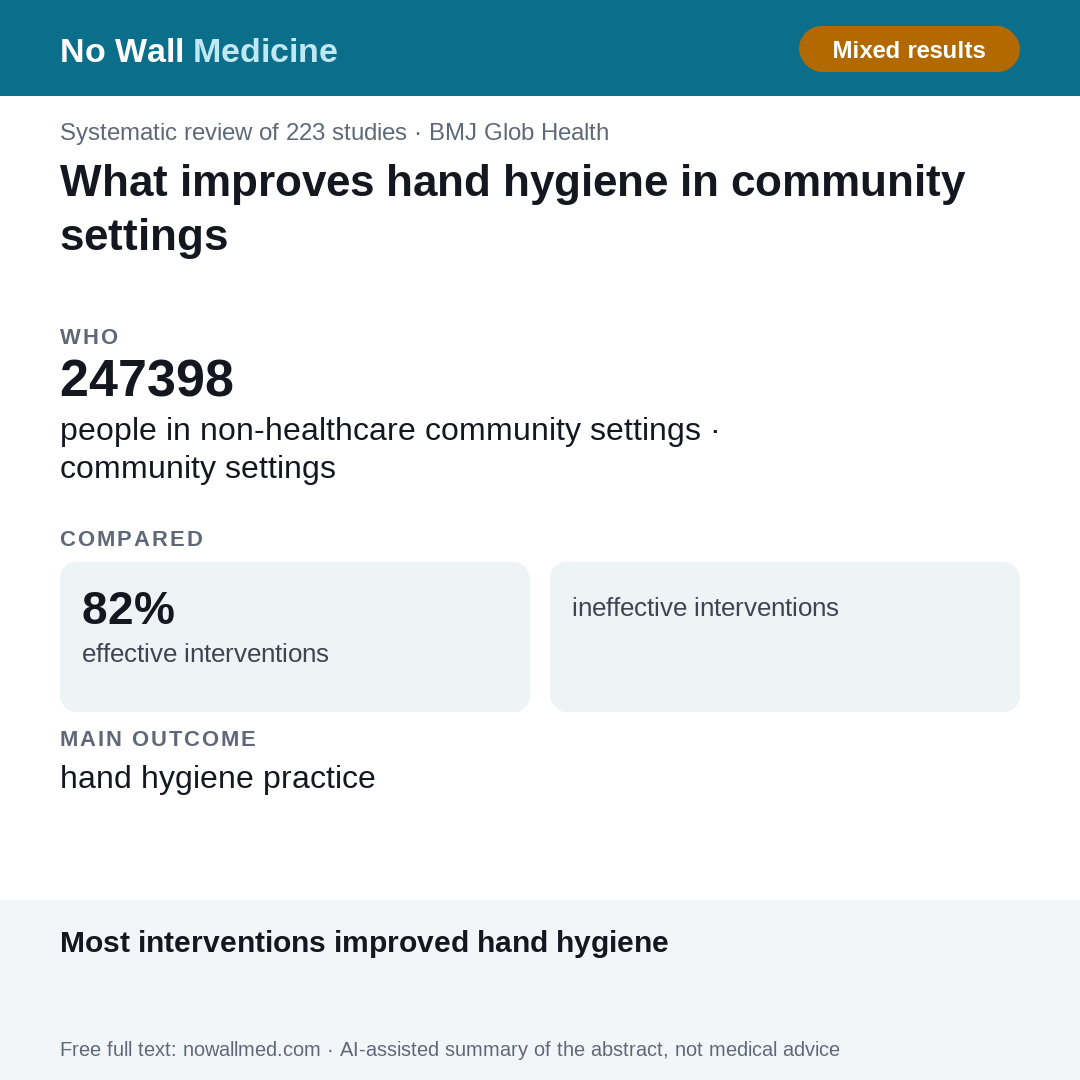
Review of 223 studies shows 82% of community hand hygiene interventions were reported as effective
Interventions to improve hand hygiene in community settings: a systematic review of theories, barriers and enablers, behaviour change techniques and hand hygiene station design features
Systematic review of 223 studiesMixed results
What improves hand hygiene in community settings
Who
247398
people in non-healthcare community settings · community settings
Compared
82%effective interventions
ineffective interventions
Main outcome
hand hygiene practice
Bottom line: Most interventions improved hand hygiene
Limitation: inconsistent intervention reporting
BMJ Glob Health · 2025-09-16Download image
Why it matters: Evidence is needed to support the development of World Health Organization guidelines for hand hygiene in community settings.
Key points
- Researchers reviewed 223 studies involving 247,398 participants to examine interventions for hand hygiene in non-healthcare community settings.
- While 82% of interventions were reported to be effective, only 28% used theory to inform their design.
- Most interventions focused on handwashing instruction rather than the physical environment or specific barriers and enablers.
Limitation the authors note: Findings are limited by inconsistent intervention reporting.
Headline and key points written with AI from the paper’s abstract, with every number checked against it. Read the paper before relying on them.
Topics
Cite this article
Prasad SK, Snyder JS, LaFon E, O'Brien LA, Rogers HK, Cumming O. Interventions to improve hand hygiene in community settings: a systematic review of theories, barriers and enablers, behaviour change techniques and hand hygiene station design features. BMJ Glob Health. 2025. doi:10.1136/bmjgh-2025-018928
Spotted a mistake? Suggest a correction