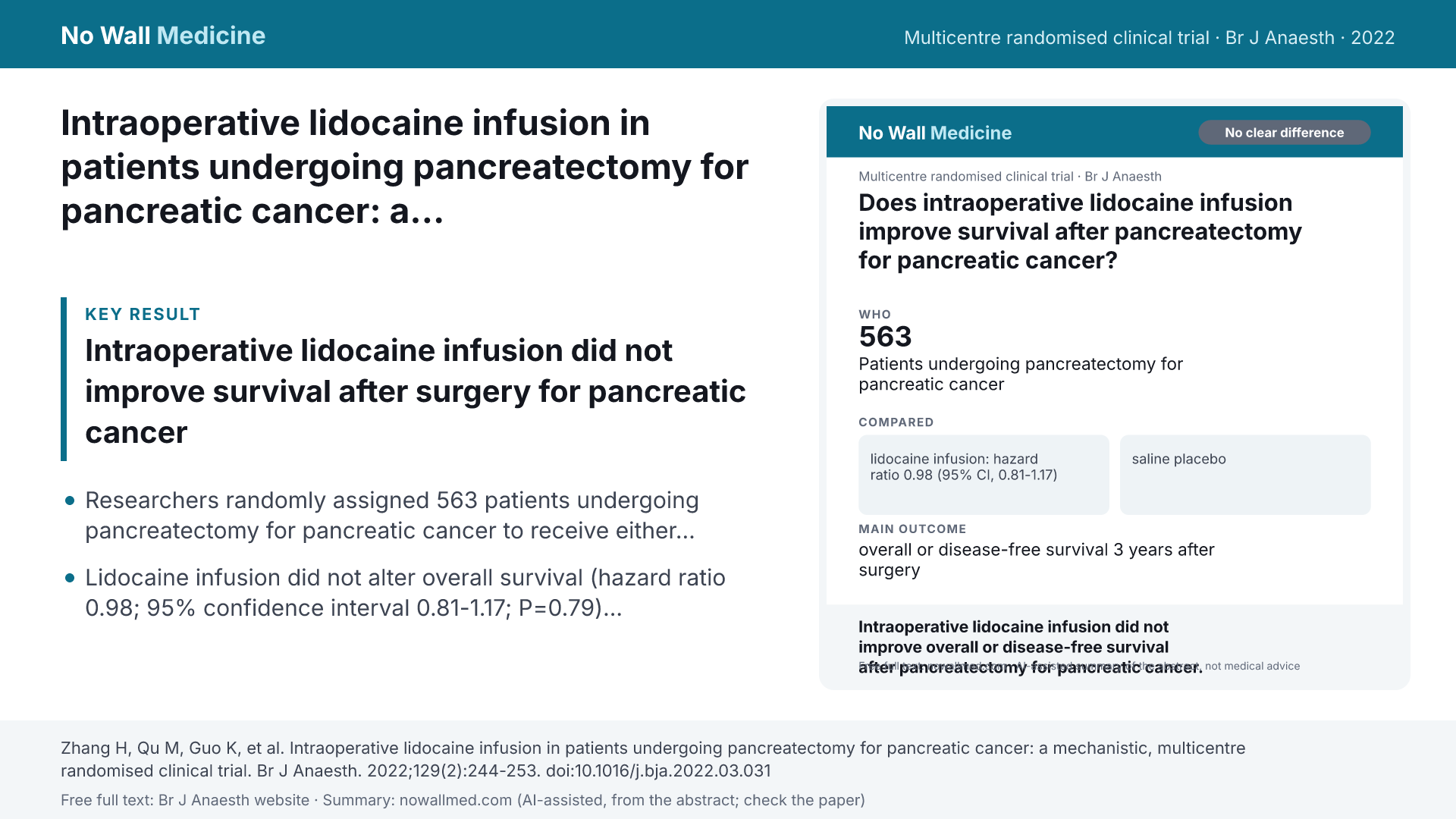
Intraoperative lidocaine infusion did not improve survival after surgery for pancreatic cancer
Intraoperative lidocaine infusion in patients undergoing pancreatectomy for pancreatic cancer: a mechanistic, multicentre randomised clinical trial
Multicentre randomised clinical trialNo clear difference
Does intraoperative lidocaine infusion improve survival after pancreatectomy for pancreatic cancer?
Who
563
Patients undergoing pancreatectomy for pancreatic cancer
Compared
lidocaine infusion: hazard ratio 0.98 (95% CI, 0.81-1.17)
saline placebo
Main outcome
overall or disease-free survival 3 years after surgery
Result: hazard ratio 0.98 (95% CI, 0.81-1.17)
Bottom line: Intraoperative lidocaine infusion did not improve overall or disease-free survival after pancreatectomy for pancreatic cancer.
Br J Anaesth · 2022-06-11Download image
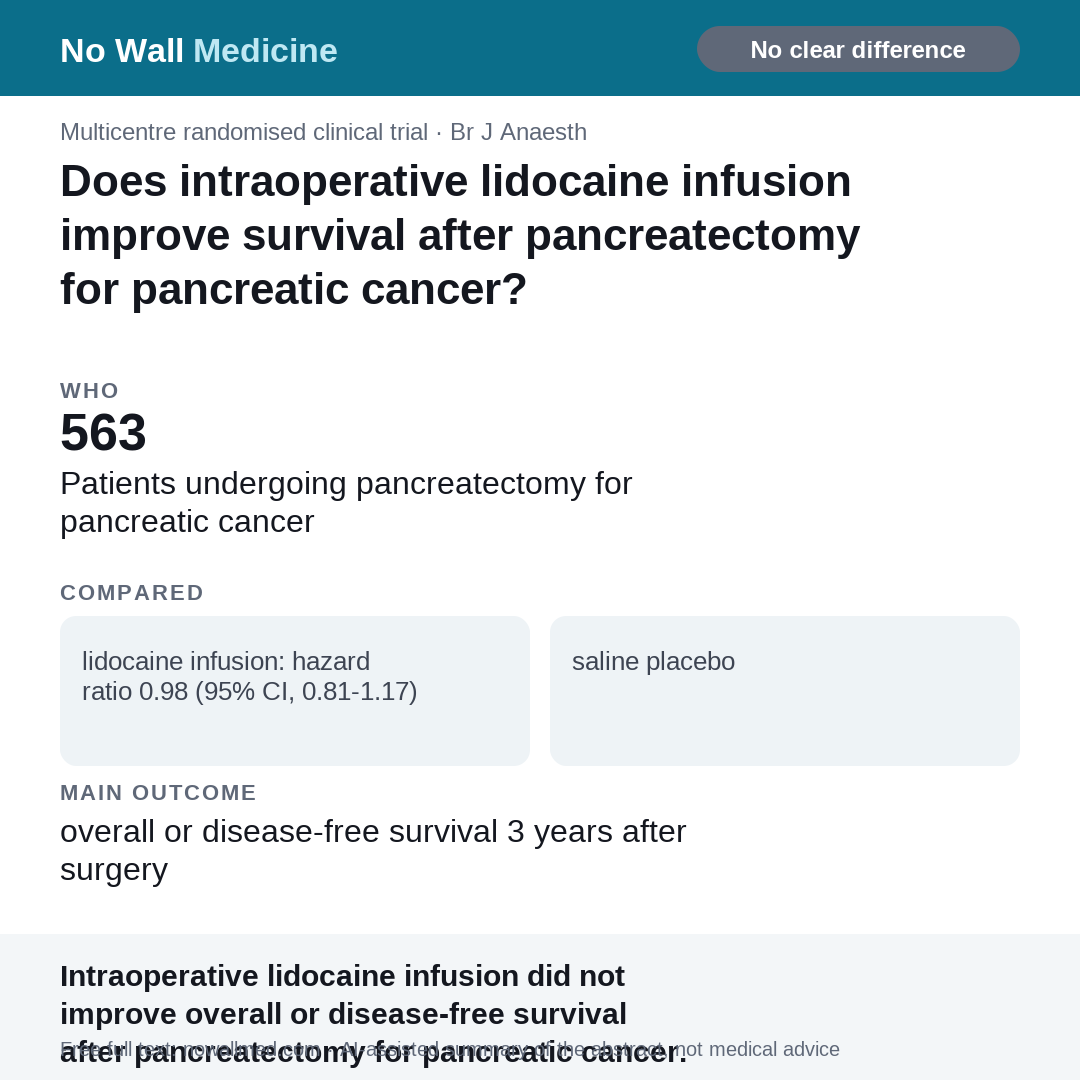
Clinical question: Does intraoperative lidocaine infusion improve survival after pancreatectomy for pancreatic cancer?
Why it matters: It was unknown if intravenous lidocaine improves long-term survival after pancreatic cancer surgery through anti-inflammatory or anti-tumour effects.
Key points
- Researchers randomly assigned 563 patients undergoing pancreatectomy for pancreatic cancer to receive either an intravenous lidocaine infusion or a saline placebo.
- Lidocaine infusion did not alter overall survival (hazard ratio 0.98; 95% confidence interval 0.81-1.17; P=0.79) or disease-free survival (hazard ratio 0.91; 95% confidence interval 0.71-1.17; P=0.44).
- Lidocaine was associated with a lower mean intraoperative sufentanil dose of 47.6 μg [4.6] compared to 68.4 μg [4.8] for placebo, though postoperative complications and hospital stay were similar.
Headline and key points written with AI from the paper’s abstract, with every number checked against it. Read the paper before relying on them.
Was this summary helpful?
Subject terms
Cite this article
Zhang H, Qu M, Guo K, Wang Y, Gu J, Wu H. Intraoperative lidocaine infusion in patients undergoing pancreatectomy for pancreatic cancer: a mechanistic, multicentre randomised clinical trial. Br J Anaesth. 2022. doi:10.1016/j.bja.2022.03.031
Spotted a mistake? Suggest a correction
Top studies every Monday
The week’s key trials and guidelines in your specialties, plus any topics you follow. By email, free.
Get the weekly digest