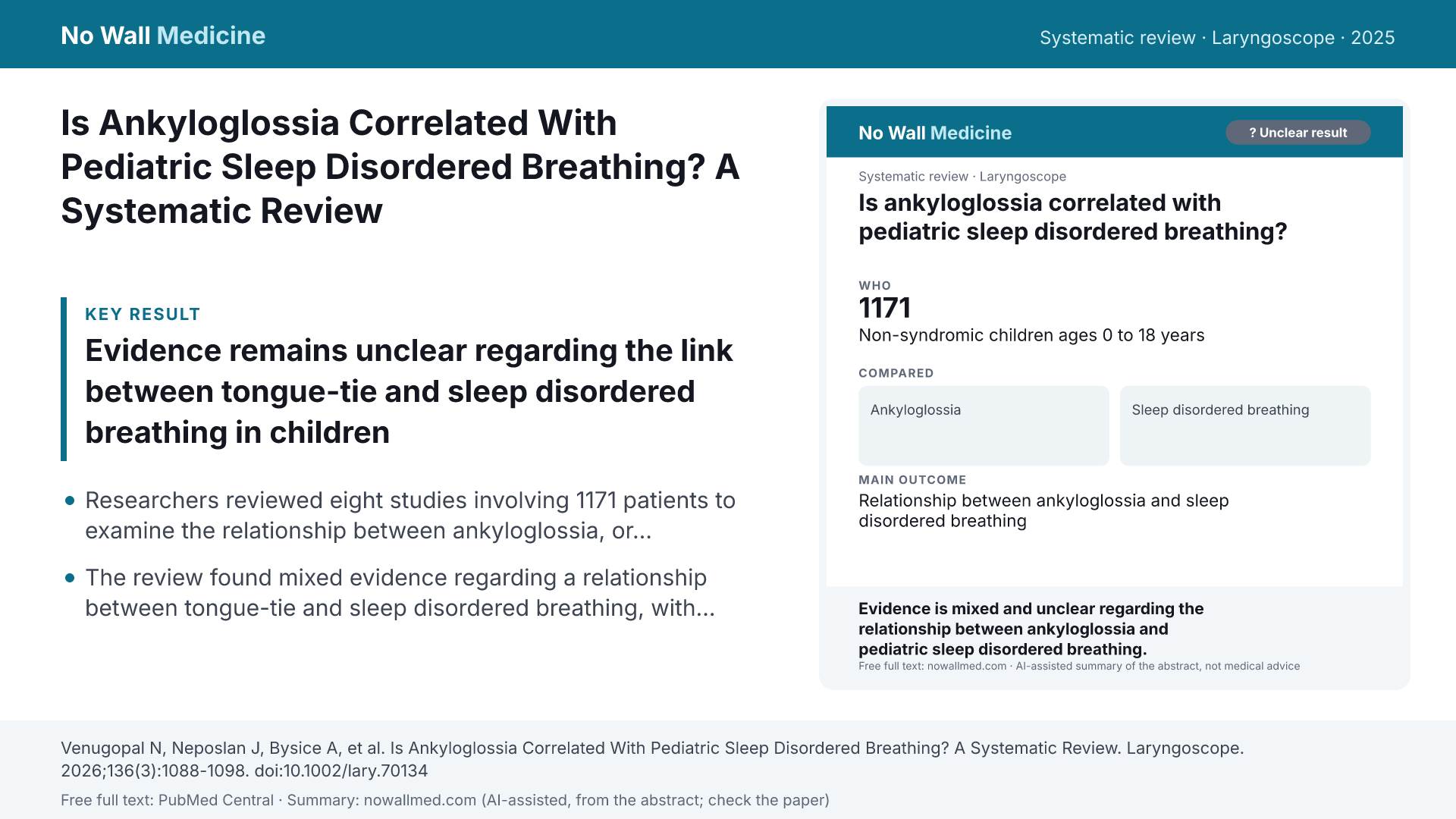
Evidence remains unclear regarding the link between tongue-tie and sleep disordered breathing in children
Is Ankyloglossia Correlated With Pediatric Sleep Disordered Breathing? A Systematic Review
Systematic reviewUnclear result
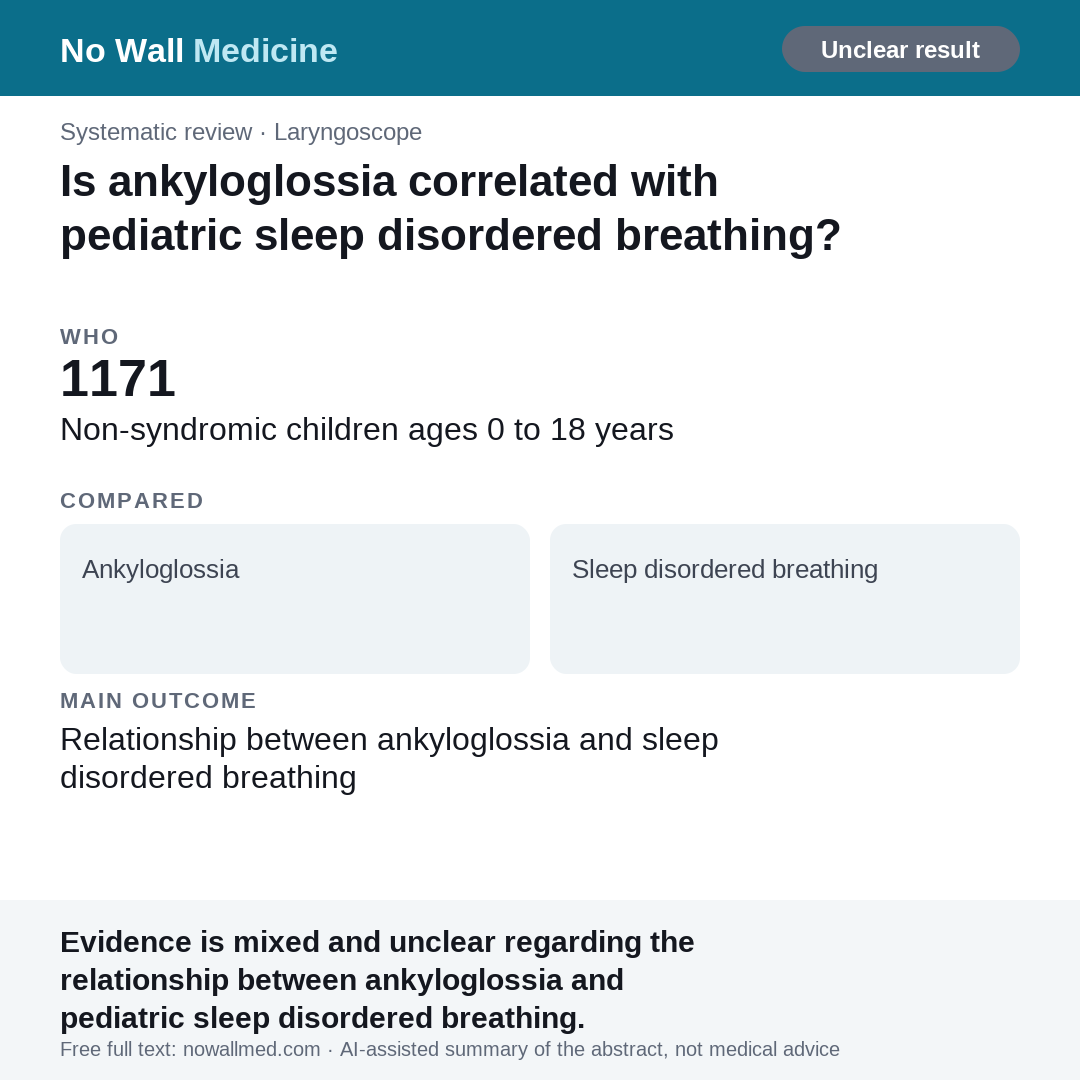
Is ankyloglossia correlated with pediatric sleep disordered breathing?
Who
1171
Non-syndromic children ages 0 to 18 years
Compared
Ankyloglossia
Sleep disordered breathing
Main outcome
Relationship between ankyloglossia and sleep disordered breathing
Bottom line: Evidence is mixed and unclear regarding the relationship between ankyloglossia and pediatric sleep disordered breathing.
Limitation: Lack of standardized diagnostic criteria and use of surveys instead of validated clinical assessment tools.
Laryngoscope · 2025-09-17Download image
Clinical question: Is ankyloglossia correlated with pediatric sleep disordered breathing?
Why it matters: It is unclear if ankyloglossia is a risk factor for sleep disordered breathing or if frenotomy is an appropriate treatment for this condition.
Key points
- Researchers reviewed eight studies involving 1171 patients to examine the relationship between ankyloglossia, or tongue-tie, and sleep disordered breathing in children aged 0 to 18 years.
- The review found mixed evidence regarding a relationship between tongue-tie and sleep disordered breathing, with only two interventional studies reporting a positive association.
- There was insufficient data to conclude that frenotomy, a surgical procedure to release the tongue-tie, is indicated for managing sleep disordered breathing in these children.
Limitation the authors note: The lack of standardized diagnostic criteria for tongue-tie and the use of surveys instead of validated clinical assessment tools for sleep disordered breathing limit the findings.
Headline and key points written with AI from the paper’s abstract, with every number checked against it. Read the paper before relying on them.
Was this summary helpful?
Subject terms
Cite this article
Venugopal N, Neposlan J, Bysice A, Khoury S, Madou E, Lee R. Is Ankyloglossia Correlated With Pediatric Sleep Disordered Breathing? A Systematic Review. Laryngoscope. 2025. doi:10.1002/lary.70134
Spotted a mistake? Suggest a correction
Top studies every Monday
The week’s key trials and guidelines in your specialties, plus any topics you follow. By email, free.
Get the weekly digest