Just-in-Time Adaptive Intervention for Stabilizing Sleep Hours of Japanese Workers: Microrandomized Trial
Microrandomized trialBenefit found
Does a just-in-time adaptive intervention improve sleep hours and stability in Japanese workers?
Who
81
Japanese workers with unstable habitual sleep behaviors · Real-world setting
Compared
Sleep feedback intervention: increasing up to 40 min
Control
Main outcome
Sleep hours and stability of sleep hours
Bottom line: Providing sleep feedback can prolong sleep hours and improve sleep stability in workers.
J Med Internet Res · 2024-06-11Download image
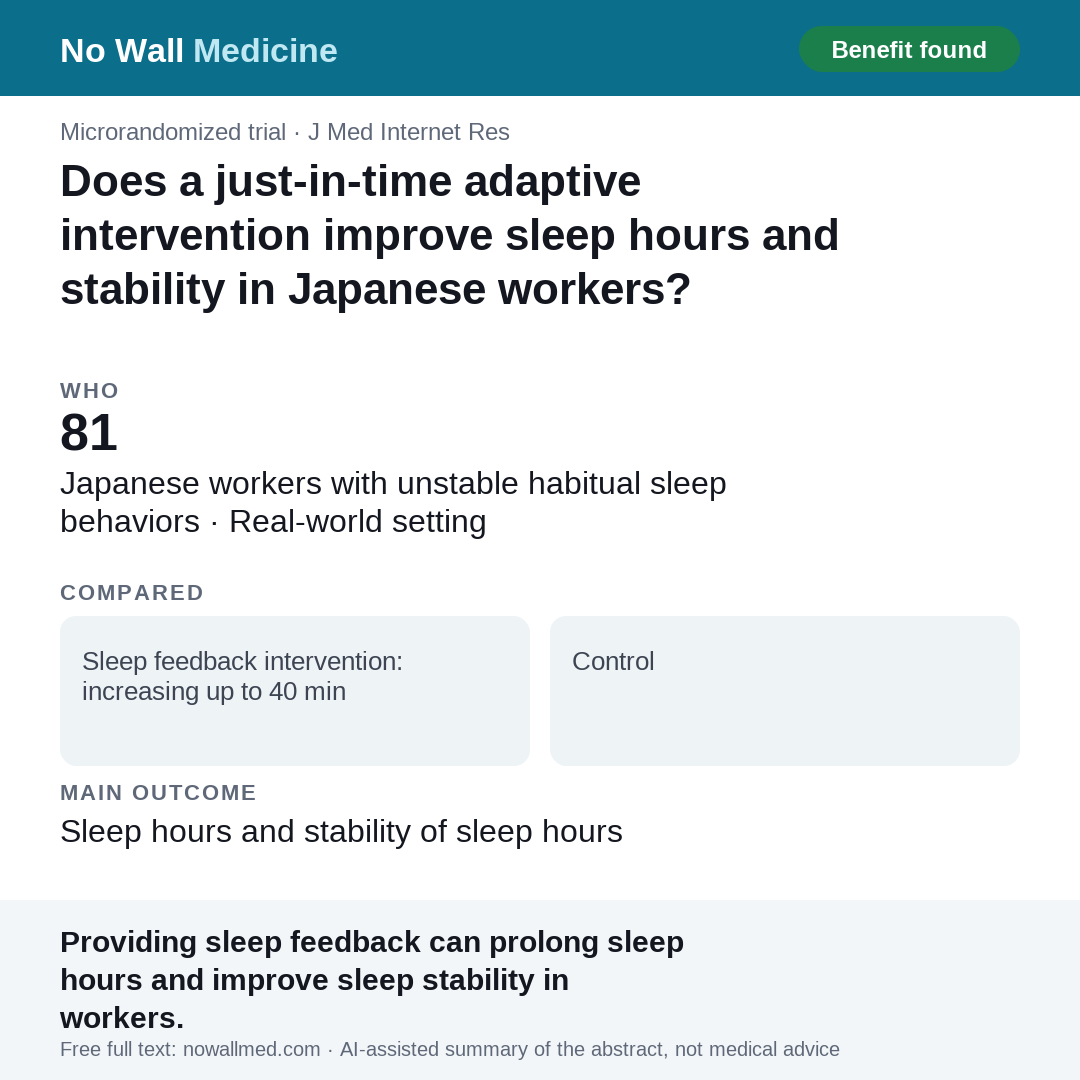
Clinical question: Does a just-in-time adaptive intervention improve sleep hours and stability in Japanese workers?
Abstract
Background
Sleep disturbance is a major contributor to future health and occupational issues. Mobile health can provide interventions that address adverse health behaviors for individuals in a vulnerable health state in real-world settings (just-in-time adaptive intervention). Objective
This study aims to identify a subpopulation with vulnerable sleep state in daily life (study 1) and, immediately afterward, to test whether providing mobile health intervention improved habitual sleep behaviors and psychological wellness in real-world settings by conducting a microrandomized trial (study 2). Methods
Japanese workers (n=182) were instructed to collect data on their habitual sleep behaviors and momentary symptoms (including depressive mood, anxiety, and subjective sleep quality) using digital devices in a real-world setting. In study 1, we calculated intraindividual mean and variability of sleep hours, midpoint of sleep, and sleep efficiency to characterize their habitual sleep behaviors. In study 2, we designed and conducted a sleep just-in-time adaptive intervention, which delivered objective push-type sleep feedback messages to improve their sleep hours for a subset of participants in study 1 (n=81). The feedback messages were generated based on their sleep data measured on previous nights and were randomly sent to participants with a 50% chance for each day (microrandomization). Results
In study 1, we applied hierarchical clustering to dichotomize the population into 2 clusters (group A and group B) and found that group B was characterized by unstable habitual sleep behaviors (large intraindividual variabilities). In addition, linear mixed-effect models showed that the interindividual variability of sleep hours was significantly associated with depressive mood (β=3.83; P=.004), anxiety (β=5.70; P=.03), and subjective sleep quality (β=-3.37; P=.03). In study 2, we found that providing sleep feedback prolonged subsequent sleep hours (increasing up to 40 min; P=.01), and this effect lasted for up to 7 days. Overall, the stability of sleep hours in study 2 was significantly improved among participants in group B compared with the participants in study 1 (P=.001). Conclusions
This is the first study to demonstrate that providing sleep feedback can benefit the modification of habitual sleep behaviors in a microrandomized trial. The findings of this study encourage the use of digitalized health intervention that uses real-time health monitoring and personalized feedback.
Subject terms
Cite this article
Takeuchi H, Ishizawa T, Kishi A, Nakamura T, Yoshiuchi K, Yamamoto Y. Just-in-Time Adaptive Intervention for Stabilizing Sleep Hours of Japanese Workers: Microrandomized Trial. J Med Internet Res. 2024. doi:10.2196/49669
Spotted a mistake? Suggest a correction
Top studies every Monday
The week’s key trials and guidelines in your specialties, plus any topics you follow. By email, free.
Get the weekly digest