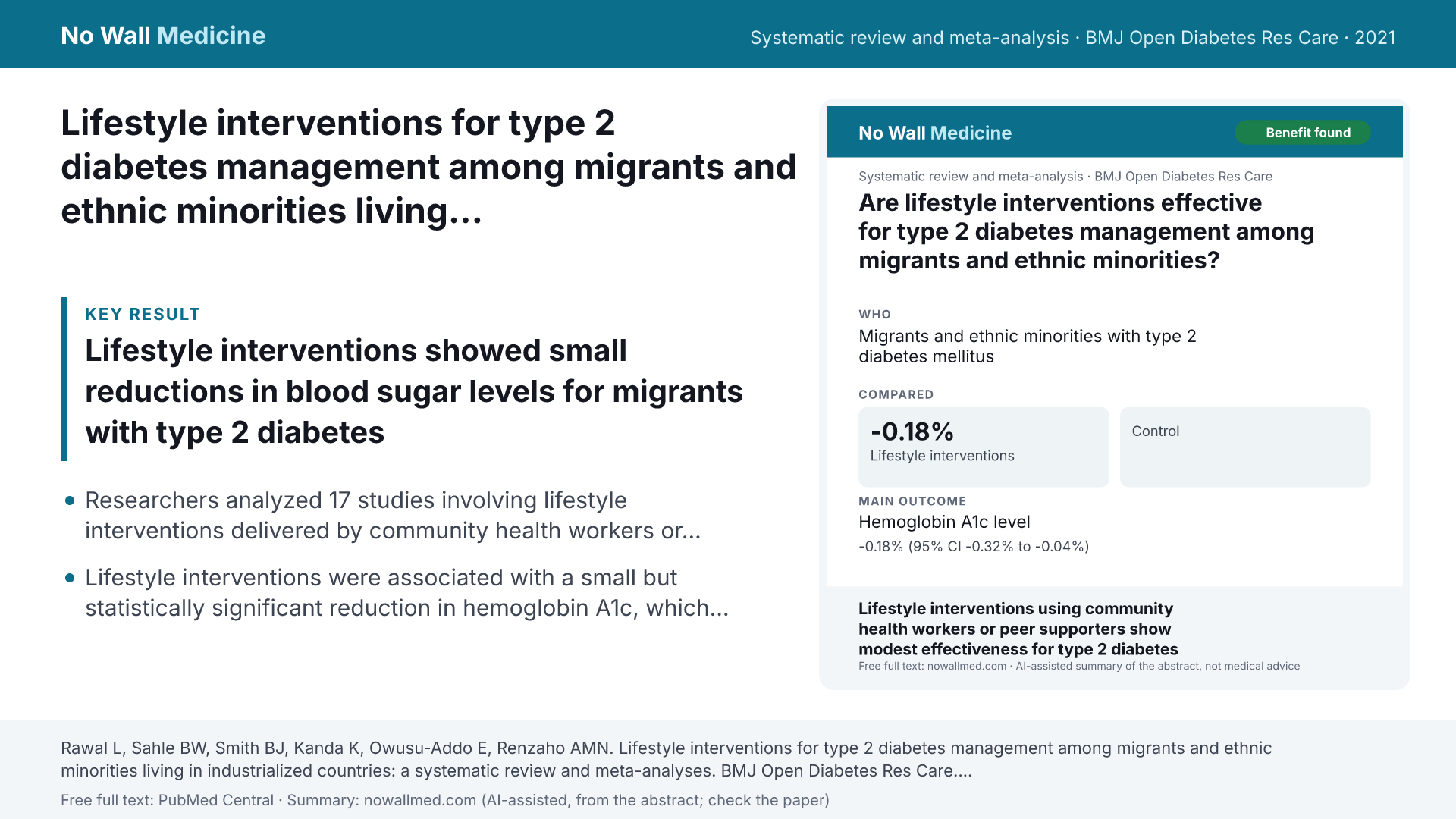
Lifestyle interventions showed small reductions in blood sugar levels for migrants with type 2 diabetes
Lifestyle interventions for type 2 diabetes management among migrants and ethnic minorities living in industrialized countries: a systematic review and meta-analyses
Systematic review and meta-analysisBenefit found
Are lifestyle interventions effective for type 2 diabetes management among migrants and ethnic minorities?
Who
Migrants and ethnic minorities with type 2 diabetes mellitus
Compared
-0.18%Lifestyle interventions
Control
Main outcome
Hemoglobin A1c level
Result: -0.18% (95% CI -0.32% to -0.04%)
Bottom line: Lifestyle interventions using community health workers or peer supporters show modest effectiveness for type 2 diabetes management.
BMJ Open Diabetes Res Care · 2021-04-21 · Save PNG
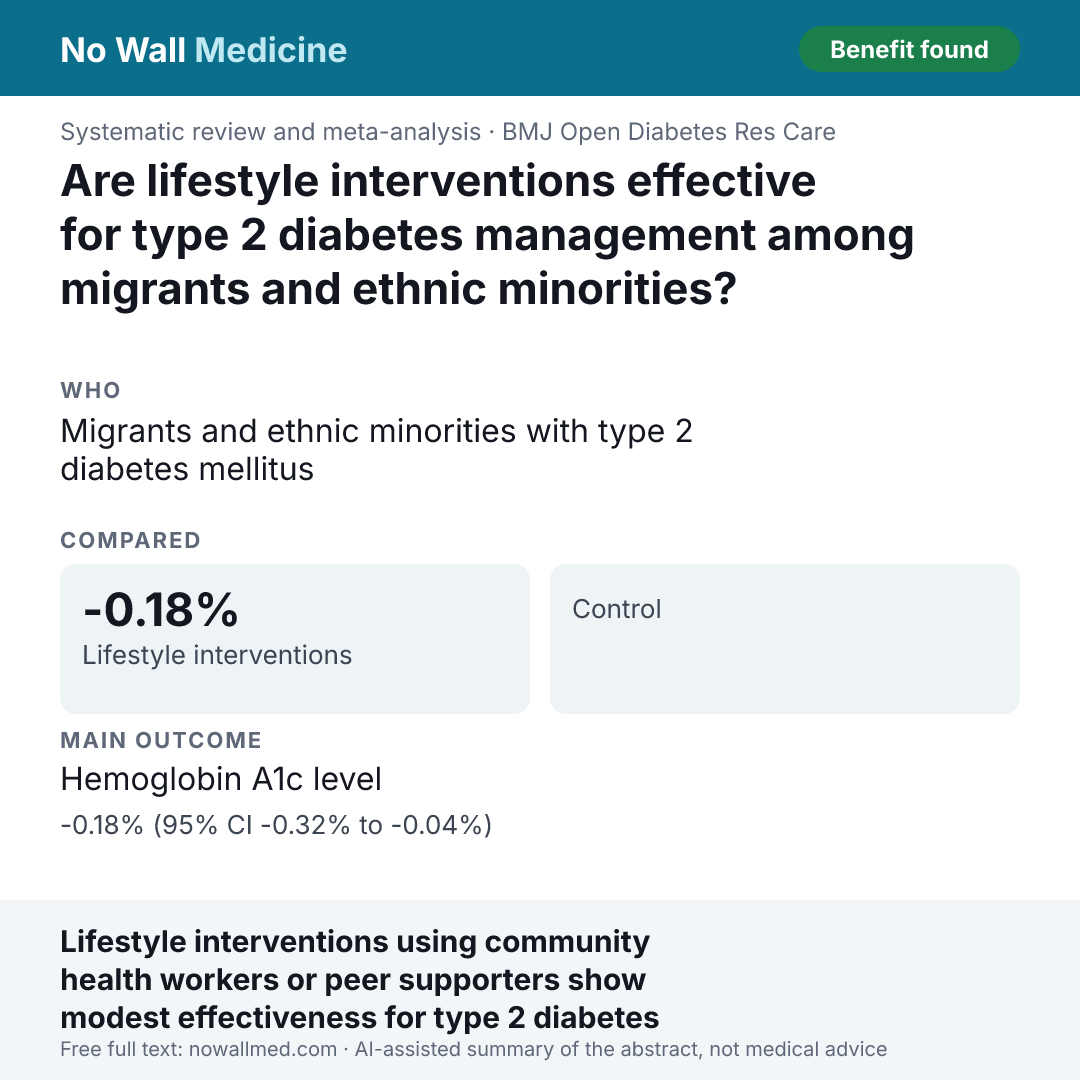
Clinical question: Are lifestyle interventions effective for type 2 diabetes management among migrants and ethnic minorities?
Key points
- Researchers analyzed 17 studies involving lifestyle interventions delivered by community health workers or peer supporters for migrants and ethnic minorities with type 2 diabetes.
- Lifestyle interventions were associated with a small but statistically significant reduction in hemoglobin A1c, which is a measure of long-term blood sugar, of -0.18% (95% CI -0.32% to -0.04%, p=0.031).
- Peer-led interventions showed relatively better hemoglobin A1c improvement than community health worker-led interventions, but this difference was not statistically significant (p=0.379).
Headline and key points written with AI from the paper’s abstract, with every number checked against it. Read the paper before relying on them.
Was this summary helpful?
Abstract
The objective of this systematic review was to determine the effectiveness of lifestyle interventions to improve the management of type 2 diabetes mellitus (T2DM) among migrants and ethnic minorities. Major searched databases included MEDLINE (via PubMed), EMBASE (via Ovid) and CINAHL. The selection of studies and data extraction followed the Preferred Reporting Items for Systematic Reviews and Meta-Analyses guidelines. In the meta-analysis, significant heterogeneity was detected among the studies (I2 >50%), and hence a random effects model was used. Subgroup analyses were performed to compare the effect of lifestyle interventions according to intervention approaches (peer-led vs community health workers (CHWs)-led). A total of 17 studies were included in this review which used interventions delivered by CHWs or peer supporters or combination of both. The majority of the studies assessed effectiveness of key primary (hemoglobin (HbA1c), lipids, fasting plasma glucose) and secondary outcomes (weight, body mass index, blood pressure, physical activity, alcohol consumption, tobacco smoking, food habits and healthcare utilization). Meta-analyses showed lifestyle interventions were associated with a small but statistically significant reduction in HbA1c level (-0.18%; 95% CI -0.32% to -0.04%, p=0.031). In subgroup analyses, the peer-led interventions showed relatively better HbA1c improvement than CHW-led interventions, but the difference was not statistically significant (p=0.379). Seven studies presented intervention costs, which ranged from US$131 to US$461 per participant per year. We conclude that lifestyle interventions using either CHWs or peer supporters or a combination of both have shown modest effectiveness for T2DM management among migrants of different background and origin and ethnic minorities. The evidence base is promising in terms of developing culturally appropriate, clinically sound and cost-effective intervention approaches to respond to the growing and diverse migrants and ethnic minorities affected by diabetes worldwide.
Abstract reproduced under the article’s CC BY NC licence.
Subject terms
Headline, design, result, key points, caveat and citation as plain text.
Cite this article
Rawal L, Sahle BW, Smith BJ, Kanda K, Owusu-Addo E, Renzaho AMN. Lifestyle interventions for type 2 diabetes management among migrants and ethnic minorities living in industrialized countries: a systematic review and meta-analyses. BMJ Open Diabetes Res Care. 2021. doi:10.1136/bmjdrc-2020-001924
Spotted a mistake? Suggest a correction