Liver resection was associated with longer overall survival than chemoembolization for intermediate liver cancer
Liver resection versus transarterial chemoembolisation for the treatment of intermediate hepatocellular carcinoma: a systematic review and meta-analysis
Systematic review and meta-analysisBenefit found
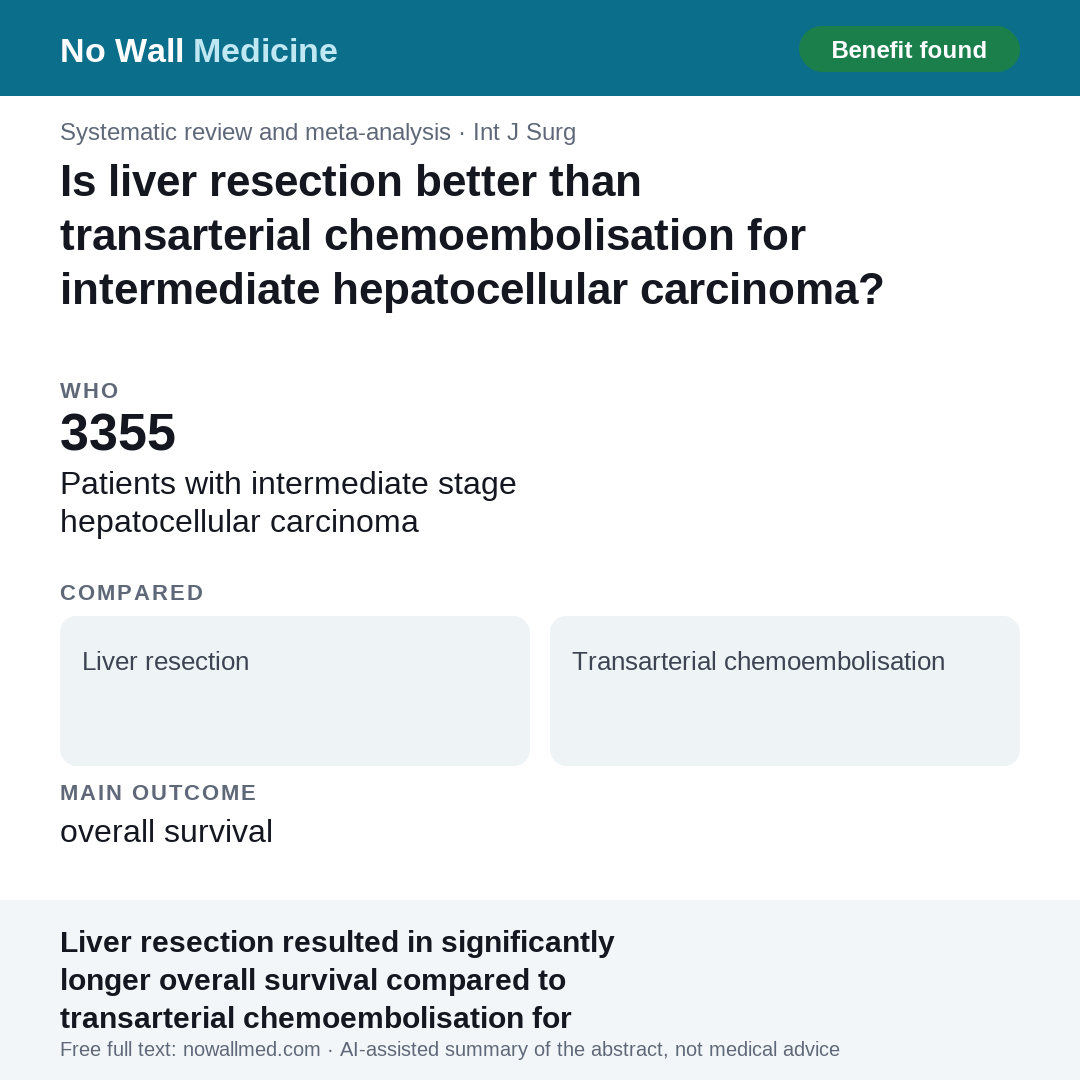
Is liver resection better than transarterial chemoembolisation for intermediate hepatocellular carcinoma?
Who
3355
Patients with intermediate stage hepatocellular carcinoma
Compared
Liver resection
Transarterial chemoembolisation
Main outcome
overall survival
Result: hazard ratio 0.52 (95% CI 0.39-0.69)
Bottom line: Liver resection resulted in significantly longer overall survival compared to transarterial chemoembolisation for intermediate-stage hepatocellular carcinoma.
Int J Surg · 2023-05-01Download image
Clinical question: Is liver resection better than transarterial chemoembolisation for intermediate hepatocellular carcinoma?
Why it matters: The best treatment option for intermediate-stage hepatocellular carcinoma remains controversial despite growing evidence favoring liver resection over chemoembolization.
Key points
- Researchers analyzed nine studies involving 3355 patients to compare liver resection and transarterial chemoembolization, a procedure that delivers chemotherapy directly to liver tumors via the arteries.
- Patients undergoing liver resection had a longer overall survival with a hazard ratio of 0.52 (95% CI: 0.39-0.69).
- A sensitivity analysis of five studies using propensity score matching, a statistical method to reduce bias, showed a hazard ratio of 0.45 (95% CI: 0.34-0.59).
Headline and key points written with AI from the paper’s abstract, with every number checked against it. Read the paper before relying on them.
Was this summary helpful?
Subject terms
Cite this article
Bogdanovic A, Djokic Kovac J, Zdujic P, Djindjic U, Dugalic V. Liver resection versus transarterial chemoembolisation for the treatment of intermediate hepatocellular carcinoma: a systematic review and meta-analysis. Int J Surg. 2023. doi:10.1097/JS9.0000000000000344
Spotted a mistake? Suggest a correction
Top studies every Monday
The week’s key trials and guidelines in your specialties, plus any topics you follow. By email, free.
Get the weekly digest