Low-dose doxorubicin reduced post-embolisation syndrome symptoms without affecting survival in liver cancer patients
Transarterial chemoembolisation in patients with hepatocellular carcinoma: low-dose doxorubicin reduces post-embolisation syndrome without affecting survival-prospective interventional study
Randomized prospective interventional studyMixed results
Does low-dose doxorubicin reduce post-embolisation syndrome without affecting survival in hepatocellular carcinoma?
Who
28
Patients with primary hepatocellular carcinoma scheduled for transarterial chemoembolisation
Compared
50 mg doxorubicin: significantly lower visual analogue scale and duration of pain
100 mg doxorubicin
Main outcome
post-embolisation syndrome and overall survival
Bottom line: Low-dose doxorubicin reduces post-embolisation syndrome symptoms without affecting tumour response or overall survival.
Eur Radiol Exp · 2021-03-02Download image
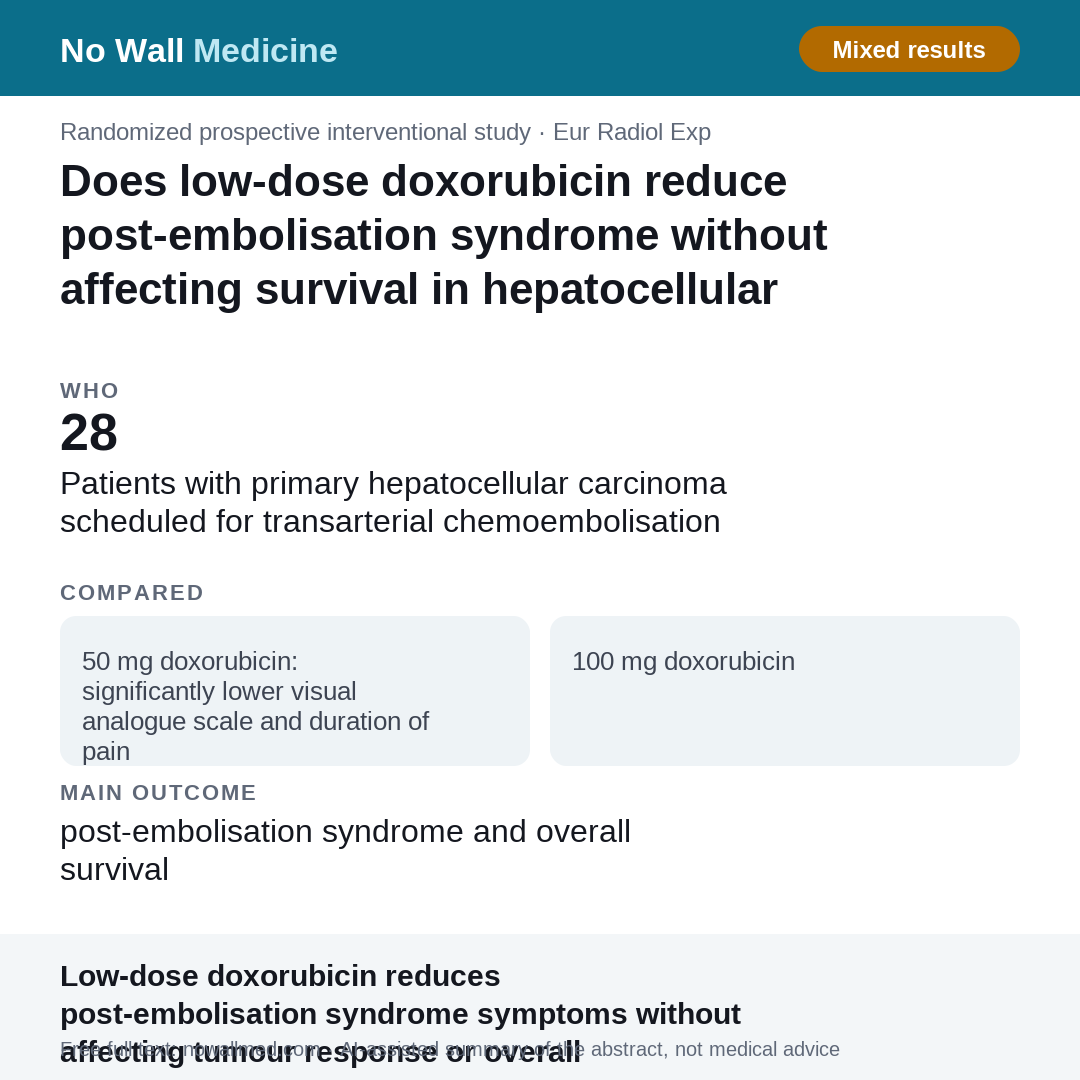
Clinical question: Does low-dose doxorubicin reduce post-embolisation syndrome without affecting survival in hepatocellular carcinoma?
Why it matters: The optimal dosage of doxorubicin for use during transarterial chemoembolisation in patients with hepatocellular carcinoma has not been standardized.
Key points
- Twenty-eight patients with primary hepatocellular carcinoma were randomized to receive either 50 mg or 100 mg of doxorubicin during transarterial chemoembolisation, a procedure to treat liver cancer.
- The 50 mg group had significantly lower pain scores and shorter fever duration compared to the 100 mg group, but there were no significant differences in overall survival or tumour response.
- The dose of doxorubicin was significantly correlated with the duration of fever, duration of pain, and visual analogue scale scores for pain.
Headline and key points written with AI from the paper’s abstract, with every number checked against it. Read the paper before relying on them.
Was this summary helpful?
Subject terms
Cite this article
Bessar AA, Farag A, Abdel Monem SM, Wadea FM, Shaker SE, Ebada MA. Transarterial chemoembolisation in patients with hepatocellular carcinoma: low-dose doxorubicin reduces post-embolisation syndrome without affecting survival-prospective interventional study. Eur Radiol Exp. 2021. doi:10.1186/s41747-021-00204-6
Spotted a mistake? Suggest a correction
Top studies every Monday
The week’s key trials and guidelines in your specialties, plus any topics you follow. By email, free.
Get the weekly digest