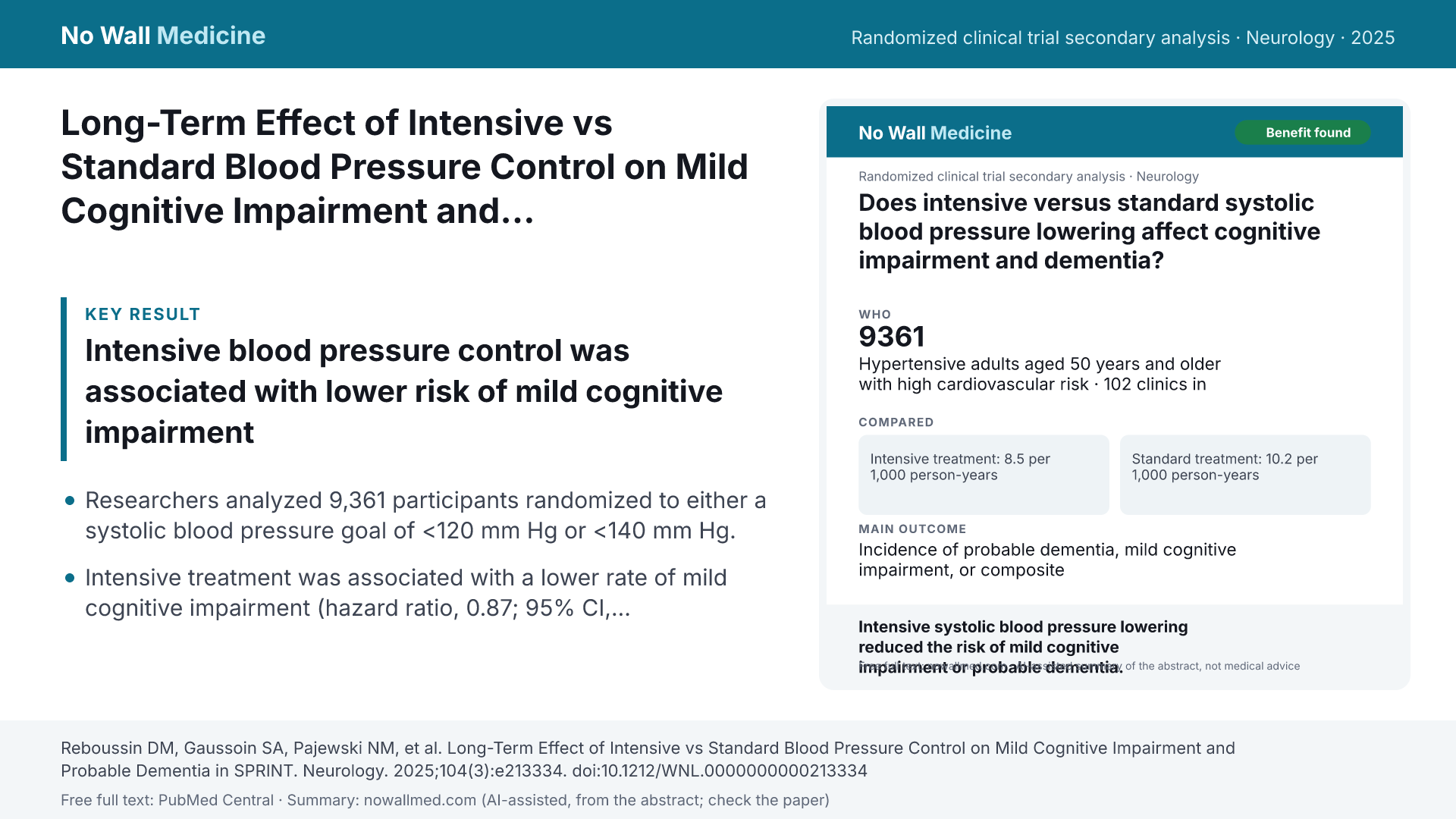
Intensive blood pressure control was associated with lower risk of mild cognitive impairment
Long-Term Effect of Intensive vs Standard Blood Pressure Control on Mild Cognitive Impairment and Probable Dementia in SPRINT
Randomized clinical trial secondary analysisBenefit found
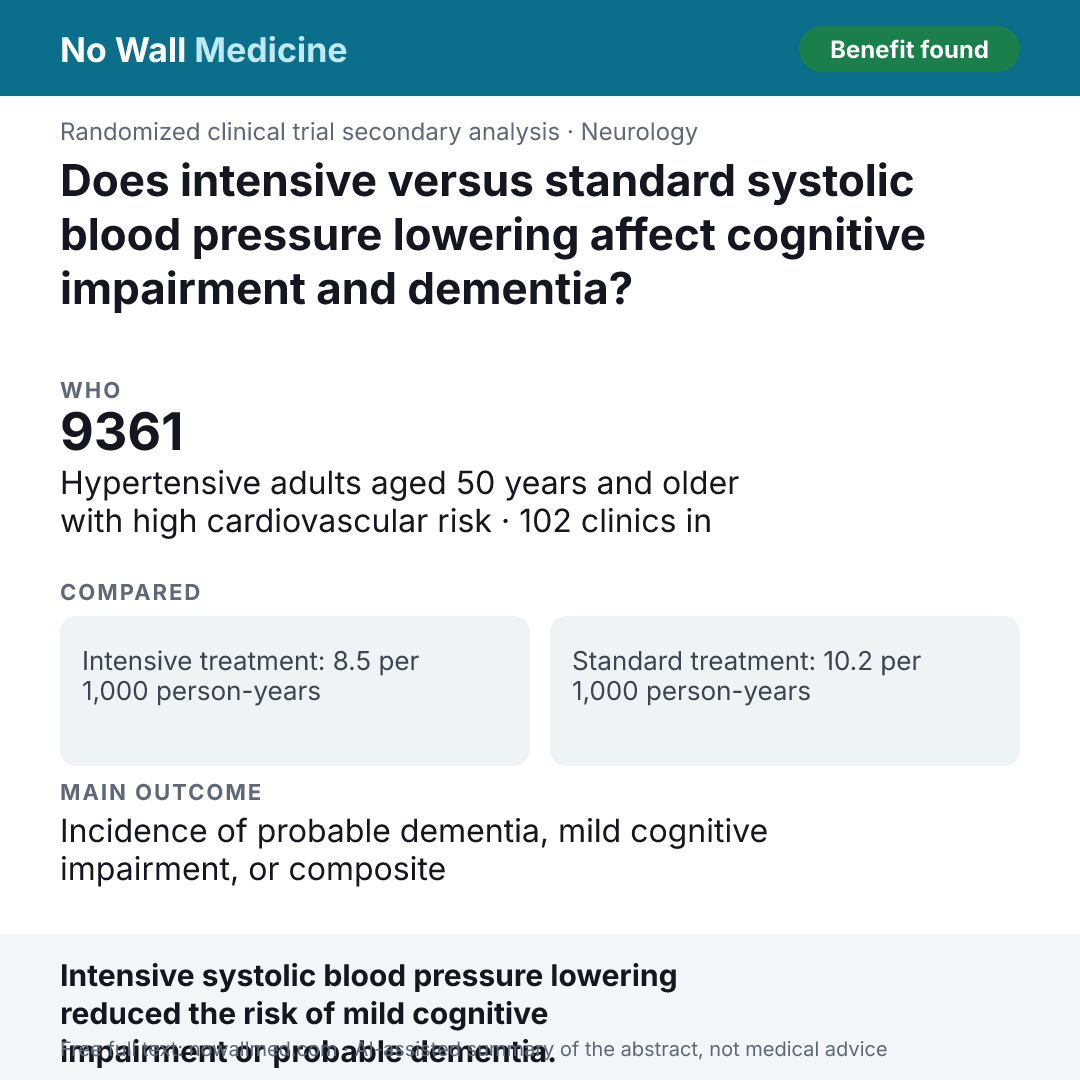
Does intensive versus standard systolic blood pressure lowering affect cognitive impairment and dementia?
Who
9361
Hypertensive adults aged 50 years and older with high cardiovascular risk · 102 clinics in the United States and Puerto Rico
Compared
Intensive treatment: 8.5 per 1,000 person-years
Standard treatment: 10.2 per 1,000 person-years
Main outcome
Incidence of probable dementia, mild cognitive impairment, or composite
Result: hazard ratio 0.89 (95% CI, 0.79, 0.99) for MCI or probable dementia
Bottom line: Intensive systolic blood pressure lowering reduced the risk of mild cognitive impairment or probable dementia.
Limitation: The number of probable dementia cases was less than the target of 326.
Neurology · 2025-01-16 · Save PNG
Same trial (NCT01206062)
Papers we list that report this registered trial, oldest first. Read a secondary analysis alongside the main results.
- Main results Benefit found
Lower blood pressure target reduced major cardiovascular events in high-risk patients NEJM 2015-11 - Secondary analysis Benefit found
Intensive blood pressure control effects on heart failure risk did not vary by kidney function Eur J Heart Fail 2020-08 - Secondary analysis Mixed results
Intensive blood pressure control was associated with greater hippocampal volume loss than standard treatment JAMA Neurol 2021-03 - Secondary analysis Mixed results
Higher baseline cardiovascular risk was associated with greater benefit from intensive blood pressure management JACC 2021-04 - Related analysis Benefit found
Intensive blood pressure control reduced major cardiovascular events and death compared to standard targets NEJM 2021-05 - Secondary analysis Benefit found
Intensive blood pressure lowering shows greater absolute risk reduction in patients with elevated cardiac biomarkers JAMA Cardiol 2021-09 - Related analysis No clear difference
Intensive blood pressure targets did not harm brain perfusion or structure in people with early kidney disease Am J Kidney Dis 2021-09 - Secondary analysis No clear difference
Race and ethnicity were associated with different rates of therapeutic inertia in blood pressure management JAMA Netw Open 2022-01 - Secondary analysis Mixed results
Intensive blood pressure control was associated with fewer cardiovascular events for some Black individuals JAMA Netw Open 2022-03 - Secondary analysis Benefit found
Intensive blood pressure control increased cerebral blood flow in adults with hypertension JAMA Neurol 2022-03 - Related analysis Benefit found
Intensive blood pressure control was associated with higher medication use and lower systolic blood pressure levels Hypertension 2022-06 - Secondary analysis No clear difference
Intensive blood pressure control benefits did not persist 4.5 years after the trial ended JAMA Cardiol 2022-10 - Secondary analysis Mixed results
Intensive blood pressure control was associated with more medication classes than standard blood pressure control Hypertension 2022-12 - Secondary analysis
Intensive blood pressure control did not harm cognition in patients with low diastolic pressure Hypertension 2023-01 - Secondary analysis Key finding
Intensive blood pressure control was associated with smaller increases in white matter lesion volume JAMA Netw Open 2023-03
Clinical question: Does intensive versus standard systolic blood pressure lowering affect cognitive impairment and dementia?
Why it matters: The early termination of the original trial left results regarding the effect of intensive blood pressure lowering on probable dementia inconclusive.
Key points
- Researchers analyzed 9,361 participants randomized to either a systolic blood pressure goal of <120 mm Hg or <140 mm Hg.
- Intensive treatment was associated with a lower rate of mild cognitive impairment (hazard ratio, 0.87; 95% CI, 0.76-1.00) and a lower rate of combined mild cognitive impairment or probable dementia (hazard ratio, 0.89; 95% CI, 0.79, 0.99).
- The difference in probable dementia alone was not statistically significant, with 8.5 per 1,000 person-years in the intensive group versus 10.2 per 1,000 person-years in the standard group (hazard ratio, 0.86; 95% CI, 0.72-1.02).
Headline and key points written with AI from the paper’s abstract, with every number checked against it. Read the paper before relying on them.
Was this summary helpful?
Subject terms
Headline, design, result, key points, caveat and citation as plain text.
Cite this article
Reboussin DM, Gaussoin SA, Pajewski NM, et al. Long-Term Effect of Intensive vs Standard Blood Pressure Control on Mild Cognitive Impairment and Probable Dementia in SPRINT. Neurology. 2025;104(3):e213334. doi:10.1212/WNL.0000000000213334
Spotted a mistake? Suggest a correction