High prevalence of urinary and sexual dysfunction found in patients after anorectal malformation repair
Long-term Functional Urinary and Sexual Outcomes in Patients with Anorectal Malformations-A Systematic Review
Systematic review and probabilistic meta-analysisHarm found
What is the prevalence of long-term urinary and sexual dysfunction after anorectal malformations repair?
Who
Patients aged over 10 years after repair of anorectal malformations in infancy
Compared
16%Urinary incontinence (95% confidence interval 7-27%)
36%Lower urinary tract symptoms or neurogenic bladder dysfunction (95% confidence interval 13-62%)
50%Sexual dysfunction among women (95% confidence interval 34-66%)
12%Erectile dysfunction (95% confidence interval 7-18%)
Main outcome
Prevalence of urinary and sexual dysfunction
Bottom line: Patients face a high prevalence of long-term urinary incontinence and sexual dysfunctions after anorectal malformations repair.
Limitation: Need for larger multicentre trials with more comparable populations.
Eur Urol Open Sci · 2021-02-03Download image
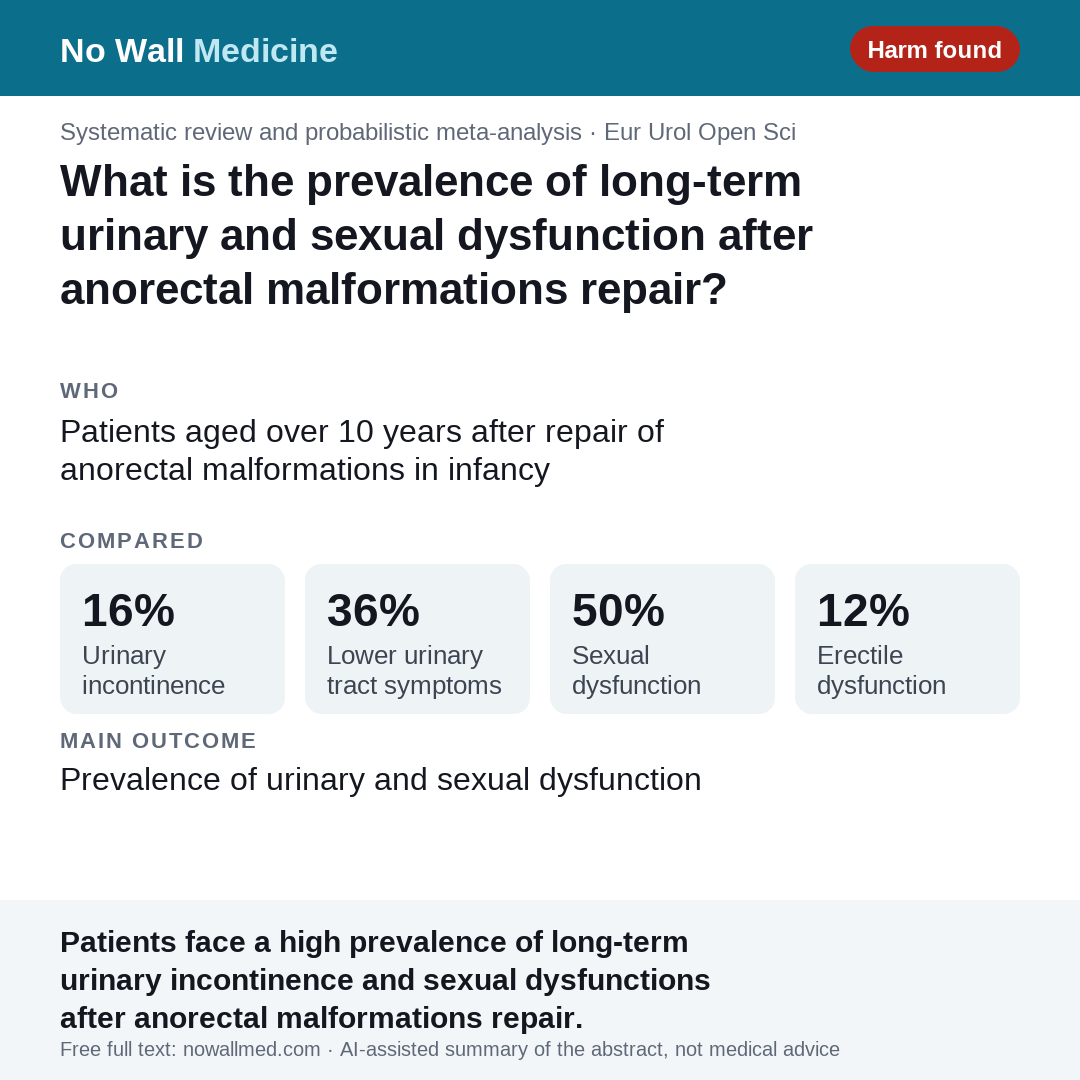
Clinical question: What is the prevalence of long-term urinary and sexual dysfunction after anorectal malformations repair?
Why it matters: The overall prevalence of urinary and sexual dysfunction remains unclear due to variations in surgical approaches and accompanying malformations of the genitalia or urinary tract.
Key points
- Researchers performed a systematic review of 17 studies to evaluate long-term urinary and sexual outcomes in patients older than 10 years who had surgery for anorectal malformations in infancy.
- The combined prevalence estimates were 16% for urinary incontinence, 36% for lower urinary tract symptoms or neurogenic bladder dysfunction, and 50% for sexual dysfunction among women.
- In men, the prevalence of erectile dysfunction was 12%, ejaculatory dysfunction was 16%, and the birth rate was 20%.
Headline and key points written with AI from the paper’s abstract, with every number checked against it. Read the paper before relying on them.
Was this summary helpful?
Cite this article
Bjoersum-Meyer T, Kaalby L, Lund L, Christensen P, Jakobsen MS, Baatrup G. Long-term Functional Urinary and Sexual Outcomes in Patients with Anorectal Malformations-A Systematic Review. Eur Urol Open Sci. 2021. doi:10.1016/j.euros.2021.01.007
Spotted a mistake? Suggest a correction
Top studies every Monday
The week’s key trials and guidelines in your specialties, plus any topics you follow. By email, free.
Get the weekly digest