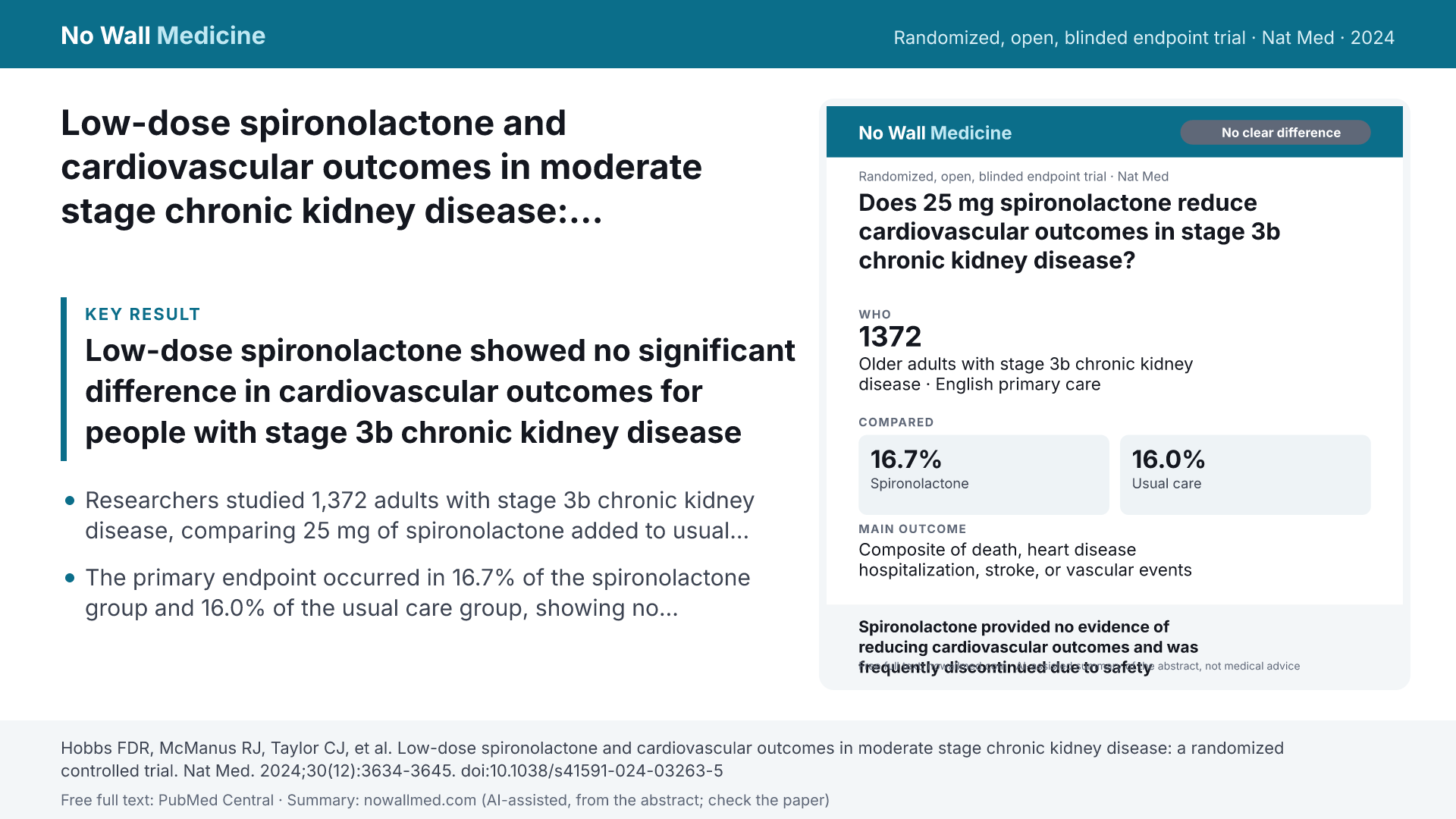
Low-dose spironolactone showed no significant difference in cardiovascular outcomes for people with stage 3b chronic kidney disease
Low-dose spironolactone and cardiovascular outcomes in moderate stage chronic kidney disease: a randomized controlled trial
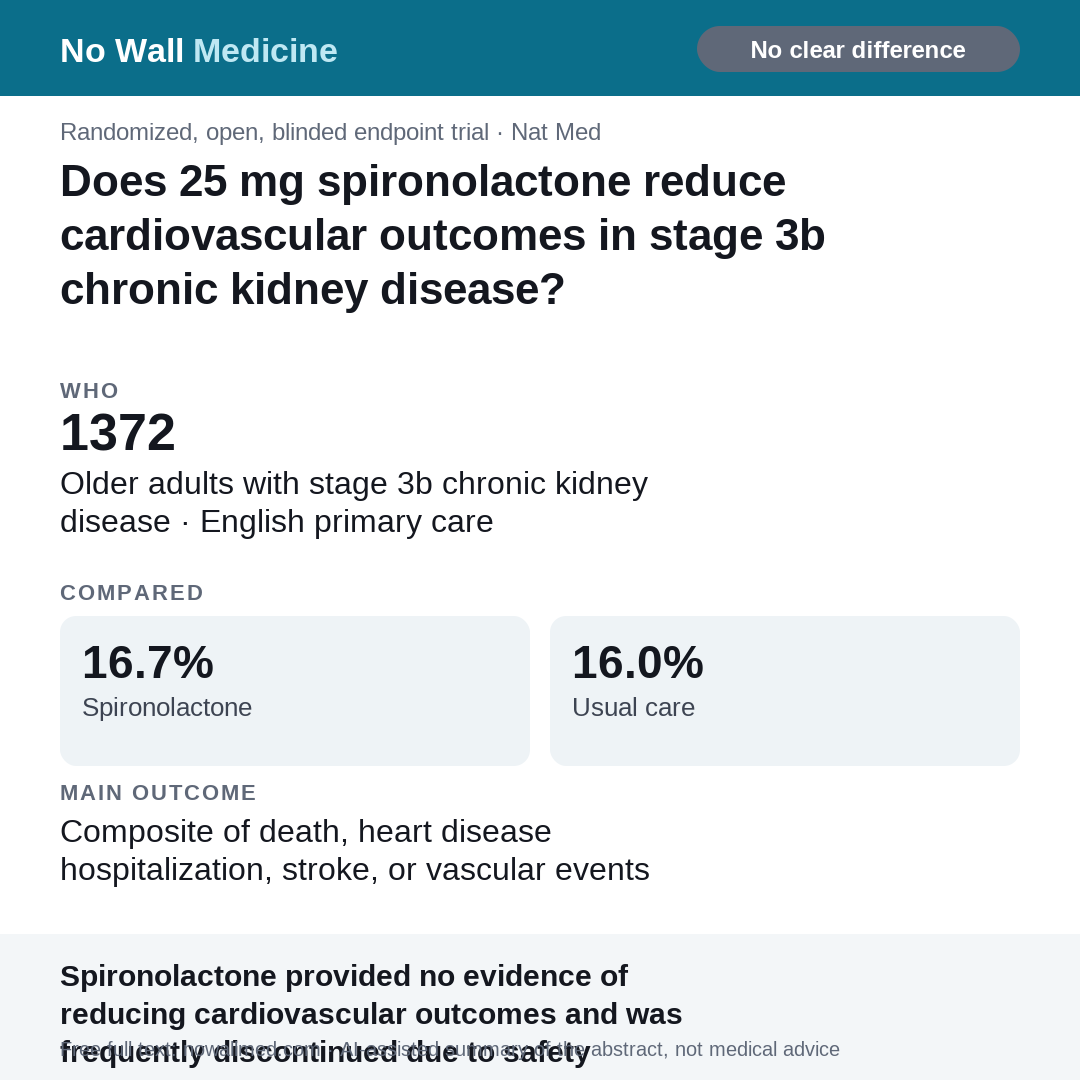
Randomized, open, blinded endpoint trialNo clear difference
Does 25 mg spironolactone reduce cardiovascular outcomes in stage 3b chronic kidney disease?
Who
1372
Older adults with stage 3b chronic kidney disease · English primary care
Compared
16.7%Spironolactone
16.0%Usual care
Main outcome
Composite of death, heart disease hospitalization, stroke, or vascular events
Result: hazard ratio 1.05 (95% confidence interval: 0.81-1.37)
Bottom line: Spironolactone provided no evidence of reducing cardiovascular outcomes and was frequently discontinued due to safety concerns.
Nat Med · 2024-09-30Download image
Clinical question: Does 25 mg spironolactone reduce cardiovascular outcomes in stage 3b chronic kidney disease?
Why it matters: It is uncertain if the steroidal mineralocorticoid receptor antagonist, spironolactone, provides the same cardiorenal protection as finerenone for people with chronic kidney disease.
Key points
- Researchers studied 1,372 adults with stage 3b chronic kidney disease, comparing 25 mg of spironolactone added to usual care against usual care alone.
- The primary endpoint occurred in 16.7% of the spironolactone group and 16.0% of the usual care group, showing no significant difference.
- Two-thirds of participants in the spironolactone group stopped treatment within 6 months, often due to a decrease in the estimated glomerular filtration rate.
Headline and key points written with AI from the paper’s abstract, with every number checked against it. Read the paper before relying on them.
Was this summary helpful?
Abstract
Chronic kidney disease (CKD) is associated with a substantial risk of progression to end-stage renal disease and vascular events. The nonsteroidal mineralocorticoid receptor antagonist (MRA), finerenone, offers cardiorenal protection for people with CKD and diabetes, but there is uncertainty if the steroidal MRA, spironolactone, provides the same protection. In this prospective, randomized, open, blinded endpoint trial, we assessed the effectiveness of 25 mg spironolactone in addition to usual care or usual care alone for reducing cardiovascular outcomes in stage 3b CKD among an older community cohort (mean age = 74.8 years and s.d. = 8.1). We recruited 1,434 adults from English primary care, of whom 1,372 (96%) were included in the primary analysis. The primary outcome was time from randomization until the first occurrence of death, hospitalization for heart disease, stroke, heart failure, transient ischemic attack or peripheral arterial disease, or first onset of any condition listed not present at baseline. Across 3 years of follow-up, the primary endpoint occurred in 113 of 677 participants randomized to spironolactone (16.7%) and 111 of 695 participants randomized to usual care (16.0%) with no significant difference between groups (hazard ratio = 1.05, 95% confidence interval: 0.81-1.37). Two-thirds of participants randomized to spironolactone stopped treatment within 6 months, predominantly because they met prespecified safety stop criteria. The most common reason for stopping spironolactone was a decrease in the estimated glomerular filtration rate that met prespecified stop criteria (n = 239, 35.4%), followed by participants being withdrawn due to treatment side effects (n = 128, 18.9%) and hyperkalemia (n = 54, 8.0%). In conclusion, we found that spironolactone was frequently discontinued due to safety concerns, with no evidence that it reduced cardiovascular outcomes in people with stage 3b CKD. Spironolactone should not be used for people with stage 3b CKD without another explicit treatment indication. ClinicalTrials.gov registration: ISRCTN44522369 .
Abstract reproduced under the article’s CC BY licence.
Subject terms
Cite this article
Hobbs FDR, McManus RJ, Taylor CJ, et al. Low-dose spironolactone and cardiovascular outcomes in moderate stage chronic kidney disease: a randomized controlled trial. Nat Med. 2024. doi:10.1038/s41591-024-03263-5
Spotted a mistake? Suggest a correction