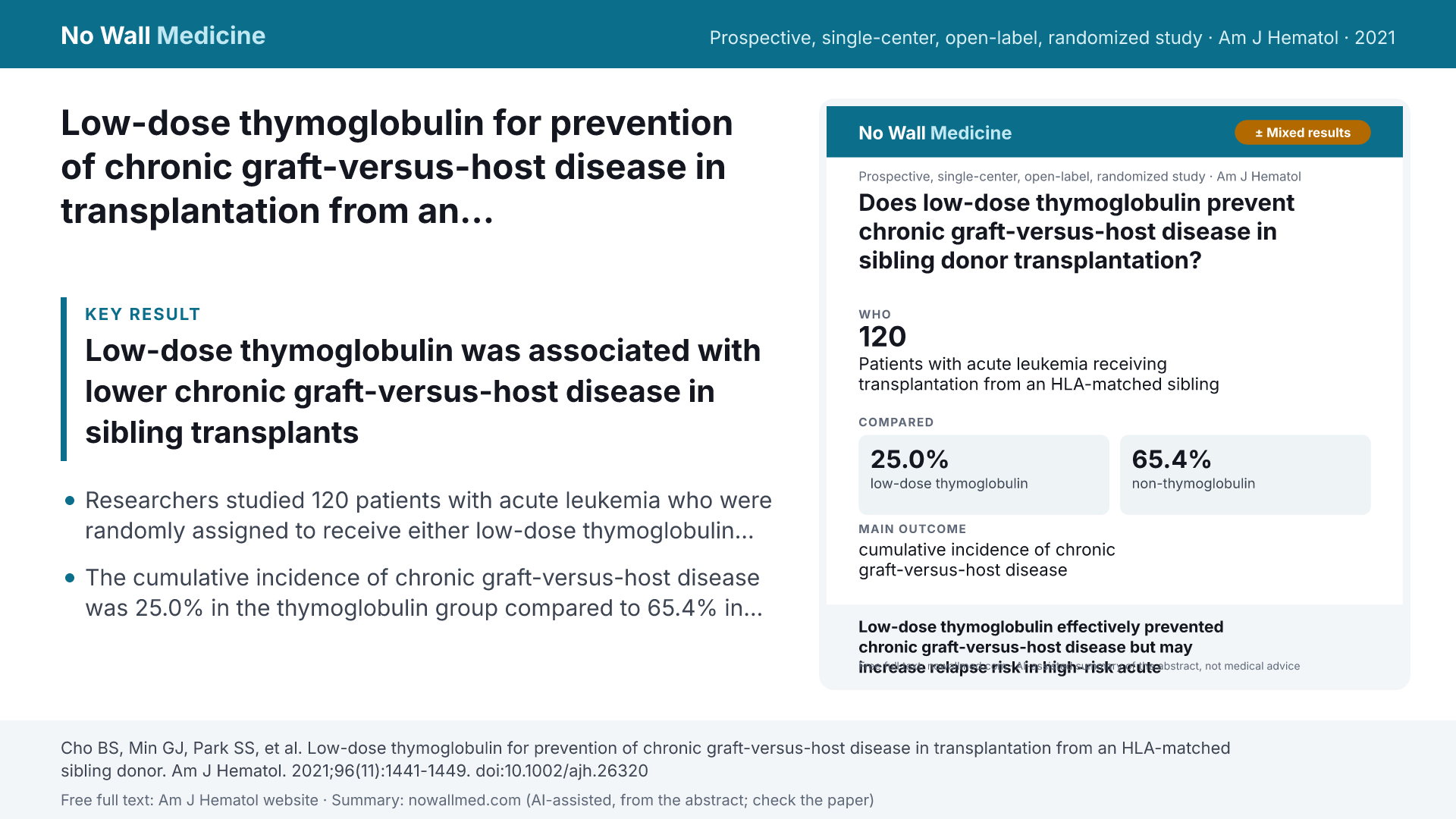
Low-dose thymoglobulin was associated with lower chronic graft-versus-host disease in sibling transplants
Low-dose thymoglobulin for prevention of chronic graft-versus-host disease in transplantation from an HLA-matched sibling donor
Prospective, single-center, open-label, randomized studyMixed results
Does low-dose thymoglobulin prevent chronic graft-versus-host disease in sibling donor transplantation?
Who
120
Patients with acute leukemia receiving transplantation from an HLA-matched sibling donor · single-center
Compared
25.0%low-dose thymoglobulin
65.4%non-thymoglobulin
Main outcome
cumulative incidence of chronic graft-versus-host disease
Bottom line: Low-dose thymoglobulin effectively prevented chronic graft-versus-host disease but may increase relapse risk in high-risk acute leukemia.
Limitation: The study notes the necessity of caution for high-risk acute leukemia regarding relapse.
Am J Hematol · 2021-08-27 · Save PNG
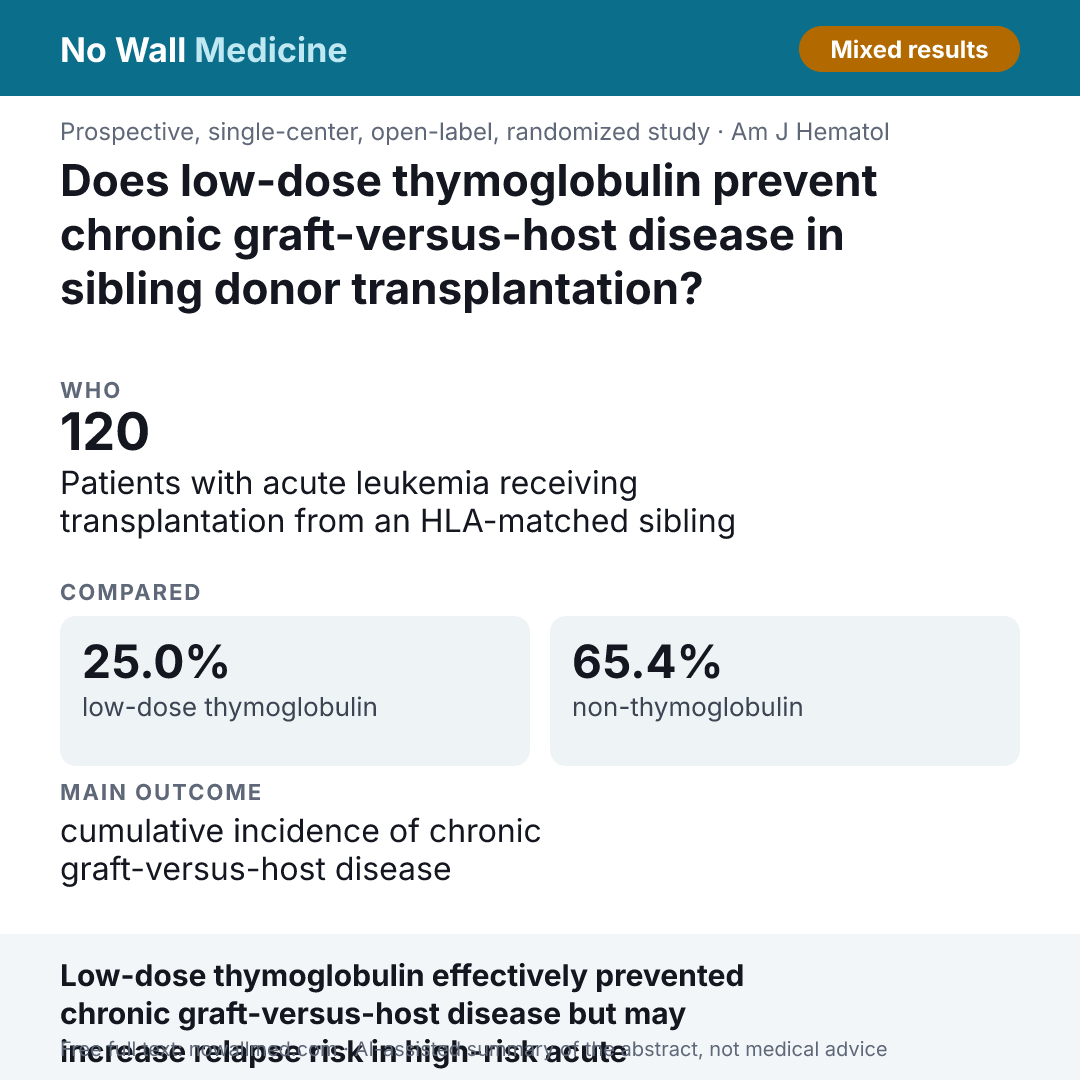
Clinical question: Does low-dose thymoglobulin prevent chronic graft-versus-host disease in sibling donor transplantation?
Why it matters: Dosing protocols and the effects of antithymocyte globulin on relapse and infection remain controversial in sibling transplants.
Key points
- Researchers studied 120 patients with acute leukemia who were randomly assigned to receive either low-dose thymoglobulin or no thymoglobulin after a sibling transplant.
- The cumulative incidence of chronic graft-versus-host disease was 25.0% in the thymoglobulin group compared to 65.4% in the group without thymoglobulin.
- The thymoglobulin group had a higher rate of Epstein-Barr virus reactivation at 21.8% compared to 5.1% in the group without thymoglobulin.
Limitation the authors note: The study was a prospective, single-center, open-label, randomized study.
Headline and key points written with AI from the paper’s abstract, with every number checked against it. Read the paper before relying on them.
Was this summary helpful?
Subject terms
Headline, design, result, key points, caveat and citation as plain text.
Cite this article
Cho BS, Min GJ, Park SS, et al. Low-dose thymoglobulin for prevention of chronic graft-versus-host disease in transplantation from an HLA-matched sibling donor. Am J Hematol. 2021;96(11):1441-1449. doi:10.1002/ajh.26320
Spotted a mistake? Suggest a correction