Lower oxygenation targets were not linked to different mortality rates in critically ill patients
Lower versus higher oxygenation targets in critically ill patients with severe hypoxaemia: secondary Bayesian analysis to explore heterogeneous treatment effects in the Handling Oxygenation Targets in the Intensive Care Unit (HOT-ICU) trial
Secondary Bayesian analysis of a randomized trialNo clear difference
Does a lower versus higher oxygenation target affect mortality in critically ill patients?
Who
2888
Critically ill adult patients with acute hypoxaemic respiratory failure
Compared
43.0%lower oxygenation target (CrI: 38.3-47.8%)
42.3%higher oxygenation target (CrI: 37.7-47.1%)
Main outcome
90-day all-cause mortality
Result: relative risk 1.02 (95% CrI: 0.93-1.11)
Bottom line: Lower oxygenation targets unlikely affect overall mortality, but may increase risk as norepinephrine doses increase.
Limitation: Findings regarding increased mortality risk with higher norepinephrine doses warrant additional investigation.
Br J Anaesth · 2021-10-19Download image
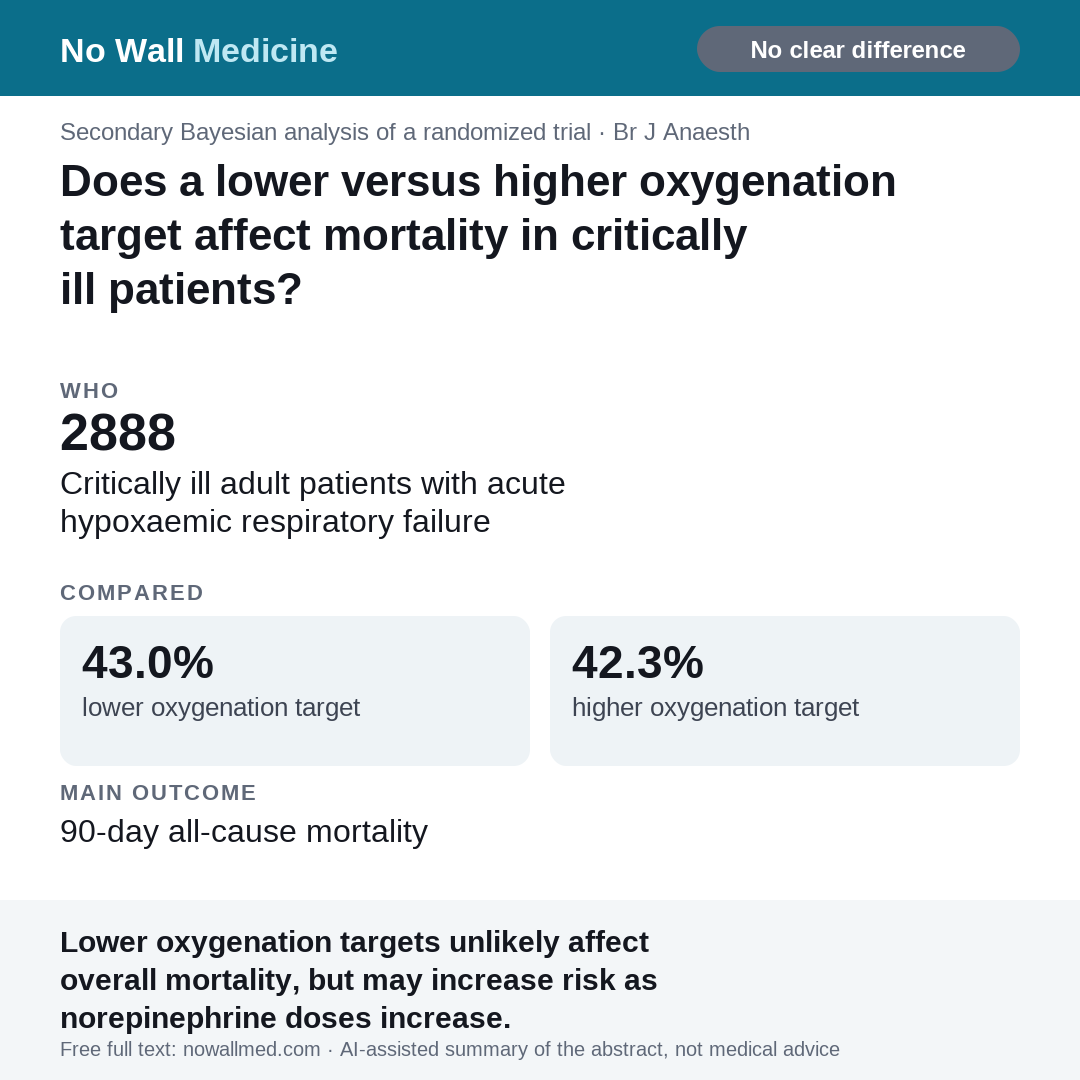
Clinical question: Does a lower versus higher oxygenation target affect mortality in critically ill patients?
Why it matters: It was unknown if specific patient characteristics, such as the need for blood pressure medication, influenced the effect of oxygenation targets on mortality.
Key points
- Researchers analyzed 2888 critically ill adult patients to compare a lower oxygen target of 8 kPa against a higher target of 12 kPa.
- The 90-day mortality rates were 43.0% for the lower target group and 42.3% for the higher target group.
- An increasing mortality risk was associated with the lower oxygen target as the baseline dose of norepinephrine, a medication used to raise blood pressure, increased.
Headline and key points written with AI from the paper’s abstract, with every number checked against it. Read the paper before relying on them.
Was this summary helpful?
Subject terms
Cite this article
Klitgaard TL, Schjørring OL, Lange T, Møller MH, Perner A, Rasmussen BS. Lower versus higher oxygenation targets in critically ill patients with severe hypoxaemia: secondary Bayesian analysis to explore heterogeneous treatment effects in the Handling Oxygenation Targets in the Intensive Care Unit (HOT-ICU) trial. Br J Anaesth. 2021. doi:10.1016/j.bja.2021.09.010
Spotted a mistake? Suggest a correction
Top studies every Monday
The week’s key trials and guidelines in your specialties, plus any topics you follow. By email, free.
Get the weekly digest