Bayesian reanalysis shows accelerated kidney replacement therapy provides no clinically important benefit for mortality
A Bayesian reanalysis of the Standard versus Accelerated Initiation of Renal-Replacement Therapy in Acute Kidney Injury (STARRT-AKI) trial
Bayesian reanalysis of a randomized trialNo clear difference
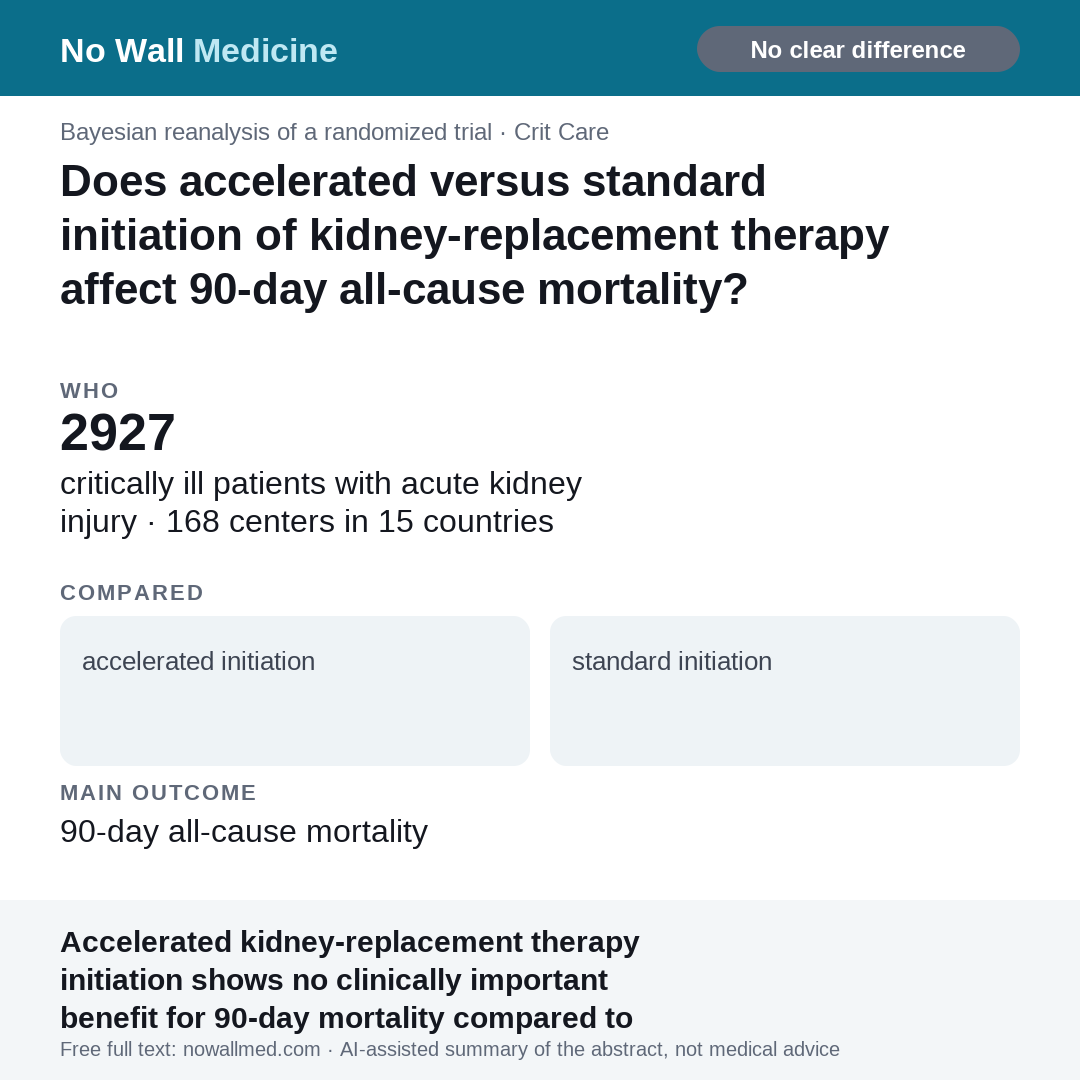
Does accelerated versus standard initiation of kidney-replacement therapy affect 90-day all-cause mortality?
Who
2927
critically ill patients with acute kidney injury · 168 centers in 15 countries
Compared
accelerated initiation
standard initiation
Main outcome
90-day all-cause mortality
Result: absolute difference of 0.13% (95% credible interval -3.30% to 3.40%)
Bottom line: Accelerated kidney-replacement therapy initiation shows no clinically important benefit for 90-day mortality compared to standard initiation.
Crit Care · 2022-08-25Download image
Clinical question: Does accelerated versus standard initiation of kidney-replacement therapy affect 90-day all-cause mortality?
Why it matters: The timing of starting kidney replacement therapy in critically ill patients with acute kidney injury remains controversial.
Key points
- Researchers reanalyzed 2927 patients from a multi-national trial to compare accelerated versus standard timing for starting kidney replacement therapy.
- The reanalysis found no important difference in 90-day all-cause mortality, with an absolute difference of 0.13% using neutral priors.
- Patients in the accelerated group had a median absolute difference of -3.55 days in kidney replacement therapy-free days.
Headline and key points written with AI from the paper’s abstract, with every number checked against it. Read the paper before relying on them.
Was this summary helpful?
Subject terms
Cite this article
Zampieri FG, da Costa BR, Vaara ST, Lamontagne F, Rochwerg B, Nichol AD. A Bayesian reanalysis of the Standard versus Accelerated Initiation of Renal-Replacement Therapy in Acute Kidney Injury (STARRT-AKI) trial. Crit Care. 2022. doi:10.1186/s13054-022-04120-y
Spotted a mistake? Suggest a correction
Top studies every Monday
The week’s key trials and guidelines in your specialties, plus any topics you follow. By email, free.
Get the weekly digest