Machine and deep learning show high potential for detecting tuberculosis on chest X-rays
Machine and Deep Learning for Tuberculosis Detection on Chest X-Rays: Systematic Literature Review
Systematic literature review and meta-analysisBenefit found
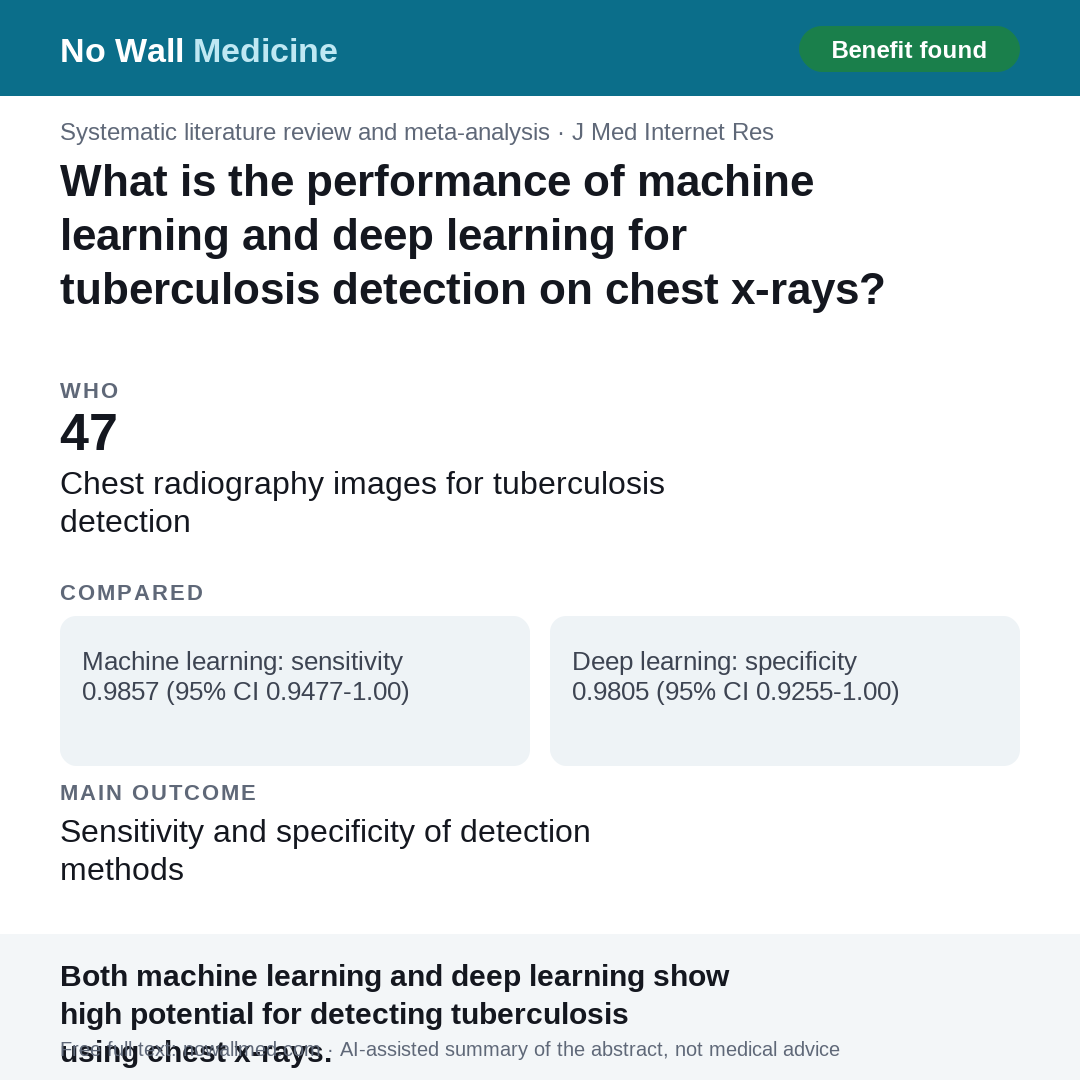
What is the performance of machine learning and deep learning for tuberculosis detection on chest x-rays?
Who
47
Chest radiography images for tuberculosis detection
Compared
Machine learning: sensitivity 0.9857 (95% CI 0.9477-1.00)
Deep learning: specificity 0.9805 (95% CI 0.9255-1.00)
Main outcome
Sensitivity and specificity of detection methods
Bottom line: Both machine learning and deep learning show high potential for detecting tuberculosis using chest x-rays.
Limitation: Unclear risks for reference standard and flow and timing aspects in many studies.
J Med Internet Res · 2023-07-03Download image
Clinical question: What is the performance of machine learning and deep learning for tuberculosis detection on chest x-rays?
Why it matters: Human experts show substantial variability and poor reliability when reading chest X-rays to diagnose tuberculosis.
Key points
- Researchers reviewed 47 studies to compare machine learning and deep learning performance in detecting tuberculosis using chest X-rays.
- Machine learning had a mean accuracy of ~93.71% and sensitivity of ~92.55%, while deep learning had a mean area under the curve of ~92.12% and specificity of ~91.54%.
- A meta-analysis of 10 studies estimated pooled sensitivity for machine learning at 0.9857 and specificity for deep learning at 0.9805.
Limitation the authors note: Many studies had unclear risks of bias regarding the reference standard and the flow and timing of participants.
Headline and key points written with AI from the paper’s abstract, with every number checked against it. Read the paper before relying on them.
Was this summary helpful?
Subject terms
Cite this article
Hansun S, Argha A, Liaw ST, Celler BG, Marks GB. Machine and Deep Learning for Tuberculosis Detection on Chest X-Rays: Systematic Literature Review. J Med Internet Res. 2023. doi:10.2196/43154
Spotted a mistake? Suggest a correction
Top studies every Monday
The week’s key trials and guidelines in your specialties, plus any topics you follow. By email, free.
Get the weekly digest