Mesenchymal precursor cells reduced major cardiovascular events in patients with ischaemic heart failure and inflammation
Mesenchymal precursor cells reduce mortality and major morbidity in ischaemic heart failure with inflammation: DREAM-HF
Randomized trialBenefit found
Do mesenchymal precursor cells improve major clinical outcomes in ischaemic heart failure with inflammation?
Who
Patients with ischaemic heart failure with reduced ejection fraction and inflammation
Compared
Mesenchymal precursor cells
Control
Main outcome
2-point and 3-point major adverse cardiovascular events
Result: reduced 2-point and 3-point major adverse cardiovascular events by 88% (p=0.005) and 52% (p=0.018)
Bottom line: Mesenchymal precursor cells significantly reduced major adverse cardiovascular events in ischaemic heart failure patients with inflammation.
Eur J Heart Fail · 2024-11-26Download image
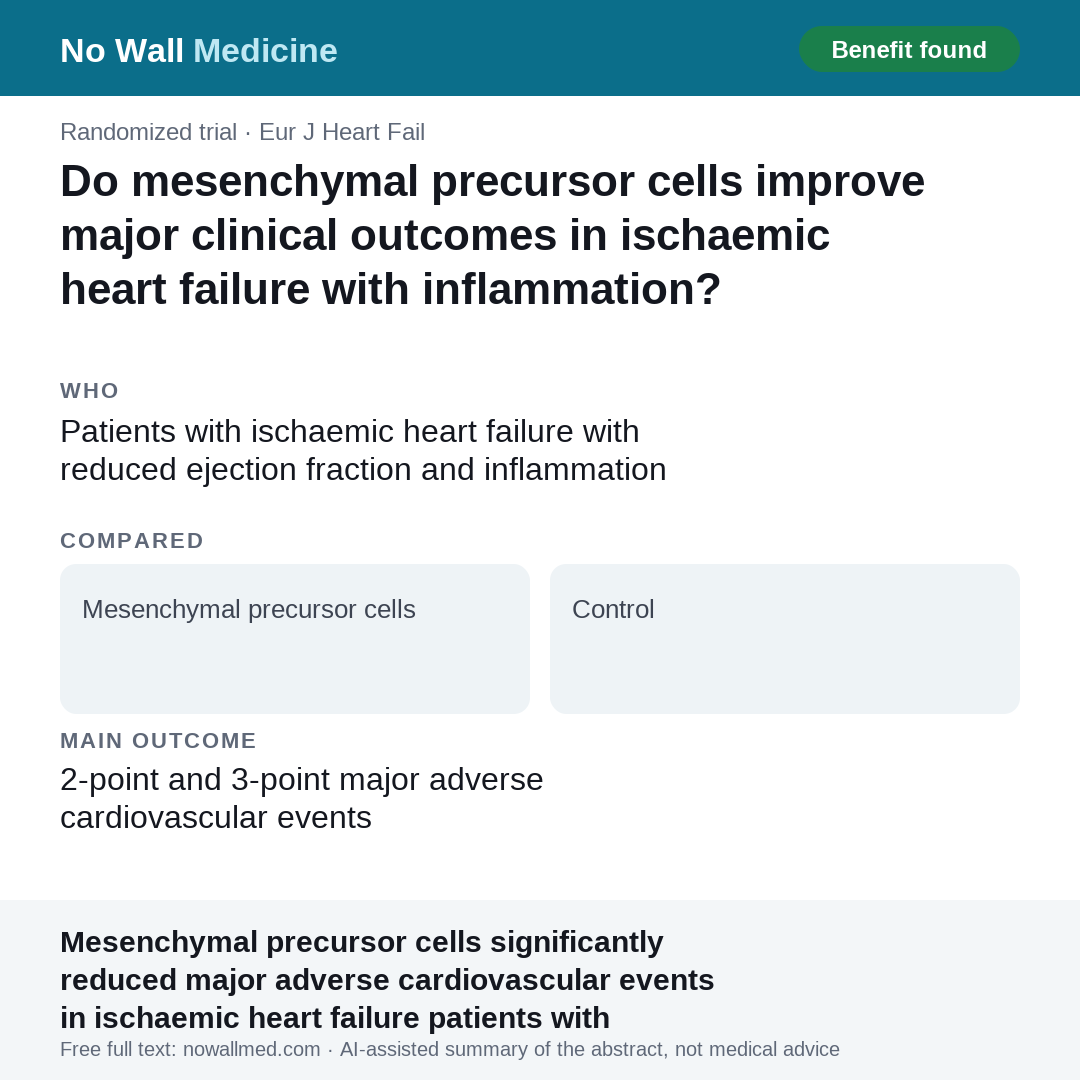
Clinical question: Do mesenchymal precursor cells improve major clinical outcomes in ischaemic heart failure with inflammation?
Why it matters: It was unknown if mesenchymal precursor cells could improve clinical outcomes in high-risk patients with ischaemic heart failure and inflammation.
Key points
- Researchers studied patients with heart failure and reduced ejection fraction, comparing those receiving mesenchymal precursor cells to a control group over a 30-month mean follow-up.
- In patients with ischaemic heart failure and inflammation, mesenchymal precursor cells reduced 2-point major adverse cardiovascular events by 88% and 3-point major adverse cardiovascular events by 52%.
- In the control group, inflammation and ischaemic heart failure were linked to increased risks of cardiovascular death of 61% and 38%, respectively.
Headline and key points written with AI from the paper’s abstract, with every number checked against it. Read the paper before relying on them.
Topics
Cite this article
Perin EC, Borow KM, Henry TD, Jenkins M, Rutman O, Hayes J. Mesenchymal precursor cells reduce mortality and major morbidity in ischaemic heart failure with inflammation: DREAM-HF. Eur J Heart Fail. 2024. doi:10.1002/ejhf.3522
Spotted a mistake? Suggest a correction
Top studies every Monday
The week’s key trials and guidelines in your specialties, plus any topics you follow. By email, free.
Get the weekly digest