Survival rates after heart valve replacement change depending on the time since the procedure
Meta-analysis of phase-specific survival after transcatheter versus surgical aortic valve replacement from randomized control trials
Meta-analysis of 8 randomized controlled trialsMixed results
What are the phase-specific survival outcomes of transcatheter versus surgical aortic valve replacement?
Who
8885
Patients with severe symptomatic aortic stenosis
Compared
Transcatheter aortic valve replacement
Surgical aortic valve replacement
Main outcome
Phase-specific survival
Result: very short-term HR 0.85 (95% CI 0.74-0.98); mid-term HR 1.15 (95% CI 1.03-1.29)
Bottom line: Transcatheter aortic valve replacement shows greater very short-term survival but lower mid-term survival compared to surgical aortic valve replacement.
J Thorac Cardiovasc Surg · 2023-05-05Download image
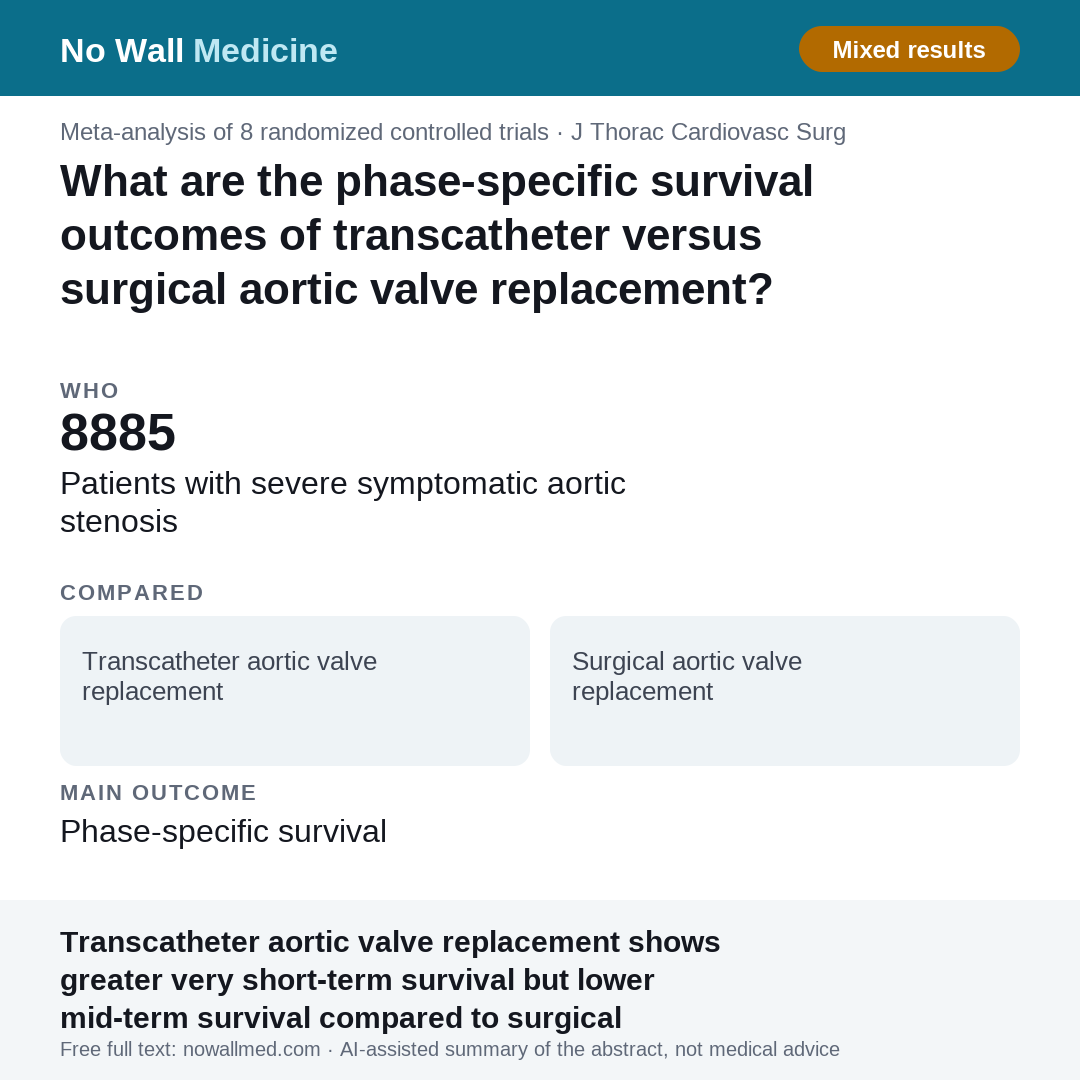
Clinical question: What are the phase-specific survival outcomes of transcatheter versus surgical aortic valve replacement?
Why it matters: It is unknown how survival and specific complications change over different time periods following transcatheter versus surgical aortic valve replacement.
Key points
- Researchers analyzed 8 randomized controlled trials involving 8885 patients with a mean age of 79 years to compare transcatheter aortic valve replacement (TAVR) and surgical aortic valve replacement (SAVR).
- TAVR was associated with higher survival in the very short-term (0-1 years) with a hazard ratio of 0.85, but lower survival in the mid-term (2-5 years) with a hazard ratio of 1.15.
- Initial rates of permanent pacemaker implantation and aortic valve reinterventions were higher in the TAVR group, though these differences disappeared by the mid-term period.
Headline and key points written with AI from the paper’s abstract, with every number checked against it. Read the paper before relying on them.
Was this summary helpful?
Subject terms
Cite this article
Yokoyama Y, Shimoda T, Sloan B, Takagi H, Fukuhara S, Kuno T. Meta-analysis of phase-specific survival after transcatheter versus surgical aortic valve replacement from randomized control trials. J Thorac Cardiovasc Surg. 2023. doi:10.1016/j.jtcvs.2023.04.041
Spotted a mistake? Suggest a correction
Top studies every Monday
The week’s key trials and guidelines in your specialties, plus any topics you follow. By email, free.
Get the weekly digest