Testing methods for MGMT methylation status influence survival predictions in glioblastoma patients
MGMT promoter methylation testing to predict overall survival in people with glioblastoma treated with temozolomide: a comprehensive meta-analysis based on a Cochrane Systematic Review
Meta-analysis of 32 independent cohortsMixed results
Does MGMT promoter methylation testing predict overall survival in glioblastoma treated with temozolomide?
Who
3474
Adults with glioblastoma treated with temozolomide
Compared
Methylation-specific PCR and pyrosequencing: more prognostic than immunohistochemistry
Immunohistochemistry
Main outcome
overall survival
Bottom line: Methylation-specific PCR and pyrosequencing are more prognostic than immunohistochemistry for predicting survival.
Limitation: No strong evidence about the best CpG sites, threshold, or tissue type.
Neuro Oncol · 2021-09-01Download image
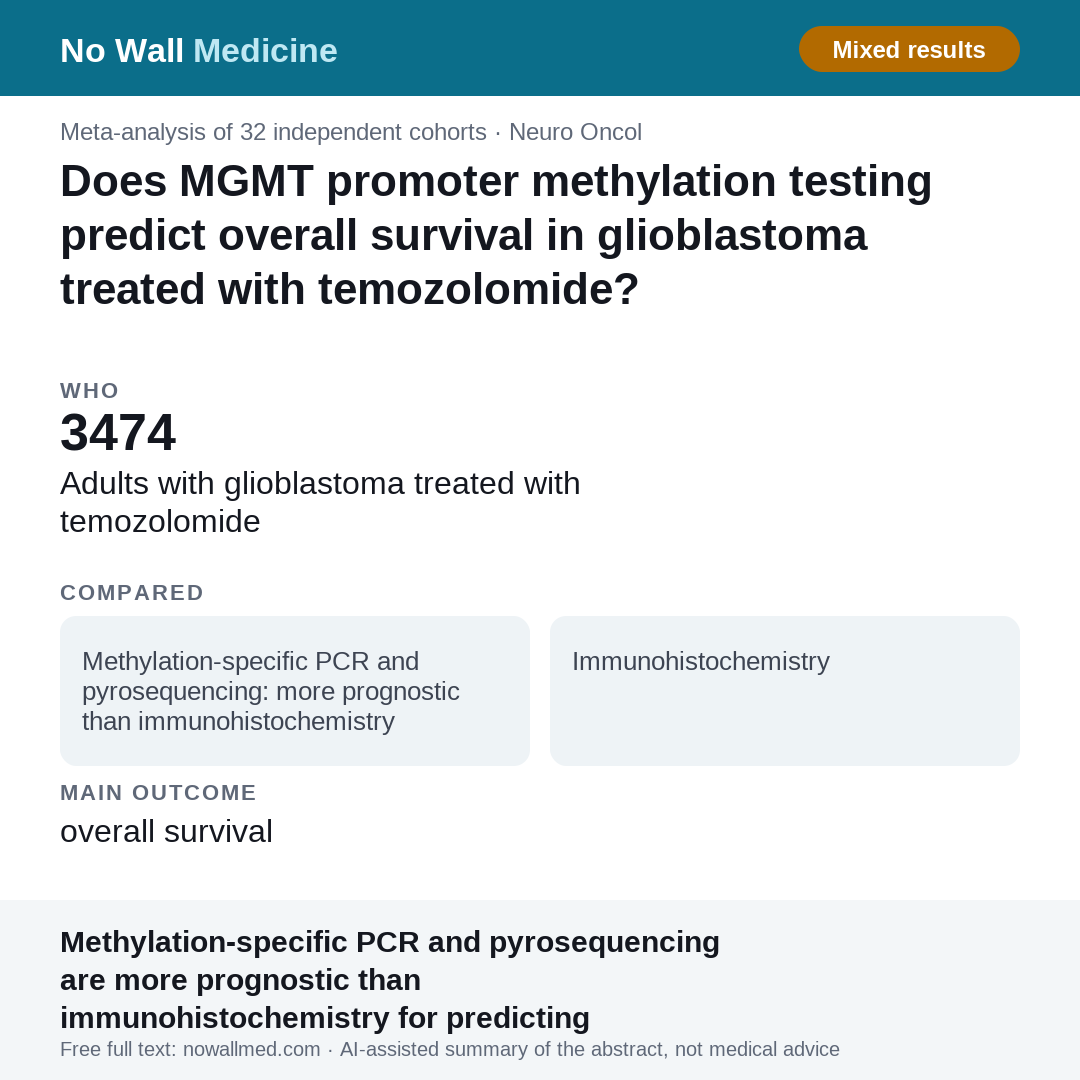
Clinical question: Does MGMT promoter methylation testing predict overall survival in glioblastoma treated with temozolomide?
Why it matters: There is no consensus on which testing method, methylation sites, or cutoff values to use to predict survival in glioblastoma patients treated with temozolomide.
Key points
- Researchers analyzed 32 independent cohorts containing 3474 patients to compare different methods of measuring MGMT, a protein that causes resistance to chemotherapy.
- Methylation-specific polymerase chain reaction and pyrosequencing were more prognostic than immunohistochemistry, with pyrosequencing being a slightly better predictor than methylation-specific polymerase chain reaction.
- A cutoff threshold of 9% for CpG sites 74-78 performed better than thresholds of 28% or 29% in 2 of the 3 good-quality studies.
Headline and key points written with AI from the paper’s abstract, with every number checked against it. Read the paper before relying on them.
Was this summary helpful?
Subject terms
Cite this article
Brandner S, McAleenan A, Kelly C, Spiga F, Cheng HY, Dawson S. MGMT promoter methylation testing to predict overall survival in people with glioblastoma treated with temozolomide: a comprehensive meta-analysis based on a Cochrane Systematic Review. Neuro Oncol. 2021. doi:10.1093/neuonc/noab105
Spotted a mistake? Suggest a correction
Top studies every Monday
The week’s key trials and guidelines in your specialties, plus any topics you follow. By email, free.
Get the weekly digest