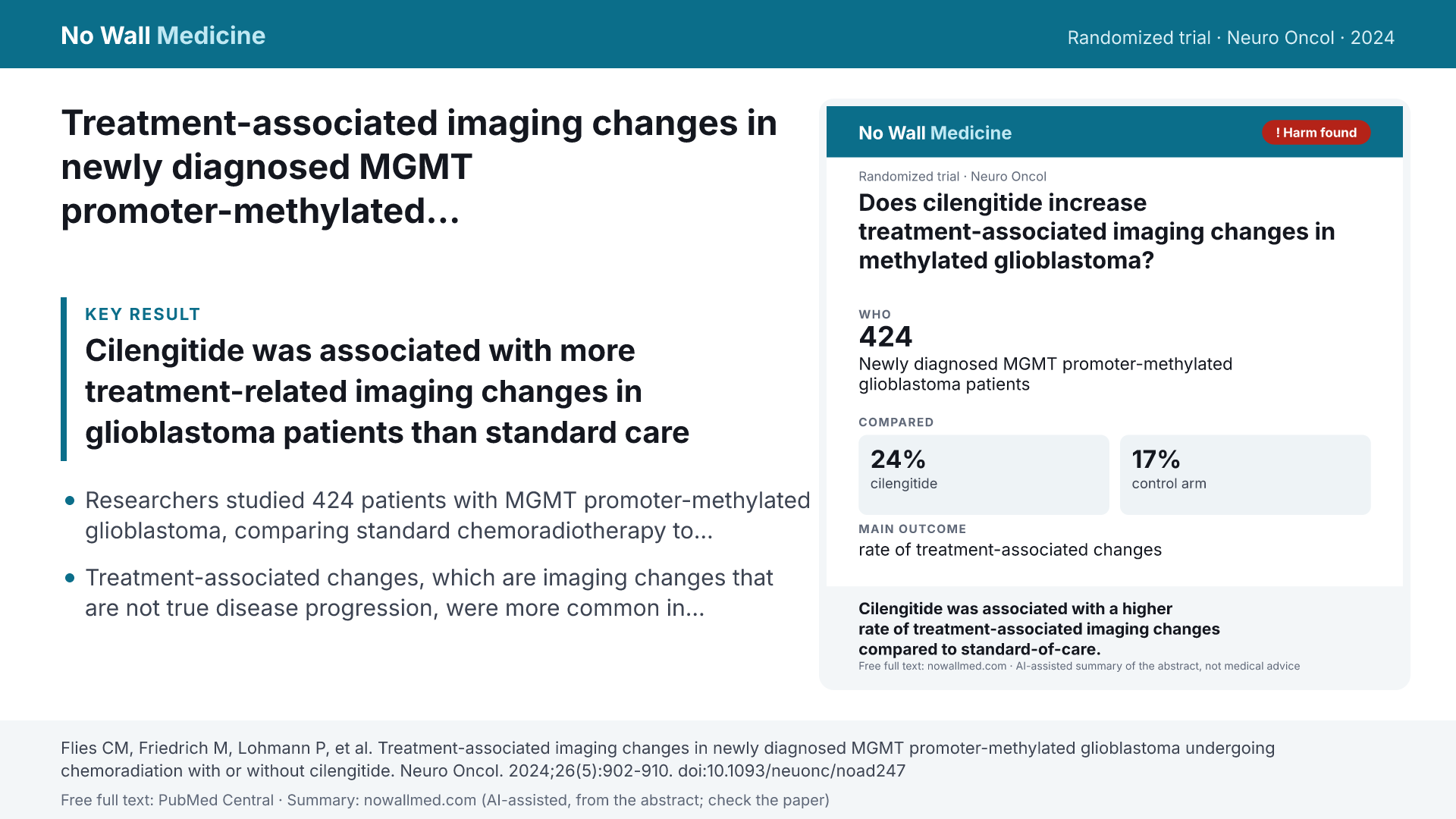
Cilengitide was associated with more treatment-related imaging changes in glioblastoma patients than standard care
Treatment-associated imaging changes in newly diagnosed MGMT promoter-methylated glioblastoma undergoing chemoradiation with or without cilengitide
Randomized trialHarm found
Does cilengitide increase treatment-associated imaging changes in methylated glioblastoma?
Who
424
Newly diagnosed MGMT promoter-methylated glioblastoma patients
Compared
24%cilengitide
17%control arm
Main outcome
rate of treatment-associated changes
Result: relative risk 1.3 (95% CI 1.004-1.795)
Bottom line: Cilengitide was associated with a higher rate of treatment-associated imaging changes compared to standard-of-care.
Neuro Oncol · 2024-01-14Download image
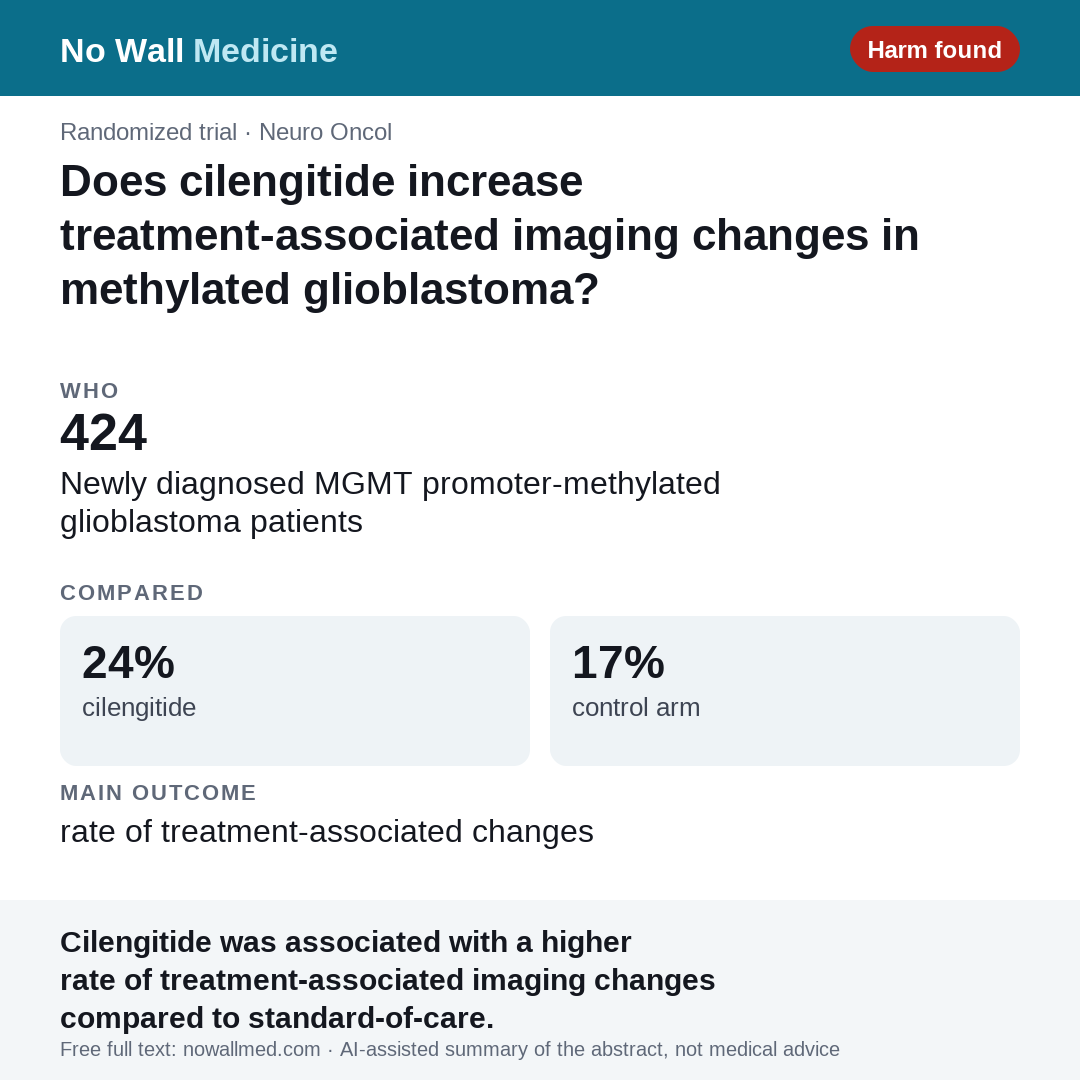
Clinical question: Does cilengitide increase treatment-associated imaging changes in methylated glioblastoma?
Why it matters: It is difficult to distinguish between true tumor growth and treatment-related changes on brain scans in patients with methylated glioblastoma.
In absolute numbers
cilengitide: 24% · control arm: 17% → a difference of 7 percentage points, so about 15 people would receive it for 1 more to be harmed (number needed to harm) over the trial’s follow-up.
Worked out by us from the two group results above, not reported by the authors. Check the paper for the exact outcome and timing.
Key points
- Researchers studied 424 patients with MGMT promoter-methylated glioblastoma, comparing standard chemoradiotherapy to treatment with or without the integrin inhibitor cilengitide.
- Treatment-associated changes, which are imaging changes that are not true disease progression, were more common in the cilengitide group at 24% compared to 17% in the control group.
- Of the 274 patients who showed preliminary disease progression, 88 patients (32%) experienced treatment-associated changes while 67 patients (25%) had true progressive disease.
Headline and key points written with AI from the paper’s abstract, with every number checked against it. Read the paper before relying on them.
Was this summary helpful?
Subject terms
Cite this article
Flies CM, Friedrich M, Lohmann P, van Garderen KA, Smits M, Tonn JC. Treatment-associated imaging changes in newly diagnosed MGMT promoter-methylated glioblastoma undergoing chemoradiation with or without cilengitide. Neuro Oncol. 2024. doi:10.1093/neuonc/noad247
Spotted a mistake? Suggest a correction