Mindfulness and cognitive behavioral therapy showed similar results for chronic low back pain treated with opioids
Mindfulness vs Cognitive Behavioral Therapy for Chronic Low Back Pain Treated With Opioids: A Randomized Clinical Trial
Partially masked, multisite, randomized clinical trialNo clear difference
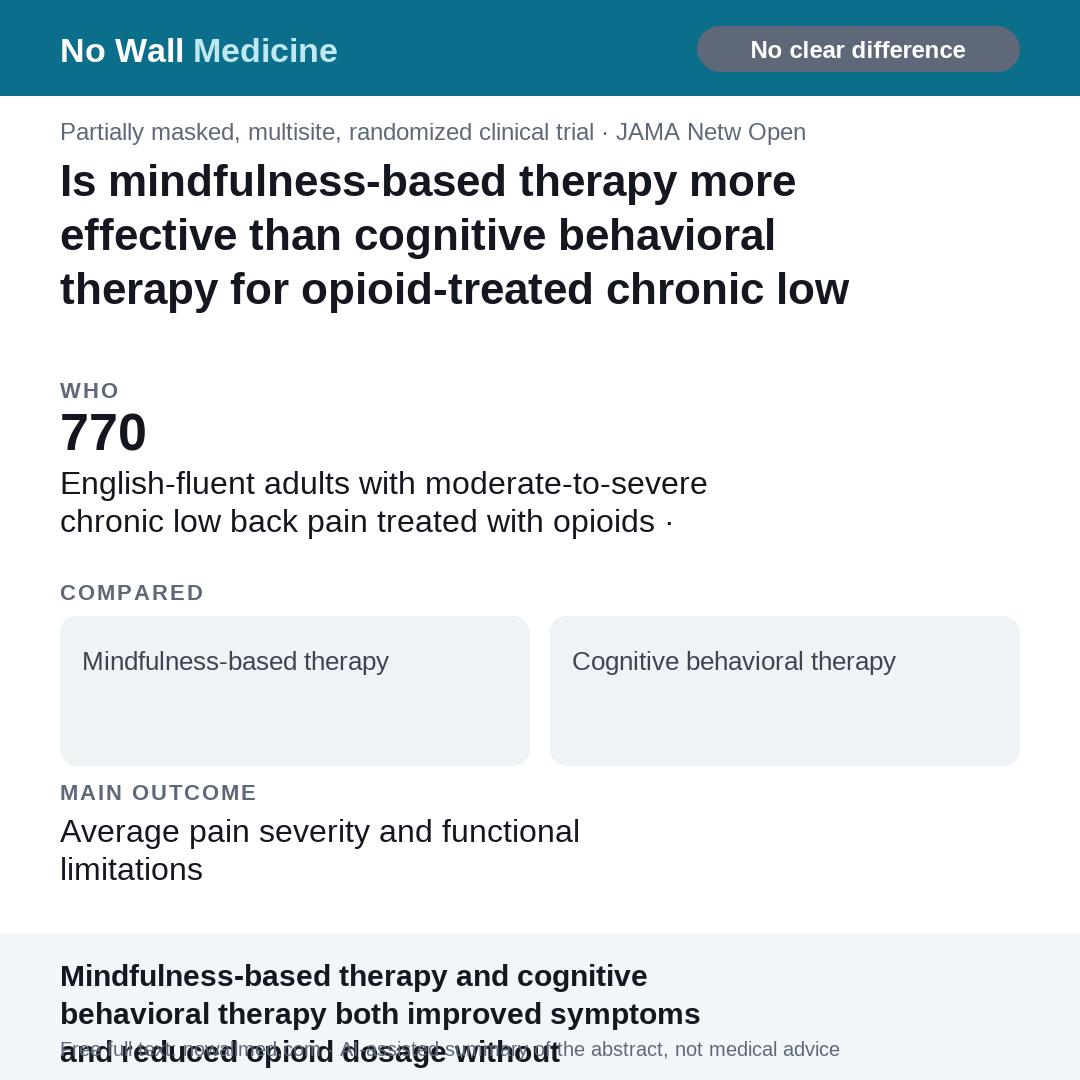
Is mindfulness-based therapy more effective than cognitive behavioral therapy for opioid-treated chronic low back pain?
Who
770
English-fluent adults with moderate-to-severe chronic low back pain treated with opioids · Primary and specialty care clinics and community settings
Compared
Mindfulness-based therapy
Cognitive behavioral therapy
Main outcome
Average pain severity and functional limitations
Result: no significant difference at 6 and 12 months
Bottom line: Mindfulness-based therapy and cognitive behavioral therapy both improved symptoms and reduced opioid dosage without significant differences between groups.
JAMA Netw Open · 2025-04-01Download image
Clinical question: Is mindfulness-based therapy more effective than cognitive behavioral therapy for opioid-treated chronic low back pain?
Why it matters: It was unknown whether mindfulness-based therapy is more effective than cognitive behavioral therapy for managing symptoms in patients using opioids for chronic low back pain.
Key points
- Researchers enrolled 770 adults with moderate-to-severe chronic low back pain treated with opioids and assigned them to either mindfulness-based therapy or cognitive behavioral therapy.
- At 6 and 12 months, there were no significant differences between the two groups for pain severity or functional limitations.
- Both groups showed improvements in symptoms and a decrease in daily opioid dosage over the study period.
Headline and key points written with AI from the paper’s abstract, with every number checked against it. Read the paper before relying on them.
Was this summary helpful?
Subject terms
Cite this article
Zgierska AE, Edwards RR, Barrett B, Burzinski CA, Jamison RN, Nakamura Y. Mindfulness vs Cognitive Behavioral Therapy for Chronic Low Back Pain Treated With Opioids: A Randomized Clinical Trial. JAMA Netw Open. 2025. doi:10.1001/jamanetworkopen.2025.3204
Spotted a mistake? Suggest a correction
Top studies every Monday
The week’s key trials and guidelines in your specialties, plus any topics you follow. By email, free.
Get the weekly digest