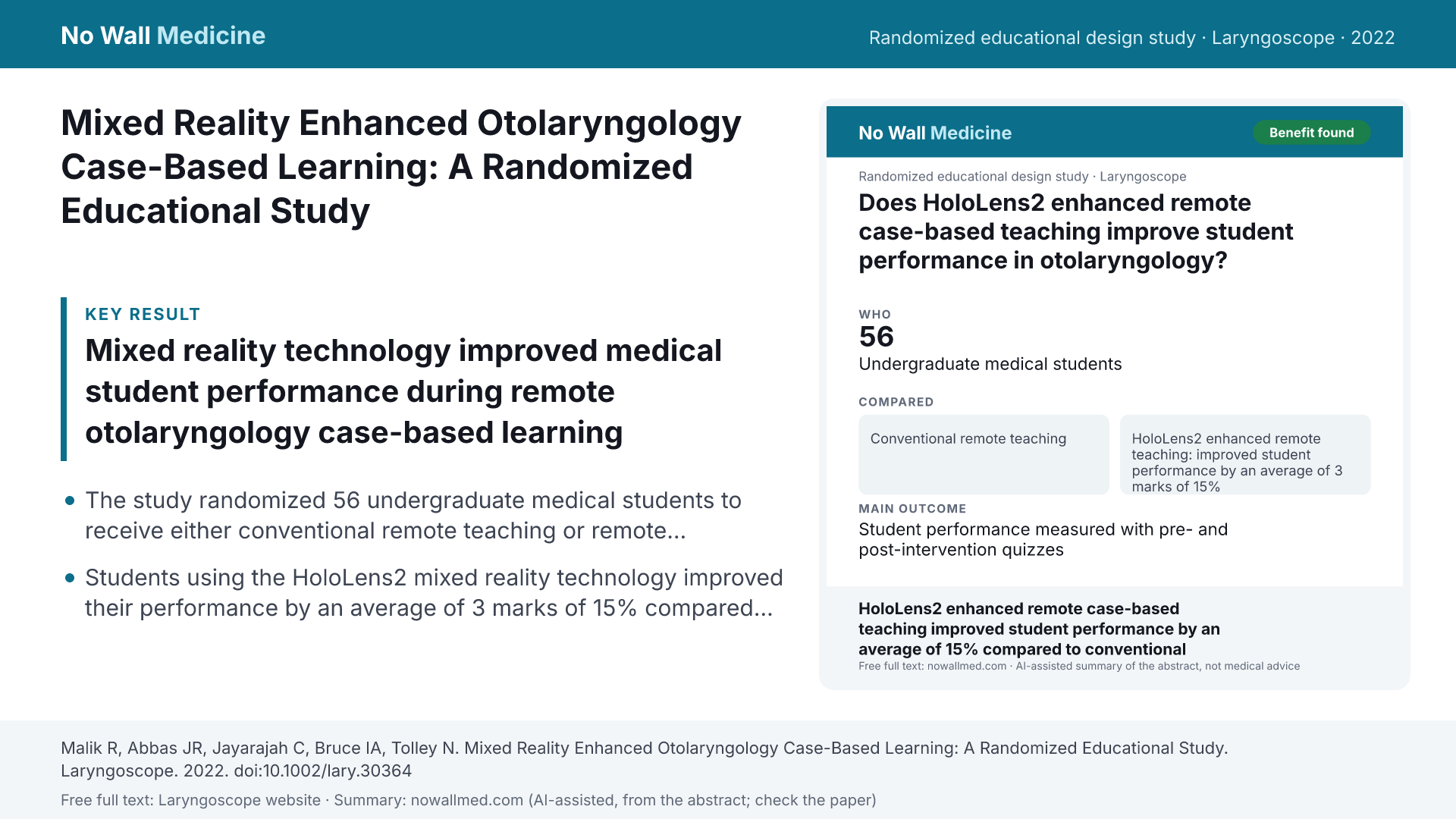
Mixed reality technology improved medical student performance during remote otolaryngology case-based learning
Mixed Reality Enhanced Otolaryngology Case-Based Learning: A Randomized Educational Study
Randomized educational design studyBenefit found
Does HoloLens2 enhanced remote case-based teaching improve student performance in otolaryngology?
Who
56
Undergraduate medical students
Compared
Conventional remote teaching
HoloLens2 enhanced remote teaching: improved student performance by an average of 3 marks of 15%
Main outcome
Student performance measured with pre- and post-intervention quizzes
Bottom line: HoloLens2 enhanced remote case-based teaching improved student performance by an average of 15% compared to conventional teaching.
Laryngoscope · 2022-09-08Download image
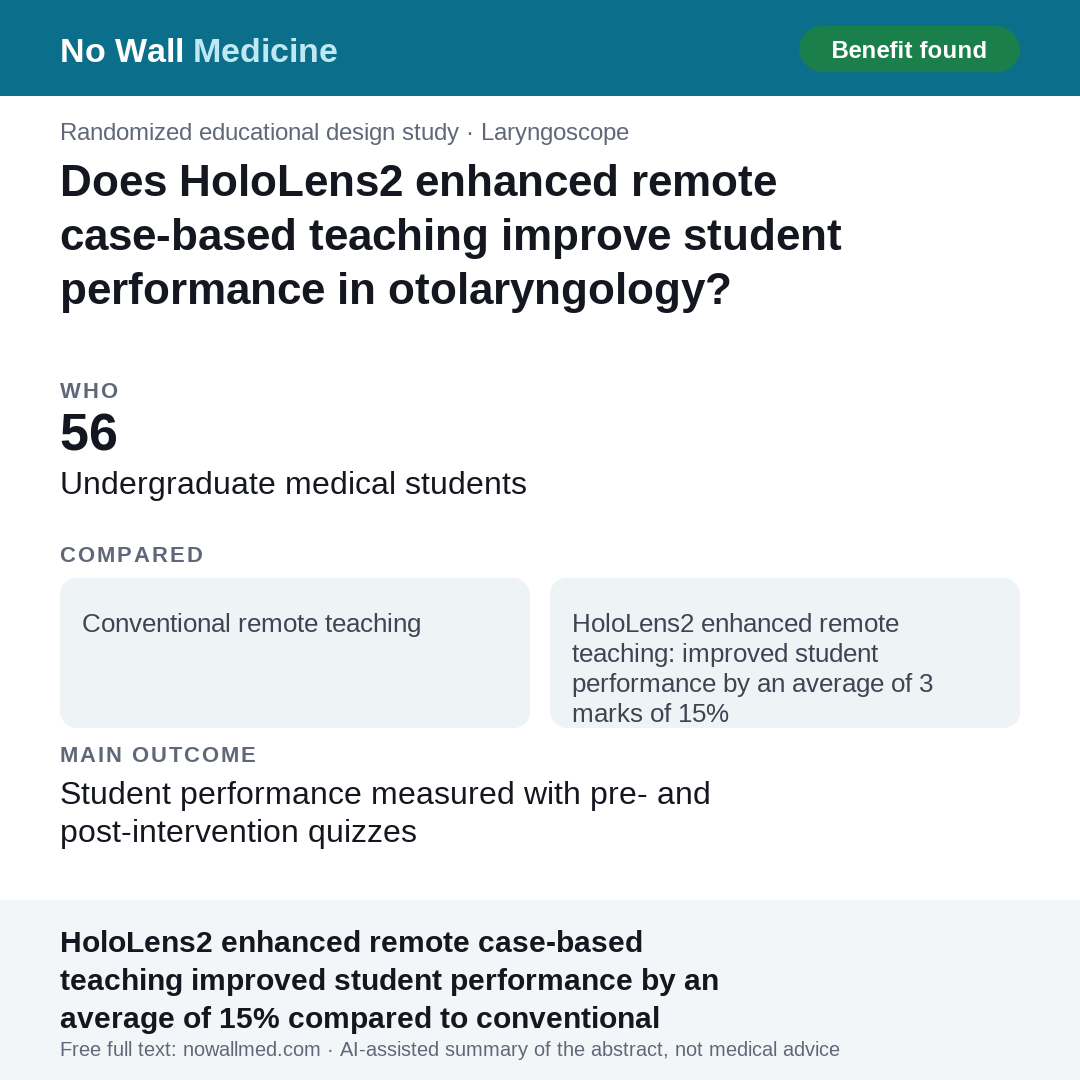
Clinical question: Does HoloLens2 enhanced remote case-based teaching improve student performance in otolaryngology?
Why it matters: Medical education in specialties like otolaryngology faces challenges such as reduced hands-on training opportunities during remote learning periods.
Key points
- The study randomized 56 undergraduate medical students to receive either conventional remote teaching or remote teaching enhanced with HoloLens2 mixed reality technology.
- Students using the HoloLens2 mixed reality technology improved their performance by an average of 3 marks of 15% compared to the conventional group.
- Secondary measures included student feedback on perceived enjoyment, engagement, and opinions regarding the role of this technology in education.
Headline and key points written with AI from the paper’s abstract, with every number checked against it. Read the paper before relying on them.
Was this summary helpful?
Abstract
Introduction
The COVID-19 pandemic has caused unprecedented disruptions to medical education. Education in medical specialties, such as otolaryngology faces multiple challenges, including reduced bedside and "hands-on" training opportunities at all levels. Educators are turning to technological advancements to deliver effective remote medical education. This study investigated the value of enhancing traditional remote case-based teaching with the HoloLens2™.Methods
We present a randomized educational design study. All educational content, media, and learning outcomes were identical. Primary outcome measures included student performance as measured with pre- and post-intervention quizzes and student engagement as measured by a tally-mark system. Secondary outcome measures, collected using feedback questionnaires, included perceived enjoyment, engagement, and opinions regarding the educational role of this technology.Results
The undergraduate medical students were randomized to either conventional or HoloLens2™ enhanced remote case-based teaching (n = 56). HoloLens2™ enhanced teaching improved student performance by an average of 3 marks of 15% (p Conclusions
Remote teaching has allowed for the continuation of medical education in uncertain times. Beyond COVID-19, we predict that there will be a paradigm shift toward remote learning as new technological advancements emerges. These novel technologies may prove invaluable in the future potentially enabling education to be delivered between different hospitals, universities, and even overseas.Level of evidence
NA Laryngoscope, 133:1606-1613, 2023.
Abstract reproduced under the article’s CC BY-NC licence.
Subject terms
Cite this article
Malik R, Abbas JR, Jayarajah C, Bruce IA, Tolley N. Mixed Reality Enhanced Otolaryngology Case-Based Learning: A Randomized Educational Study. Laryngoscope. 2022. doi:10.1002/lary.30364
Spotted a mistake? Suggest a correction