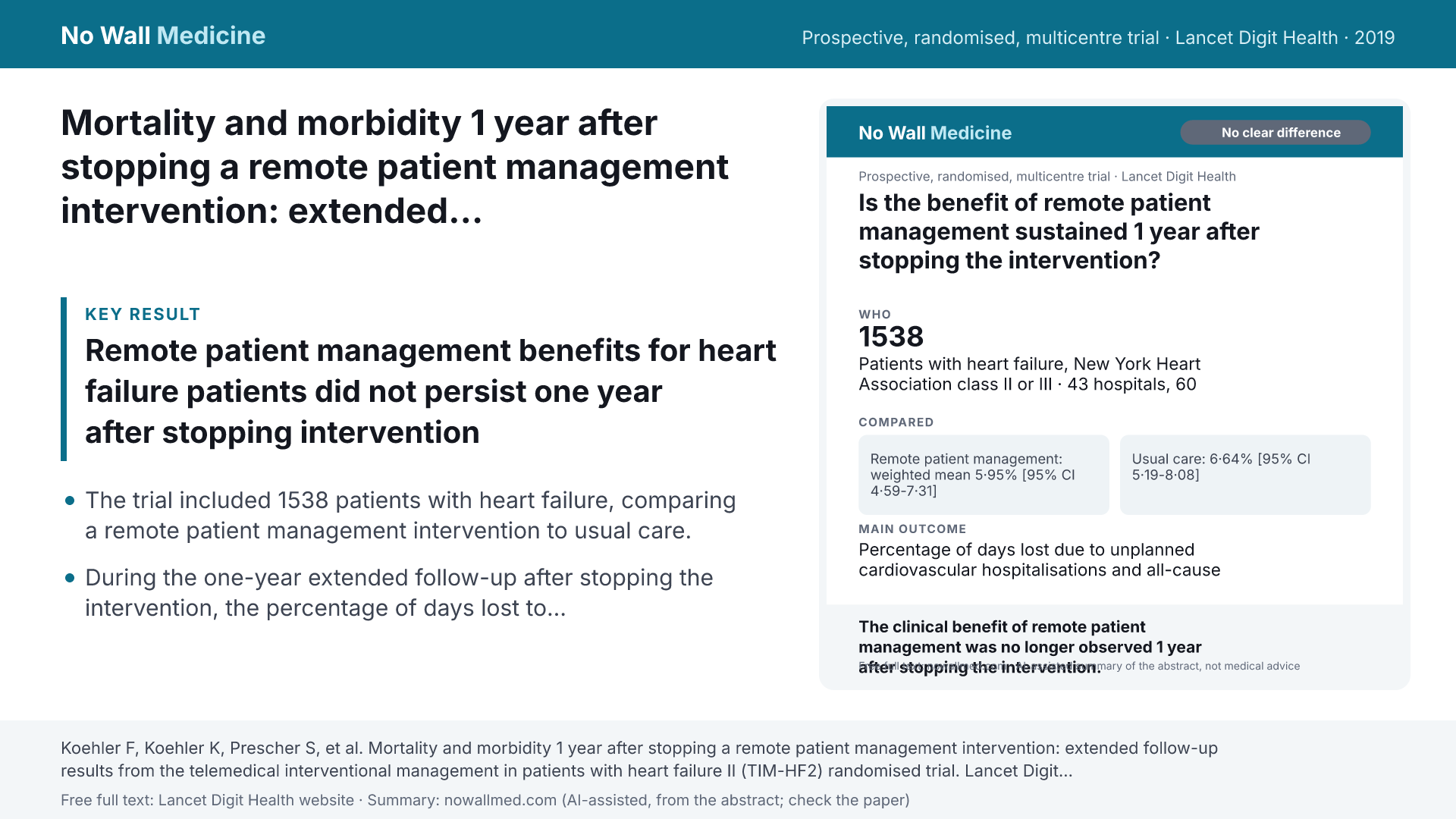
Remote patient management benefits for heart failure patients did not persist one year after stopping intervention
Mortality and morbidity 1 year after stopping a remote patient management intervention: extended follow-up results from the telemedical interventional management in patients with heart failure II (TIM-HF2) randomised trial
Prospective, randomised, multicentre trialNo clear difference
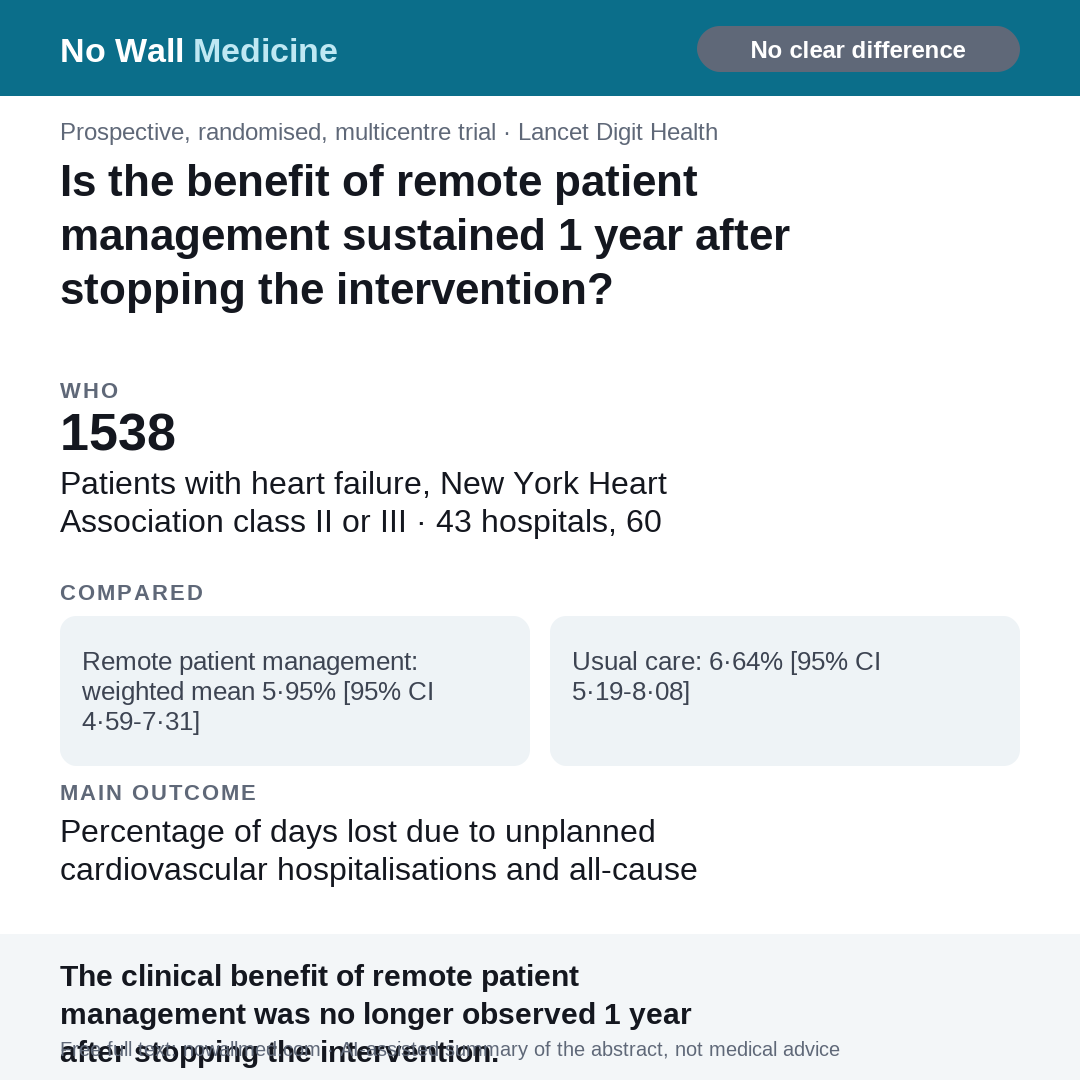
Is the benefit of remote patient management sustained 1 year after stopping the intervention?
Who
1538
Patients with heart failure, New York Heart Association class II or III · 43 hospitals, 60 cardiology practices, and 87 general practitioners in Germany
Compared
Remote patient management: weighted mean 5·95% [95% CI 4·59-7·31]
Usual care: 6·64% [95% CI 5·19-8·08]
Main outcome
Percentage of days lost due to unplanned cardiovascular hospitalisations and all-cause mortality
Result: rate ratio 0·79; 95% CI 0·78-1·21
Bottom line: The clinical benefit of remote patient management was no longer observed 1 year after stopping the intervention.
Limitation: The trial was not powered to show significance during the extended follow-up period.
Funded by: German Federal Ministry of Education and Research
Lancet Digit Health · 2019-12-12Download image
Same trial (NCT01878630)
Papers we list that report this registered trial, oldest first. Read a secondary analysis alongside the main results.
- Longer follow-up No clear difference
This paper Lancet Digit Health 2019-12 - Secondary analysis Benefit found
Remote patient management reduced days lost to death or hospitalization across all heart failure types Eur J Heart Fail 2023-07 - Secondary analysis Benefit found
Remote patient management was associated with fewer days lost to hospitalization or death in heart failure patients with diabetes Cardiovasc Diabetol 2024-06 - Secondary analysis Benefit found
Remote heart failure care reduced hospital days equally for rural and urban patients Lancet Reg Health Eur 2025-05
Clinical question: Is the benefit of remote patient management sustained 1 year after stopping the intervention?
Key points
- The trial included 1538 patients with heart failure, comparing a remote patient management intervention to usual care.
- During the one-year extended follow-up after stopping the intervention, the percentage of days lost to unplanned cardiovascular hospitalizations and all-cause death did not differ significantly between groups.
- When combining the main trial and extended follow-up data, the remote patient management group had a weighted mean of 9.28% days lost compared to 11.78% in the usual care group.
Headline and key points written with AI from the paper’s abstract, with every number checked against it. Read the paper before relying on them.
Was this summary helpful?
Abstract
Background
The Telemedical Interventional Management in Heart Failure II (TIM-HF2) trial showed that, compared with usual care, a structured remote patient management (RPM) intervention done over 12-months reduced the percentage of days lost due to unplanned cardiovascular hospitalisations and all-cause death. The aim of the study was to evaluate whether this clinical benefit seen for the RPM group during the initial 12 month follow-up of the TIM-HF2 trial would be sustained 1 year after stopping the RPM intervention. Methods
TIM-HF2 was a prospective, randomised, multicentre trial done in 43 hospitals, 60 cardiology practices, and 87 general practitioners in Germany. Patients with heart failure, New York Heart Association functional class II or III, and who had been hospitalised for heart failure within 12 months before randomisation were randomly assigned to either the RPM intervention or usual care. At the final study visit (main trial), the RPM intervention was stopped and the 1 year extended follow-up period started, which lasted 1 year. The primary outcome was percentage of days lost due to unplanned cardiovascular hospitalisations and all-cause mortality. Analyses were done using the intention-to-treat principle. This trial is registered with ClinicalTrials.gov, number NCT01878630. Findings
Between Aug 13, 2013, and May 12, 2017, 1538 patients were enrolled (765 to the remote patient management group and 773 to the usual care group) in the main trial. 671 of 765 patients in the remote patient management group and 673 of 773 in the usual care group completed the main trial and started the extended follow-up period up to 1 year later. In the extended follow-up period, the percentage of days lost due to unplanned cardiovascular hospital admissions and all-cause mortality did not differ significantly between groups weighted mean 5·95% [95% CI 4·59-7·31] in the RPM group vs 6·64% [95% CI 5·19-8·08] in the usual care group [rate ratio 0·79; 95% CI 0·78-1·21]). However, when data from the main trial and the extended follow-up period were combined, the percentage of days lost due to unplanned cardiovascular hospitalisation or all-cause death was significantly less in patients allocated to the RPM group (382 [50%] of 765; weighted mean 9·28%; 95% CI 7·76-10·81) than in the UC group (398 [51%] of 773; 11·78%; 95% CI 10·08-13·49; ratio of weighted average 0·79; 95% CI 0·62-1·00; p=0·0486). Interpretation
The positive effect of our RPM intervention on morbidity and mortality over the course of the main trial was no longer observed 1 year after stopping the RPM intervention. However, because the TIM-HF2 trial was not powered to show significance during the extended follow-up period, our results are exploratory and require further research. Funding
German Federal Ministry of Education and Research.
Abstract reproduced under the article’s CC BY NC ND licence.
Subject terms
Headline, design, result, key points, caveat and citation as plain text.
Cite this article
Koehler F, Koehler K, Prescher S, et al. Mortality and morbidity 1 year after stopping a remote patient management intervention: extended follow-up results from the telemedical interventional management in patients with heart failure II (TIM-HF2) randomised trial. Lancet Digit Health. 2019. doi:10.1016/S2589-7500(19)30195-5
Spotted a mistake? Suggest a correction