Network Meta-Analysis of Non-Conventional Therapies for Improving Upper Limb Motor Impairment Poststroke
Network meta-analysis of randomized controlled trialsBenefit found
Which non-conventional therapies improve upper extremity motor impairment after stroke?
Who
6781
Poststroke patients aged 18 years or older
Compared
Non-conventional interventions
Conventional care
Main outcome
Fugl-Meyer upper extremity scale
Bottom line: Eight non-conventional interventions were significantly better than conventional care for improving upper extremity motor impairment.
Stroke · 2022-10-14Download image
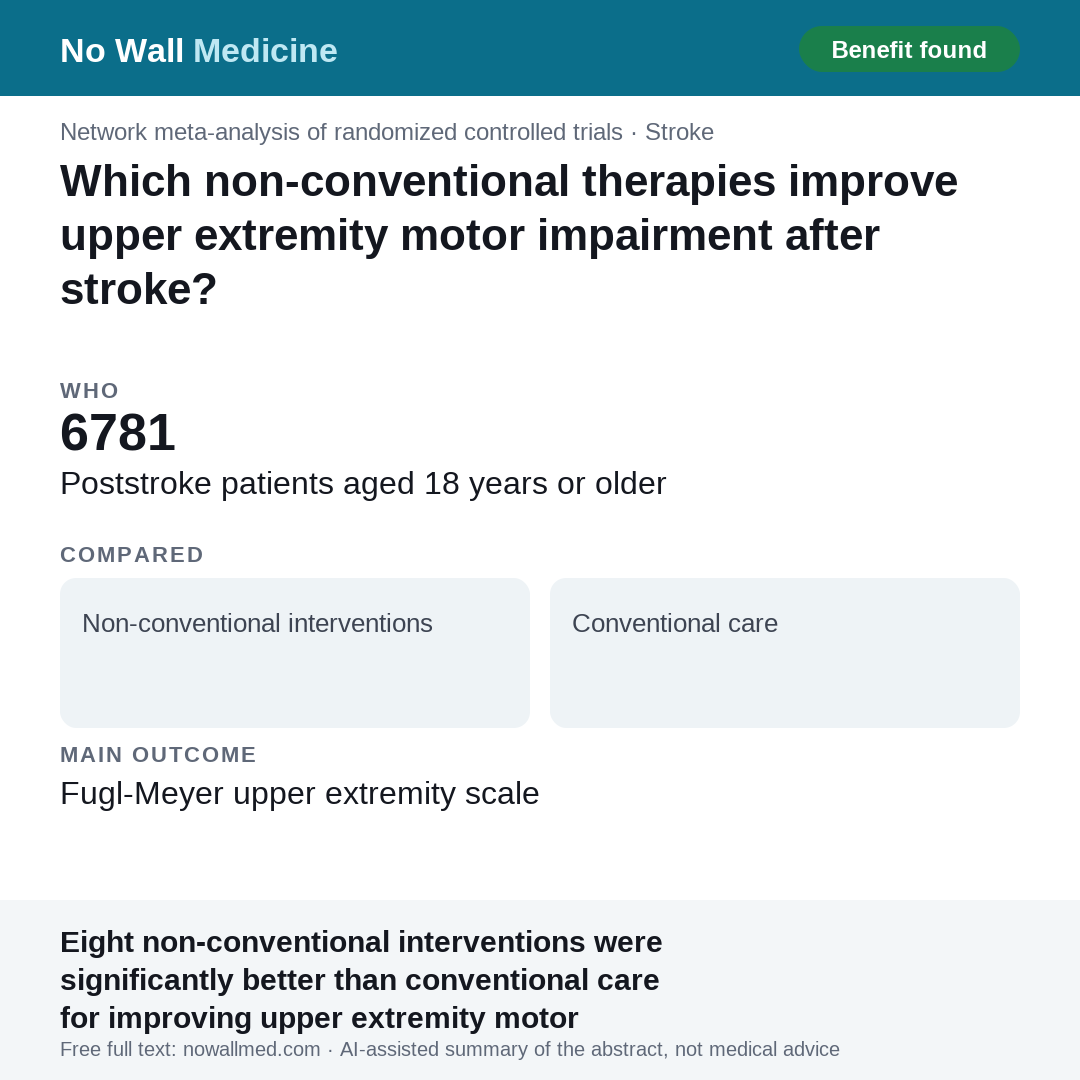
Clinical question: Which non-conventional therapies improve upper extremity motor impairment after stroke?
Abstract
Background
Network meta-analysis is a method that can estimate relative efficacy between treatments that may not have been compared directly within the literature. The purpose of this study is to present a network meta-analysis of non-conventional interventions to improve upper extremity motor impairment after stroke. Methods
A literature search was conducted in 5 databases from their inception until April 1, 2021. Terms were used to narrow down articles related to stroke, the upper extremity, and interventional therapies. Randomized controlled trials written in English were eligible if; 50% poststroke patients; ≥18 years old; applied an intervention for the upper extremity, and/or used the Fugl-Meyer upper extremity scale as an outcome measure; the intervention had ≥3 randomized controlled trials with comparisons against a conventional care group; conventional care groups were dose matched for therapy time. A Bayesian network meta-analysis approach was taken to estimate mean difference (MD) and 95% CI. Results
One hundred seventy-six randomized controlled trials containing 6781 participants examining 20 non-conventional interventions were identified for inclusion within the final model. Eight of the identified interventions proved significantly better than conventional care, with modified constraint induced movement therapy (MD, 6.7 [95% CI, 4.3-8.9]), high frequency repetitive transcranial magnetic stimulation (MD, 5.4 [95% CI, 1.9-8.9]), mental imagery (MD, 5.4 [95% CI, 1.8-8.9]), bilateral arm training (MD, 5.2 [95% CI, 2.2-8.1]), and intermittent theta-burst stimulation (MD, 5.1 [95% CI, 0.62-9.5]) occupying the top 5 spots according to the surface under the cumulative ranking curve. Conclusions
Overall, it would seem that modified constraint induced movement therapy has the greatest probability of being the most effective intervention, with high-frequency repetitive transcranial magnetic stimulation, mental imagery, and bilateral arm training all having similar probabilities of occupying the next spot in the rankings. We think this analysis can provide a guide for where future resources and clinical trials should be directed, and where a clinician may begin when considering alternative therapeutic interventions.
Subject terms
Cite this article
Saikaley M, Pauli G, Sun H, Serra JR, Iruthayarajah J, Teasell R. Network Meta-Analysis of Non-Conventional Therapies for Improving Upper Limb Motor Impairment Poststroke. Stroke. 2022. doi:10.1161/STROKEAHA.122.040687
Spotted a mistake? Suggest a correction
Top studies every Monday
The week’s key trials and guidelines in your specialties, plus any topics you follow. By email, free.
Get the weekly digest